
Stress Ages You Faster: The Science and How to Stop It
Discover how stress ages you faster and learn effective strategies to reverse its effects. Explore proven methods to reclaim your youth.
Stress Ages You Faster: The Science and How to Stop It
Chronic stress accelerates biological aging. That is not a metaphor. Research from the Dunedin cohort shows higher perceived stress links to measurable faster aging per calendar year, with effect sizes comparable to smoking. The Frontiers in Aging review maps six specific hallmarks stress disrupts at the molecular level. The good news: the aging program stress writes into your biology can be rewritten. The TIMELESS four-layer protocol exists precisely for that. Read on for the mechanisms, the tests that measure your progress, and an 8-week plan you can start this week.
- Stress activates the HPA axis, flooding cells with cortisol and triggering six aging hallmarks simultaneously
- The Dunedin cohort quantified the damage: measurable months of biological age added per year of chronic stress
- Biomarkers including TruAge DNA methylation tests, telomere assays, and HRV can track both damage and recovery
- A four-layer approach (Physical, Emotional, Spiritual, Energetic) is required because stress operates on all four levels at once
Key Takeaways
Chronic stress accelerates biological aging through six measurable hallmarks, and a four-layer intervention protocol addressing Physical, Emotional, Spiritual, and Energetic dimensions can reverse measurable markers within weeks to months.
| Point | Details |
|---|---|
| Stress adds measurable biological age | Dunedin cohort data links higher perceived stress to approximately 0.8 months of faster aging per year. |
| Six hallmarks are disrupted simultaneously | Mitochondrial dysfunction, telomere attrition, senescence, epigenetic changes, inflammation, and genomic instability all activate under chronic stress. |
| Fast and slow markers both matter | HRV and inflammatory markers (CRP, IL-6) respond within weeks; TruAge epigenetic age requires 3–6 months to show meaningful change. |
| Four layers are required | Physical interventions alone cannot fix a dysregulated nervous system; all four layers must be addressed together for lasting biological-age reversal. |
| Timeless - Reverse Your Age | The TIMELESS four-layer protocol, verified by TruAge DNA methylation testing, is designed to reverse biological age in 6 months, or the program fee is fully refunded. |
Table of Contents
- How stress ages you faster: the six hallmarks it disrupts
- What human studies show about how much stress accelerates aging
- Which tests reveal stress-driven aging and how to use them
- How HPA-axis dysregulation creates a persistent aging signal
- Evidence-backed strategies organized by the four TIMELESS layers
- What the evidence doesn’t prove and when to get clinical help
- How oxidative stress links psychological pressure to cellular damage
- How chronic stress ages your immune system
- How stress-driven behaviors add an indirect aging burden
- Why your genes don’t determine your stress-aging outcome
- How to evaluate your stress levels clinically and when to retest
- The part most longevity programs get wrong
- What TIMELESS offers beyond this article
- Useful sources
- FAQ
How stress ages you faster: the six hallmarks it disrupts
Stress does not age you through one pathway. A 2026 Frontiers review identifies six distinct hallmarks of aging that chronic psychological stress disrupts simultaneously. Most single interventions address one. That is why they fail.
- Telomere attrition. Glucocorticoids and catecholamines accelerate telomere erosion. Harvard Health summarizes the evidence linking shorter telomeres to elevated disease risk.
Key insight: Research published in PMC confirms that life stress affects all six hallmarks and raises risk for multiple age-related diseases, not just one.
What human studies show about how much stress accelerates aging
Numbers matter here. The Dunedin cohort, a longitudinal study of 955 individuals tracked from birth, found that higher perceived stress correlates with approximately 0.8 months of accelerated biological aging per year. Adverse childhood experiences (ACEs), PTSD, and cumulative stressful life events each showed independent associations with faster aging. Critically, the effect sizes were comparable to those of smoking and low educational attainment — two risks most people take seriously.
The UK Biobank analysis adds another dimension. That study found that trauma-related psychopathology clusters accelerated both biological aging (measured by epigenetic clocks) and facial aging, with psychological distress mediating a significant share of the ACE effect. In other words, it is not just what happened to you; it is how your nervous system is still carrying it.
What this means practically:
- A person under chronic high stress for a decade may carry several years of excess biological age
- Trauma history compounds the effect beyond what perceived stress alone predicts
- Resilience factors, including social support and psychological flexibility, measurably buffer the acceleration
Which tests reveal stress-driven aging and how to use them
| Biomarker | What it measures | Strengths | Limitations |
|---|---|---|---|
| TruAge (DNA methylation) | Epigenetic biological age | Gold standard for tracking aging program changes; validated in multiple cohorts | Requires lab sample; changes visible at 3–6 months |
| Telomere length | Average telomere length in white blood cells | Well-researched stress link; accessible | High variability between labs; single snapshot less informative than trends |
| IL-6 / CRP | Systemic inflammatory load | Fast-changing; reflects recent stress and lifestyle | Confounded by infection, injury, and other acute factors |
| HRV (heart rate variability) | Autonomic nervous system tone | Daily tracking possible with wearables; responds within days to weeks | Requires consistent measurement protocol for reliable trends |
Pro Tip: Run a baseline panel at week 0 covering HRV, sleep metrics, CRP, and IL-6. Recheck HRV and sleep at week 4. Add a TruAge epigenetic clock test at baseline and again at 6 months to capture biological-age change. Repeated measures matter far more than a single snapshot.
Epigenetic clocks like TruAge work by analyzing DNA methylation patterns across hundreds of genomic sites. The algorithm converts those patterns into a biological age estimate. Because methylation-based aging markers respond to both stress exposure and targeted interventions, they are the most informative endpoint for tracking a reversal protocol.
How HPA-axis dysregulation creates a persistent aging signal
The acute stress response is not the problem. Cortisol, norepinephrine, and epinephrine spike, mobilize energy, and then clear. The problem is chronic activation, where the HPA axis never fully returns to baseline.
Under prolonged glucocorticoid exposure, cells downregulate their glucocorticoid receptors. This glucocorticoid resistance means cortisol can no longer suppress inflammatory cytokines effectively. Inflammation becomes self-sustaining. Mechanistic research shows that chronic glucocorticoid exposure drives mitochondrial energy expenditure upward, destabilizes mitochondrial DNA, and accelerates DNA methylation aging markers.
“Chronic stress forces mitochondria to prioritize immediate energy production over cellular maintenance, creating a bioenergetic shift that underlies the long-term accumulation of senescent cells and epigenetic aging.” — PMC, Chronic glucocorticoid exposure study
The PubMed review on stress-induced biological aging maps this chain precisely: psychological stress triggers neuroendocrine mediators, which drive mitochondrial ROS production, which causes DNA damage, which accelerates telomere shortening and cellular senescence. Each step is measurable. Each step is addressable.
Evidence-backed strategies organized by the four TIMELESS layers
Aging is a four-layer problem. Physical interventions alone will not fix a dysregulated nervous system. Nervous-system work alone will not repair mitochondrial damage. The TIMELESS protocol addresses all four layers simultaneously.
Physical layer
- Sleep architecture: Prioritize slow-wave and REM sleep. Sleep quality directly governs cellular repair and HPA reset. Expect HRV improvement within 2–3 weeks of consistent sleep optimization.
- Nutrition: Anti-inflammatory whole-food diet with adequate B vitamins and magnesium for methylation support. Nutritional deficiencies accelerate epigenetic aging; correcting them is foundational.
Emotional layer
- Trauma-informed therapy (EMDR or somatic experiencing) to discharge stored stress from the nervous system
- HRV biofeedback training: 20 minutes daily at a 0.1 Hz resonance frequency improves vagal tone within 4–8 weeks
- Community and social support measurably buffer biological aging acceleration
Spiritual layer
- Daily identity-reframing practice: write one belief about aging you hold, then write three pieces of evidence that contradict it. Five minutes, every morning.
- Subconscious beliefs about aging influence stress perception and HPA reactivity. Rewriting them is not optional; it is mechanistic.
Energetic layer
- Box breathing (4-4-4-4 pattern) twice daily activates the parasympathetic nervous system and lowers cortisol within minutes
- Grounding (direct skin contact with earth) and morning light exposure support circadian alignment and bioelectric regulation
- Vagal tone training through cold exposure or humming stimulates the vagus nerve directly
Pro Tip: Start with sleep and HRV biofeedback in week one. These two interventions produce the fastest measurable changes and create the physiological foundation every other layer depends on.
What the evidence doesn’t prove and when to get clinical help
Current human trials establish strong associations between stress and accelerated aging, but most are observational. Causality is well-supported mechanistically; randomized controlled trials on full reversal protocols in humans are still limited. Expect the science to sharpen over the next five years.
Red flags that require clinician involvement before or alongside any self-directed protocol:
- Active PTSD with flashbacks or hypervigilance
- Suicidal ideation or self-harm
- Uncontrolled cardiovascular disease, diabetes, or autoimmune conditions
- Severe depression unresponsive to lifestyle changes
When you see a clinician, bring a symptom timeline, your biomarker results (HRV trends, inflammatory panel), and your current medication list. Ask specifically about HPA-axis evaluation (morning cortisol, DHEA-S) and whether a referral to a trauma-informed therapist is appropriate.
How oxidative stress links psychological pressure to cellular damage
Psychological stress does not damage DNA directly. It does so through a molecular middleman: reactive oxygen species. When the HPA axis activates, mitochondria ramp up energy production and generate excess ROS as a byproduct. Those free radicals oxidize DNA bases, break DNA strands, and overwhelm the cell’s antioxidant defenses (superoxide dismutase, catalase, glutathione peroxidase).

Impaired DNA repair enzymes, themselves damaged by ROS, cannot keep up. The result is genomic instability and accelerating telomere erosion. This is the direct biochemical chain connecting a stressful meeting to a measurably older cell.
How chronic stress ages your immune system
Chronic stress accelerates immunosenescence, the gradual deterioration of immune function that normally accompanies aging. Prolonged cortisol exposure shifts the immune system toward a pro-inflammatory, less adaptive state. Naive T-cell production declines; senescent immune cells accumulate. The practical consequence is higher susceptibility to infections, slower wound healing, and elevated risk for cardiovascular disease, type 2 diabetes, and certain cancers. Targeted immune reversal strategies can partially offset this trajectory when started early.
How stress-driven behaviors add an indirect aging burden
Stress does not only age you directly. It also pushes people toward smoking, excess alcohol, poor sleep, and ultra-processed food, each of which independently accelerates aging through overlapping mechanisms. Separating direct from indirect effects matters for intervention design. The Dunedin cohort data suggests a meaningful direct biological effect of stress on aging markers even after controlling for behavioral factors, meaning the HPA-axis pathway operates independently of lifestyle choices. But the behavioral layer amplifies the damage substantially. A person under chronic stress who also smokes and sleeps poorly is stacking three independent aging accelerators.
Why your genes don’t determine your stress-aging outcome
Genetic variants in the FKBP5 gene, which regulates glucocorticoid receptor sensitivity, and in the serotonin transporter gene (SLC6A4) influence how strongly the HPA axis responds to stress. Telomere length at birth also varies genetically. These differences are real, but they are not destiny. Epigenetic research consistently shows that lifestyle and psychological interventions can shift biological-age markers regardless of baseline genetic risk. The childhood stress and epigenetic aging literature is particularly clear on this: early adversity raises risk, but it does not fix outcomes.
How to evaluate your stress levels clinically and when to retest
Clinically, stress load is assessed through a combination of self-report tools (Perceived Stress Scale, PHQ-9 for depression, PCL-5 for PTSD), physiological markers (morning salivary cortisol, DHEA-S ratio, HRV), and behavioral history. No single test captures the full picture.
For biomarker testing cadence: measure HRV and sleep quality continuously with a wearable. Run an inflammatory panel (CRP, IL-6) at baseline and every 3 months during active intervention. Order a TruAge DNA methylation test at baseline and at 6 months to capture epigenetic age change. Annual retesting after that is reasonable for maintenance. If you are making significant protocol changes, a 3-month inflammatory recheck tells you quickly whether the intervention is working at the cellular level.
The part most longevity programs get wrong
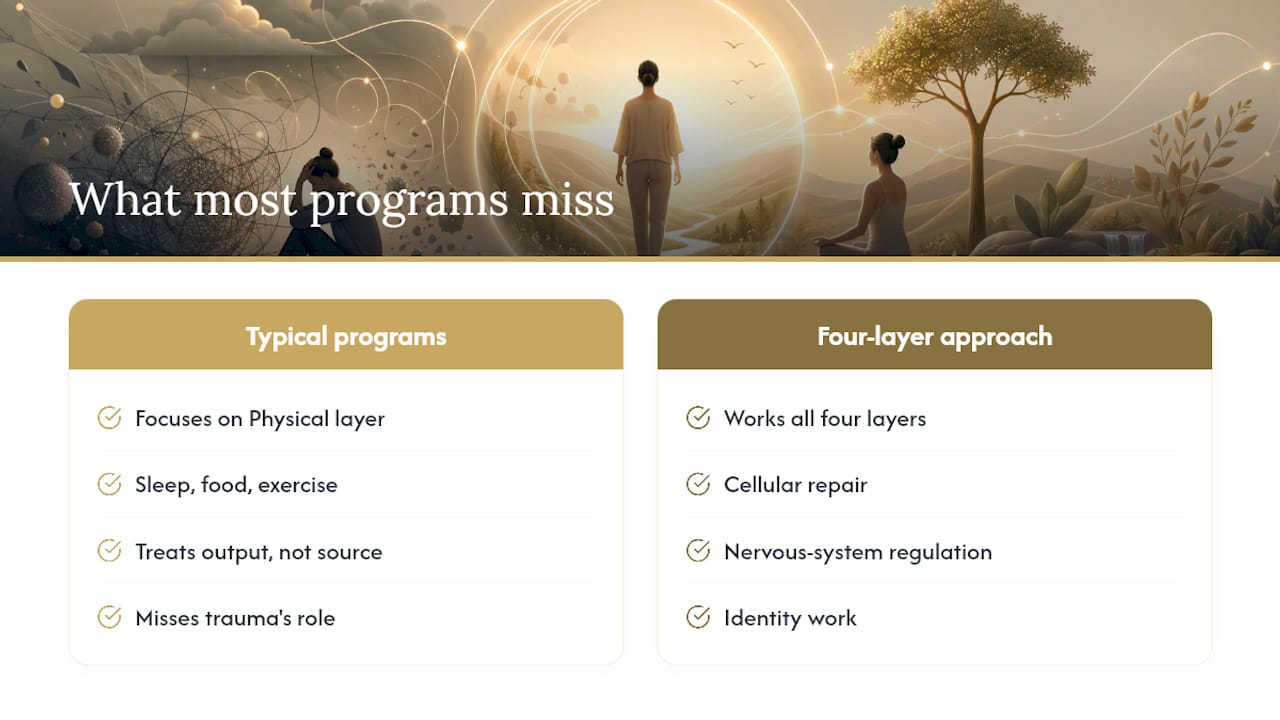
Most stress-and-aging protocols I see focus almost entirely on the Physical layer: better sleep, cleaner food, more exercise. Those matter. But they are treating the output while ignoring the program generating it.
The research is clear that trauma history and psychological distress mediate a significant share of biological aging acceleration, independent of lifestyle behaviors. That means unresolved emotional stress is writing aging signals into your epigenome right now, regardless of how well you eat. Single-method interventions fail because they address one layer of a four-layer problem.
My own TruAge result, a biological age of 23 at 41, did not come from optimizing one variable. It came from working all four layers simultaneously: cellular repair, nervous-system regulation, identity work, and energetic coherence. The science supports this integrated approach. The Frontiers review, the Dunedin data, and the UK Biobank findings all point toward the same conclusion: you cannot out-supplement a dysregulated HPA axis, and you cannot meditate your way out of mitochondrial damage without also addressing the physical substrate.
The four-layer framing is not a philosophy. It is a mechanistic response to what the biology actually requires.
What TIMELESS offers beyond this article
The 14 biological upgrades in the free guide at reverseyourage.org/14-upgrades give you the next concrete steps across all four layers, with specific protocols you can implement this week.
For a complete, structured system, the book TIMELESS: Reverse Your Age ($29.99) is a 370-page blueprint covering every mechanism and intervention in this article, plus the full four-layer protocol tested across 40 countries. If you want personalized guidance with DNA-verified accountability, the TIMELESS Vitality Intensive is an 8-week private coaching program priced at $7,000, designed to reverse your biological age in 6 months as confirmed by TruAge testing, or every dollar is refunded. No other longevity program in the U.S. offers that level of scientific accountability. To find out whether you qualify, book a free Vitality Diagnosis Call and we will map your current biological age and build your protocol from there.
Useful sources
- Molecular pathways linking chronic psychological stress to accelerated aging: mechanisms and interventions
- Stress-induced biological aging: A review and guide for research priorities
- The impact of life stress on hallmarks of aging and accelerated senescence: connections in sickness and in health
- Which types of stress are associated with accelerated biological aging? Comparing perceived stress, stressful life events, childhood adversity, and posttraumatic stress disorder
- The association of psychological and trauma-related factors with biological and facial aging acceleration: evidence from the UK Biobank
FAQ
Can stress really make you biologically older?
Yes. Longitudinal data from the Dunedin cohort shows chronic stress links to measurably faster biological aging, with effect sizes comparable to smoking.
How long does it take to reverse stress-driven aging markers?
HRV and inflammatory markers like CRP can improve within 4–8 weeks of consistent intervention. Epigenetic biological age, measured by tools like TruAge, typically requires 3–6 months to show significant change.
What is the best test to measure stress-related aging?
TruAge DNA methylation testing is the most validated method for tracking biological age changes over time. Pairing it with HRV monitoring and an inflammatory panel (CRP, IL-6) gives a complete picture across fast and slow-changing markers.
Does the TIMELESS protocol address stress-driven aging specifically?
Yes. The TIMELESS four-layer protocol targets all six stress-disrupted aging hallmarks simultaneously across the Physical, Emotional, Spiritual, and Energetic layers, with biological age reversal verified by TruAge testing.
Is stress-accelerated aging reversible?
Current evidence, including the UK Biobank analysis and mechanistic reviews, indicates that HPA-axis changes and epigenetic aging markers are partially reversible with systematic, multi-layer interventions. Full reversal depends on the duration and severity of prior stress exposure.