
Why Sleep Architecture Reverses Aging: A Science Guide
Discover why sleep architecture reverses aging and learn how optimizing your sleep stages can boost your biological repair processes.
Why Sleep Architecture Reverses Aging: A Science Guide
Sleep architecture is defined as the pattern and sequence of sleep stages your brain cycles through each night, and optimizing it is one of the most powerful biological levers for reversing aging. The term “sleep architecture” is the recognized clinical standard, used in polysomnography and EEG research to describe how your brain moves through N1, N2, N3 (slow-wave), and REM stages across roughly 90-minute cycles. Understanding why sleep architecture reverses aging requires looking at what happens inside those stages at the molecular level. The glymphatic system, NREM sleep, and circadian rhythm integrity are the three entities that determine whether your sleep repairs you or quietly accelerates your biological clock.
Why sleep architecture reverses aging at the cellular level
Sleep architecture reverses aging because specific sleep stages trigger biological repair processes that no other state can replicate. During N3 slow-wave sleep, the glymphatic system activates and clears amyloid-beta and tau proteins from the brain into plasma. These are the same proteins that accumulate in Alzheimer’s disease. A 2026 randomized crossover clinical study confirmed this clearance happens during NREM sleep stages and is measurable in human subjects.
The implications are direct. Every night you skip deep sleep, your brain retains more neurotoxic waste. Over years, that accumulation accelerates neurodegeneration and measurable biological aging. This is not a theoretical risk. It is a documented molecular pathway.

Circadian rhythm integrity adds a second layer. A 2026 JAMA Network Open study found that stronger circadian amplitude correlates with lower epigenetic aging markers, specifically GrimAge and PhenoAge, two of the most validated biological age clocks in use today. Circadian fragmentation, meaning irregular sleep-wake timing, correlates with accelerated epigenetic aging. Your body’s internal clock is not just a scheduling tool. It is an epigenetic regulator.
How does sleep change with age, and why does it matter?
Aging shifts sleep architecture in predictable and damaging ways. Sleep cycles across the lifespan show a clear decline in N3 slow-wave sleep and increased fragmentation as people move through their 40s, 50s, and beyond. The body spends more time in lighter N1 and N2 stages, reducing the restorative windows that matter most.
Circadian timing also shifts with age. Older adults tend toward earlier sleep-wake cycles, and their circadian amplitude weakens. This means the biological signal that coordinates tissue repair, hormone release, and immune function becomes less precise. The result is not just feeling tired. It is measurable acceleration of biological aging.
The consequences compound over time:
- Reduced N3 sleep cuts glymphatic clearance of brain waste proteins overnight
- Circadian fragmentation raises epigenetic age markers like GrimAge and PhenoAge
- Increased sleep fragmentation impairs neurovascular coupling, the mechanism that drives waste clearance through brain tissue
- Lighter sleep dominance reduces growth hormone secretion, which peaks during slow-wave sleep and drives cellular repair
Pro Tip: If you wake frequently between 2 a.m. and 4 a.m., that is a circadian fragmentation signal, not just a bathroom habit. Addressing it directly through consistent sleep timing can restore deeper sleep architecture within weeks.
What biological mechanisms connect sleep stages to slower aging?
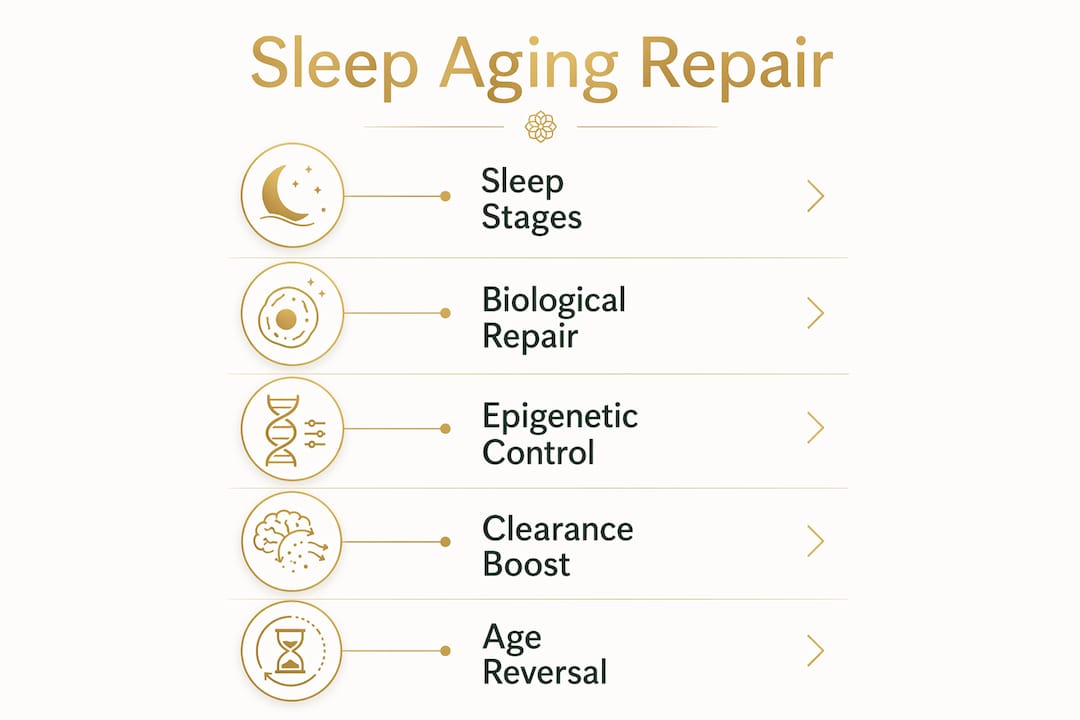
The biology here is specific and worth understanding in detail. During NREM sleep, cerebrospinal fluid pulses through the brain’s interstitial spaces in a process gated by sleep-active physiology. This glymphatic clearance pathway removes metabolic waste that accumulates during waking hours. When sleep disorders or fragmentation disrupt this process, waste builds up and neurodegeneration risk rises.
A 2026 npj preclinical study added a second mechanism. Chronic sleep restriction activates the complement cascade and coagulation pathways in the brain. These are the same molecular signatures seen in accelerated brain aging. The study identified a direct molecular link between sleep loss and aging-related neuroinflammation. This is not correlation. It is a causal pathway confirmed in a controlled model.
| Sleep stage | Primary anti-aging function | What disruption causes |
|---|---|---|
| N3 (slow-wave) | Glymphatic clearance of amyloid-beta and tau | Neurotoxic waste accumulation, Alzheimer’s risk |
| REM | Emotional memory consolidation, synaptic pruning | Cognitive decline, stress dysregulation |
| N2 | Sleep spindle production, memory encoding | Reduced neural plasticity |
| Circadian rhythm | Epigenetic age clock regulation | Elevated GrimAge and PhenoAge markers |
“Sleep-active physiology gates biomolecular clearance pathways that are simply unavailable during wakefulness. Restoring sleep architecture does not fully reverse age-related stage decline, but it expands the clearance windows the brain depends on for long-term health.” — Nature Communications, 2026
The epigenetic angle is equally significant. Circadian rhythm integrity directly modulates DNA methylation patterns, the same markers measured by TruAge and other biological age clocks. When your circadian rhythm is strong and consistent, your epigenetic program runs closer to a younger biological age. When it fragments, the program ages faster.
Sleep duration vs. sleep architecture: which one actually drives aging?
Total sleep hours are not the primary driver of aging outcomes. Sleep stage composition and fragmentation determine biological age far more than the number of hours logged. A 2026 Nature study analyzing 23 aging clocks with UK Biobank data found that optimal sleep duration for the lowest biological aging falls between 6.4 and 7.8 hours per day. Both short and long sleep increase aging markers. But the study’s deeper finding is that two people sleeping identical hours can have very different aging outcomes based on their sleep stage distribution.
This is the insight most sleep advice misses entirely. You can sleep eight hours and still age faster if those hours are dominated by light N1 and N2 sleep with minimal N3 and fragmented REM. Conversely, six and a half hours of well-structured sleep with strong slow-wave cycles and consistent circadian timing produces better biological outcomes.
Sleep fragmentation and disordered architecture impair neurovascular clearance pathways regardless of total duration. Circadian misalignment, such as shift work or irregular bedtimes, compounds this damage by disrupting the epigenetic regulation that sleep architecture depends on.
Pro Tip: Consumer wearables like Oura Ring and WHOOP provide useful trend data on sleep stage estimates, but the strongest evidence comes from EEG-based staging. Use wearable data to track directional changes over weeks, not to diagnose a single night’s architecture.
How to improve sleep architecture for anti-aging results
Improving sleep architecture is not about sleeping more. It is about protecting and restoring the specific conditions that allow deep sleep and circadian integrity to function. These steps are grounded in current research and aligned with the TIMELESS four-layer aging protocol, which addresses the physical, emotional, spiritual, and energetic dimensions of biological aging simultaneously.
-
Set a fixed wake time every day, including weekends. Circadian amplitude depends on consistent timing signals. A stable wake time anchors your entire sleep architecture and is the single highest-leverage change most people can make.
-
Eliminate caffeine after 1 p.m. Caffeine has a half-life of approximately five to six hours. Evening caffeine suppresses adenosine, the sleep pressure molecule that drives N3 slow-wave entry. This directly reduces your glymphatic clearance window.
-
Block blue light after sunset. Blue light suppresses melatonin and delays circadian phase. Use blue-light-blocking glasses or switch screens to warm settings after 8 p.m. to protect your natural sleep onset timing.
-
Lower your bedroom temperature to 65–68°F. Core body temperature must drop to initiate and maintain N3 sleep. A cool sleep environment accelerates this drop and extends slow-wave duration.
-
Address emotional and nervous system dysregulation. Stored trauma and chronic stress keep the nervous system in a sympathetic state that prevents deep sleep entry. The TIMELESS protocol treats this as a separate layer, not a side note. Practices like somatic release, breathwork, and nervous system regulation directly improve sleep architecture by shifting the body into parasympathetic dominance before bed.
-
Limit alcohol entirely. Alcohol suppresses REM sleep and fragments sleep architecture in the second half of the night. Even one drink measurably reduces sleep quality. This is one of the most evidence-based aging reversal methods available at zero cost.
-
Expose yourself to morning sunlight within 30 minutes of waking. Morning light is the primary circadian zeitgeber, the external signal that sets your biological clock. Ten minutes of outdoor light before 9 a.m. strengthens circadian amplitude and improves sleep architecture that same night.
Key Takeaways
Optimized sleep architecture reverses aging by protecting glymphatic clearance, strengthening circadian epigenetic regulation, and preserving the slow-wave sleep stages where the most critical biological repair occurs.
| Point | Details |
|---|---|
| Architecture beats duration | Sleep stage composition and fragmentation drive aging outcomes more than total hours slept. |
| Glymphatic clearance is key | NREM slow-wave sleep clears amyloid-beta and tau from the brain, reducing neurodegeneration risk. |
| Circadian rhythm is epigenetic | Strong circadian amplitude lowers GrimAge and PhenoAge markers, directly slowing biological aging. |
| Sleep loss activates aging pathways | Chronic sleep restriction activates complement and coagulation cascades linked to accelerated brain aging. |
| Lifestyle changes work fast | Consistent wake times, light management, and temperature control can restore sleep architecture within weeks. |
Sleep is not a passive state. It is the most active repair program your body runs.
I spent years studying longevity before I fully understood what sleep was actually doing at the molecular level. My TruAge DNA methylation test confirmed a biological age of 23 at 41. Sleep architecture was not a minor variable in that result. It was central.
What I have learned from working with practitioners across 40 countries is that most people treat sleep as a quantity problem. They count hours. They buy supplements. They ignore the architecture entirely. That is the wrong frame. The question is never “did I sleep enough?” It is “did I get enough N3 slow-wave sleep, and was my circadian rhythm intact?”
The emotional and energetic layers matter here more than most longevity researchers acknowledge. Unresolved stress and nervous system dysregulation are among the most common reasons people fail to enter deep sleep consistently. You can do everything right physically and still have fragmented architecture if your nervous system is running a chronic threat response. The TIMELESS four-layer protocol addresses this directly because aging is a four-layer problem. Physical interventions alone will not fix a nervous system that has never been regulated.
My honest caution: do not let perfect be the enemy of good. You do not need EEG-grade sleep data to start improving. You need a consistent wake time, morning light, and an honest look at what is keeping your nervous system activated at night. Start there. The biology will follow.
— E. Christian Trejo
What the TIMELESS program offers beyond sleep optimization
Sleep architecture is one layer of a four-layer aging problem. Addressing it alone produces results. Addressing all four layers simultaneously produces verified biological age reversal.

The TIMELESS book is a 370-page blueprint that covers the physical, emotional, spiritual, and energetic dimensions of biological aging, including detailed protocols for restoring sleep architecture and circadian integrity. It is available worldwide for $29.99. For those who want a personalized path, the TIMELESS Vitality Intensive is an 8-week private coaching program with a DNA-verified guarantee: reverse your biological age by at least 10 years in 6 months, confirmed by TruAge testing, or receive a full refund. No other longevity program in the world backs its results with that level of scientific accountability.
FAQ
What is sleep architecture and why does it affect aging?
Sleep architecture is the clinical term for the pattern and sequence of sleep stages (N1, N2, N3, and REM) your brain cycles through each night. Specific stages, especially N3 slow-wave sleep, trigger glymphatic clearance and epigenetic repair processes that directly slow biological aging.
Can improving sleep quality actually reverse biological age?
Yes. A 2026 JAMA Network Open study found that stronger circadian rhythm amplitude correlates with lower epigenetic age markers like GrimAge and PhenoAge. Restoring sleep architecture expands the biological repair windows that drive measurable age reversal.
How many hours of sleep are optimal for the lowest biological aging?
A 2026 Nature study analyzing 23 aging clocks found the optimal range is 6.4–7.8 hours per day. Both shorter and longer sleep durations correlate with increased biological aging markers.
Does sleep fragmentation accelerate aging even with enough total hours?
Yes. Two people with identical sleep duration can have very different aging outcomes based on sleep stage distribution and fragmentation. Fragmented sleep impairs glymphatic clearance and neurovascular coupling regardless of total hours logged.
What is the fastest way to improve sleep architecture?
Setting a fixed daily wake time is the highest-leverage starting point because it anchors circadian amplitude, the primary epigenetic regulator that sleep architecture depends on. Combining this with morning sunlight exposure and eliminating evening caffeine produces measurable improvements within weeks.