
The Mind-Epigenome Connection: What It Means for Mental Health
Discover how the mind-epigenome connection impacts mental health, revealing the secrets to reshaping your genetic future.
The Mind-Epigenome Connection: What It Means for Mental Health
The mind-epigenome connection is the set of molecular processes by which experiences, thoughts, and environmental inputs alter chemical marks on your DNA and histones, changing which genes your brain cells can access without rewriting the underlying genetic code itself. That single mechanism explains how chronic stress can rewire stress-response circuits, how early-life adversity leaves measurable marks on genes like NR3C1 and BDNF years later, and why mental health is not simply a matter of the genes you inherited. Understanding this connection is the first step toward doing something about it. The TIMELESS four-layer protocol was built on exactly this science. My own TruAge DNA methylation result, a biological age of 23 at 41, is the proof that these marks can be shifted.
Key Takeaways
The mind-epigenome connection is a real, measurable molecular system through which experiences, stress, and behavior alter gene expression in the brain, with direct implications for mental health, biological aging, and the possibility of verified reversal.
| Point | Details |
|---|---|
| Core mechanism | Stress, learning, and environment alter DNA methylation and histone marks at genes like NR3C1 and BDNF within hours to years. |
| Psychiatric relevance | Epigenetic marks at FKBP5, NR3C1, BDNF, and SLC6A4 are consistently associated with depression, PTSD, and schizophrenia, but do not establish deterministic causation. |
| Measurement limits | Methylation clocks (e.g., TruAge) reliably track biological age; brain-specific epigenetic biomarkers are not yet clinical-grade for psychiatric diagnosis. |
| Reversibility | Activity-linked histone marks reverse in days; stress-linked DNA methylation can persist for years but is partially modifiable through exercise, sleep, nutrition, and psychotherapy. |
| Timeless - Reverse Your Age | The TIMELESS four-layer protocol addresses epigenetic drivers across Physical, Emotional, Spiritual, and Energetic layers simultaneously, verified by TruAge DNA methylation testing. |
Table of Contents
- What is the mind-epigenome connection, exactly?
- How do your experiences and environment actually rewrite epigenetic marks?
- What does the research actually show about epigenetics, memory, and behavior?
- Which psychiatric disorders have the strongest epigenetic evidence?
- How do researchers measure these connections, and what are the limits?
- How long do epigenetic changes last, and can they be passed to your children?
- What can you actually measure and change? A practical guide
- Why the epigenome changes everything about how we think about aging
- The TIMELESS protocol puts this science to work for you
- Sources
- FAQ
What is the mind-epigenome connection, exactly?
To follow the science, you need a working model of what the epigenome actually is. Think of your genome as a fixed text, roughly 3 billion base pairs that do not change across your lifetime. The epigenome is the annotation layer sitting on top of that text: chemical tags and protein structures that tell each cell which paragraphs to read, which to skip, and how loudly to read them. Crucially, these annotations respond to experience.
Three molecular systems do most of the work.
DNA methylation is the addition of a methyl group, typically to cytosine bases at CpG sites. Methylation at a gene’s promoter region generally silences that gene. Demethylation, driven by TET enzymes, tends to reactivate it. This is the mechanism most methylation clocks, including TruAge, measure to estimate biological age.
Histone modification works differently. DNA wraps around protein spools called histones, and chemical groups (acetyl, methyl, phosphate) added to histone tails either loosen or tighten that wrapping. Loose chromatin means accessible DNA and active transcription. Tight chromatin means silenced genes. Enzymes called HDACs remove acetyl groups to silence; HATs add them to activate. Activity-regulated histone acetyltransferases such as CBP open promoters within hours of neuronal stimulation, which is why a single intense experience can begin reshaping gene expression almost immediately.
Noncoding RNAs (microRNAs, lncRNAs) add a third layer by regulating messenger RNA stability and translation after transcription has already occurred. They act as fine-tuning dials rather than on/off switches.
Common assay readouts researchers use to measure these marks include:
- Bisulfite sequencing: converts unmethylated cytosines so they can be distinguished from methylated ones; gold standard for single-base resolution
- Array-based methylation profiling (e.g., Illumina EPIC array): surveys hundreds of thousands of CpG sites simultaneously; the basis for most commercial methylation clocks
- ChIP-seq: maps histone modifications genome-wide by pulling down chromatin with antibodies
- RNA-seq: quantifies noncoding RNA populations alongside messenger RNA
Together, these three systems form a programmable interface between your life history and your gene expression. That interface is what we mean when we talk about the epigenome.
How do your experiences and environment actually rewrite epigenetic marks?
The pathway from experience to epigenetic change runs through biology you can trace step by step. A stressful event activates the hypothalamic-pituitary-adrenal (HPA) axis, flooding the body with cortisol. Cortisol binds glucocorticoid receptors in neurons. Those receptors recruit DNMT enzymes, which add methyl groups to the promoter of NR3C1, the gene encoding the glucocorticoid receptor itself. The result: fewer receptors, a blunted stress-response feedback loop, and a brain that stays in high-alert mode longer than it should. Environmental factors drive exactly this kind of persistent change at genes like NR3C1, BDNF, and FKBP5, and those changes are now directly implicated in stress-related disorders.

The same logic applies in the other direction. Neuronal activity during learning triggers calcium signaling that activates kinases, which phosphorylate histone H3. That phosphorylation recruits HATs, which acetylate nearby histones, opening chromatin at immediate-early gene promoters like c-Fos and Arc. Within hours, the epigenome integrates that activity signal and reshapes synaptic architecture, making the connection between neurons more durable. Memory, at the molecular level, is partly an epigenetic event.
Where do thoughts fit? Thoughts are patterns of neural firing. They trigger the same neurotransmitter and hormonal cascades that any external event would. A ruminative thought loop activates the HPA axis just as a physical threat does. A meditative state shifts autonomic tone and reduces cortisol. The proximate mechanisms are hormonal and electrochemical, but the upstream driver is the pattern of mental activity itself. Social and environmental exposures leave molecular marks on the epigenome that alter gene regulation and plausibly shape long-term mental health outcomes, and internally generated mental states are part of that exposure landscape.
Key environmental inputs and their primary molecular mediators:
- Chronic stress: elevated cortisol and CRH activate DNMTs and HDACs, silencing stress-buffering genes (NR3C1, FKBP5)
- Physical exercise: increases BDNF expression partly via histone acetylation and active demethylation at the BDNF promoter
- Nutrition (folate, B12, SAM): methyl-donor availability directly affects DNMT substrate supply and global methylation levels
- Early-life adversity: alters methylation at NR3C1 and SLC6A4 in ways that persist into adulthood
- Toxins (heavy metals, endocrine disruptors): interfere with DNMT and HDAC activity, producing off-target methylation changes
- Social bonding and community: reduces glucocorticoid signaling and supports epigenetic patterns associated with lower inflammatory gene expression
What does the research actually show about epigenetics, memory, and behavior?
The evidence base for activity-dependent epigenetic changes in neurons is strong at the mechanistic level in animal models, and increasingly supported by human correlational data, though causal proof in living human brains remains limited by obvious ethical and technical constraints.
Four lines of evidence stand out.
-
Rapid chromatin remodeling after neuronal activation. Studies in rodents show that fear conditioning produces measurable histone acetylation changes at immediate-early gene loci within 30 minutes. Blocking HDAC activity with pharmacological inhibitors enhances memory consolidation, and activating it impairs it. This causal chain, from experience to chromatin state to behavior, is among the most replicated findings in neuroepigenetics.
-
Persistent methylation after early-life stress. Human studies find altered NR3C1 methylation in individuals who experienced childhood adversity, with differences detectable in blood samples decades later. Early-life stress produces long-lasting epigenetic alterations in brain regions that regulate stress sensitivity, and these changes may accelerate epigenetic aging as measured by methylation clocks.
-
Addiction and compulsive behavior. Repeated drug exposure in animal models produces lasting changes in histone acetylation and DNA methylation at genes controlling dopamine signaling (DRD2, FosB). These marks correlate with compulsive drug-seeking behavior and persist long after the drug is removed, suggesting the epigenome encodes behavioral habits, not just acute responses.
-
Human twin studies. Monozygotic twins begin life with nearly identical epigenomes. By middle age, their methylation profiles diverge substantially, with the degree of divergence correlating with how differently they have lived. This is some of the clearest human evidence that experience, not just genetics, writes epigenetic marks.
Important limitations:
- Most mechanistic work is in rodents; direct causal evidence in human brains is scarce
- Human studies typically use blood or saliva, which may not reflect brain-specific methylation states
- Correlation between a methylation mark and a behavior does not establish that the mark causes the behavior
- Many findings have not replicated across independent cohorts
Which psychiatric disorders have the strongest epigenetic evidence?
Epigenetic marks are associated with psychiatric disorders and are being investigated as potential biomarkers for diagnosis, prognosis, and precision psychiatry approaches. The association is real and consistent enough to take seriously. What it does not yet support is deterministic causation: an epigenetic mark at a given locus does not guarantee a disorder, and its absence does not guarantee health.
The most studied candidate genes and what their epigenetic changes typically signal:
- NR3C1 (glucocorticoid receptor): hypermethylation at the promoter reduces receptor expression, impairing cortisol feedback and sustaining HPA hyperactivation; consistently associated with PTSD and depression following early adversity
- BDNF (brain-derived neurotrophic factor): reduced BDNF expression via promoter methylation is one of the most replicated findings in major depressive disorder; BDNF supports neuronal survival and synaptic plasticity
- FKBP5: methylation changes at this co-chaperone gene alter glucocorticoid receptor sensitivity; FKBP5 variants and methylation interact to modulate PTSD risk after trauma exposure
- SLC6A4 (serotonin transporter): methylation differences at this locus have been found in depression and anxiety, though effect sizes are modest and replication is inconsistent
- COMT (catechol-O-methyltransferase): methylation influences dopamine metabolism in the prefrontal cortex; implicated in schizophrenia and cognitive function
- DRD2 (dopamine receptor D2): methylation changes affect receptor density and are associated with schizophrenia and addiction vulnerability
A critical caveat on sample source: most human psychiatric epigenetics studies use blood or saliva because postmortem brain tissue is scarce and introduces its own confounds (cause of death, medication history, postmortem interval). Blood-based methylation at NR3C1 or BDNF may correlate with brain-region methylation, but that correlation is imperfect. Findings from peripheral samples should be interpreted as signals, not direct readouts of brain epigenetic state.
The clinical promise is real. Epigenetic marks are being investigated as biomarkers for diagnosis, prognosis, and precision psychiatry, with the goal of matching patients to treatments based on their molecular profile rather than symptom clusters alone. Standardization and replication remain the primary barriers to clinical adoption.
How do researchers measure these connections, and what are the limits?
Neuroepigenetics uses several study designs, each with a different tradeoff between causal power and human applicability.
Longitudinal cohort studies follow people over years, collecting biological samples at multiple time points. They can detect whether epigenetic changes precede or follow mental health outcomes, which is essential for causal inference. The Avon Longitudinal Study of Parents and Children (ALSPAC) in the UK is one of the largest, though most comparable U.S. cohorts are smaller.
Twin studies compare monozygotic and dizygotic twins to partition genetic from environmental contributions to epigenetic variation. They are the cleanest human design for estimating how much of an epigenetic mark is experience-driven.
Case-control studies compare methylation profiles between people with a diagnosis and healthy controls. They are common but vulnerable to confounding by medication, lifestyle, and cell-type composition.
Animal causal experiments use genetic knockouts, pharmacological inhibitors, or epigenome editing to establish that a specific mark causes a specific behavioral outcome. These provide the mechanistic backbone the field relies on.
Major limitations to keep in mind:
- Tissue heterogeneity: a blood sample contains multiple cell types (T cells, B cells, monocytes), each with a distinct methylation profile. Bulk methylation measures average across all of them, masking cell-type-specific signals
- Peripheral vs. brain mismatch: blood methylation at a given locus may not reflect the state of that locus in prefrontal cortex or hippocampus
- Small sample sizes: many published studies have fewer than 200 participants, limiting statistical power and replication probability
- Causality gaps: most human findings are correlational; the mark and the disorder may share a common upstream cause rather than one driving the other
- Assay differences: Illumina 450K arrays and EPIC arrays cover different CpG sites; findings from one platform do not always replicate on the other
Pro Tip: Before trusting any commercial epigenetic test or published study, ask three questions: What tissue was sampled? Has the finding been replicated in an independent cohort? Is the assay platform validated against a clinical or behavioral outcome? If the answer to any of these is unclear, treat the result as preliminary.
A brief glossary of terms researchers sometimes use loosely:
- Epigenome-wide association study (EWAS): a genome-scale scan for methylation differences associated with a trait, analogous to a GWAS for genetic variants
- Methylation clock: a statistical model that uses methylation levels at selected CpG sites to estimate biological age; TruAge is one of the most validated commercial implementations
- Cell-type deconvolution: a computational method that estimates the proportion of each cell type in a bulk sample and adjusts methylation values accordingly
How long do epigenetic changes last, and can they be passed to your children?
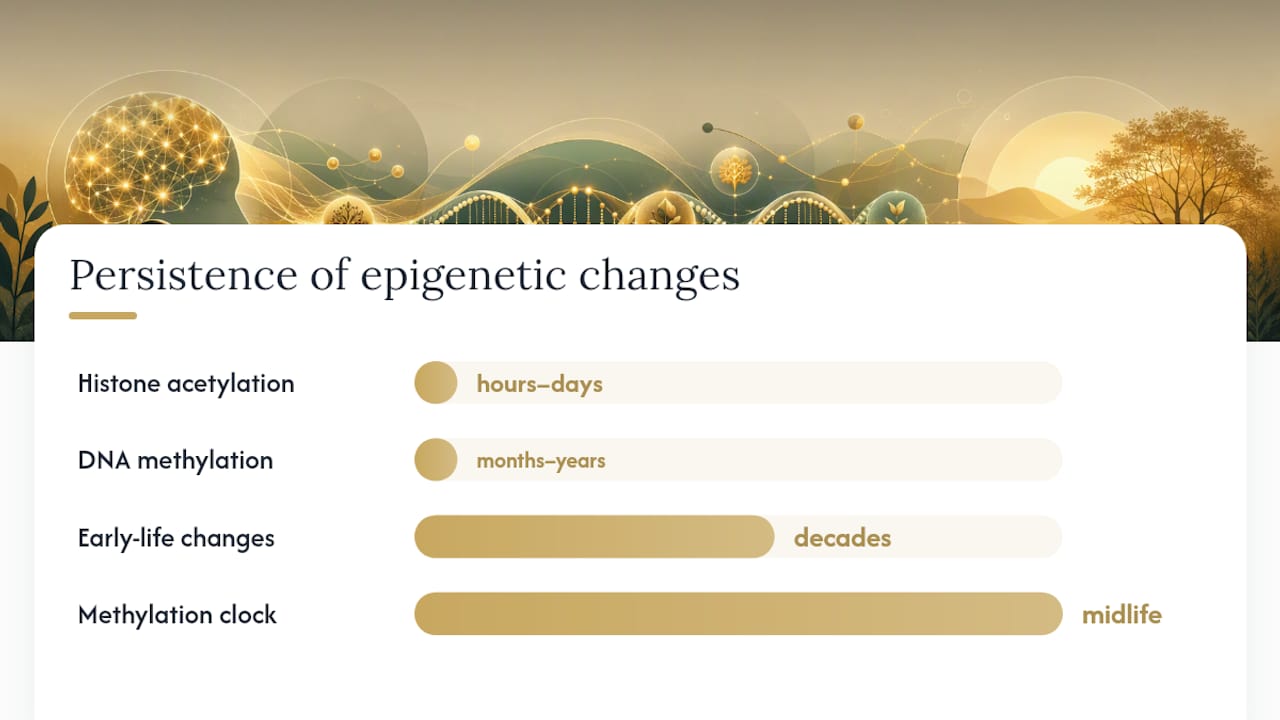
Timescale varies by mechanism and context. Activity-dependent histone modifications, the kind triggered by a single learning event or a stressful afternoon, can appear within hours and fade within days if the stimulus is not repeated. DNA methylation changes at stress-response genes are more durable. Early-life stress is associated with long-lasting epigenetic alterations that persist into adulthood in both animal and human studies, sometimes spanning decades.
Persistence windows by mechanism:
- Activity-linked histone acetylation: hours to days; highly reversible
- DNA methylation at stress genes (NR3C1, FKBP5): months to years; partially reversible with behavioral and pharmacological intervention
- Methylation clock acceleration from early adversity: detectable in midlife; degree of reversibility under active investigation
- Epigenome editing (CRISPR-dCas9 with epigenetic effectors): experimentally durable in animal models; human clinical use remains experimental
The intergenerational question is where the science gets genuinely contested. Animal studies, particularly in rodents, show that stress-induced epigenetic marks in parents can influence offspring behavior and stress reactivity. The mechanisms proposed include germline transmission of methylation marks, altered maternal behavior that re-establishes marks in the next generation, and in utero hormonal exposure. Stress-induced epigenomic changes are a plausible risk factor in the onset of mental disorders, and some of those changes may propagate across generations through these pathways.
Human evidence for true epigenetic inheritance, meaning marks that survive the near-complete reprogramming that occurs in early embryogenesis, is limited and contested. Studies of Holocaust survivors’ descendants and children of famine-exposed parents show methylation differences, but whether those differences are transmitted epigenetically or arise from shared environment and altered parenting behavior is difficult to disentangle. The honest summary: intergenerational transmission of trauma-linked epigenetic marks is biologically plausible and supported by animal data, but robust causal evidence in humans is not yet established.
What is clear is that childhood stress shapes epigenetic aging in ways that are measurable and, to a meaningful degree, modifiable.
What can you actually measure and change? A practical guide
Some tests track biological age reliably enough to be worth using. Most brain-specific epigenetic biomarkers are not yet clinical-grade. That distinction matters before you spend money on any test or program.
Measurement options compared
| Measurement type | Sample source | Resolution | Consumer availability | Clinical readiness |
|---|---|---|---|---|
| DNA methylation clock (e.g., TruAge) | Blood or saliva | Biological age estimate; whole-body | Yes, commercially available | Validated for biological age tracking; not diagnostic for specific disorders |
| Tissue-specific methylation assay | Postmortem brain or biopsy | Gene-level, region-specific | Not available to consumers | Research use only |
| Peripheral biomarker panel (blood-based gene methylation) | Blood | Selected loci (NR3C1, BDNF, etc.) | Limited; some research labs offer | Investigational; not clinically validated for psychiatric diagnosis |
The methylation clock is the tool with the most validated consumer application. It does not tell you what is happening at a specific gene in your hippocampus, but it gives you a reproducible, longitudinal signal of how fast your biology is aging, and that signal responds to intervention.
Evidence-based interventions with epigenetic support
The following have the strongest published association with favorable epigenetic changes, particularly at stress-response and neuroplasticity genes:
- Aerobic exercise (150+ minutes per week): associated with BDNF promoter demethylation and reduced methylation clock acceleration
- Sleep (7–9 hours, consistent architecture): disrupted sleep accelerates methylation clock aging; sleep architecture directly influences epigenetic regulation and biological age
- Nutrition (adequate folate, B12, choline, polyphenols): methyl-donor nutrients support DNMT function; Mediterranean-pattern diets associate with slower epigenetic aging
- Psychotherapy (trauma-focused CBT, EMDR): small studies show methylation changes at FKBP5 and NR3C1 following successful trauma treatment
- Mindfulness and meditation: associated with reduced cortisol and preliminary evidence of favorable methylation shifts at inflammatory gene loci
- Targeted pharmacology (SSRIs, mood stabilizers): some agents produce measurable epigenetic changes, though whether those changes mediate clinical benefit is still under investigation
Pro Tip: If you are using a methylation clock to track your protocol, test at baseline, then retest after at least 90 days of consistent intervention. Methylation clocks have measurement variability, so a single-point reading is less informative than a trajectory across two or three time points.
The TIMELESS four-layer protocol addresses epigenetic drivers across all four dimensions simultaneously: Physical (cellular, epigenetic, mitochondrial), Emotional (stored trauma and nervous system dysregulation), Spiritual (identity and subconscious beliefs about aging), and Energetic (bioelectric field and meridians). Most programs address one layer. The epigenome is regulated by all four. That is why single-axis interventions, even good ones, tend to produce partial results. Aging reversal methods that actually work integrate across these layers rather than optimizing one in isolation.
Why the epigenome changes everything about how we think about aging
Most longevity researchers I know focus on one layer: fix the mitochondria, or clear senescent cells, or optimize the microbiome. Those are real levers. But the epigenome sits upstream of most of them. It controls which repair genes are expressed, how aggressively your cells respond to stress signals, and whether your nervous system stays in a chronic threat state that accelerates every downstream aging process.
My TruAge result, a biological age of 23 at 41, did not come from optimizing one variable. It came from working all four layers simultaneously over 15 years. The Emotional layer matters as much as the Physical one, because unresolved stored trauma keeps the HPA axis activated, which keeps DNMT enzymes writing silencing marks on stress-buffering genes, which accelerates the methylation clock. You cannot out-supplement a nervous system that is running a chronic stress program.
The science here is genuinely exciting, but it also demands honesty. Epigenetic associations with psychiatric disorders are real and replicating. Causal proof in living human brains is still limited. Intergenerational transmission is plausible but not definitively established in humans. What is established is that the marks are not fixed, that behavior and environment write and rewrite them continuously, and that measurement tools like TruAge give us a way to verify whether the rewriting is going in the right direction.
The conventional wellness industry treats aging as inevitable and mental health as a separate domain from biology. Both assumptions are wrong. The mind-epigenome connection is the mechanism that unifies them. Work the mechanism across all four layers, measure the result, and adjust. That is the protocol.
The TIMELESS protocol puts this science to work for you
The science of the mind-epigenome connection points to one clear conclusion: you need a multi-layer approach verified by real measurement. The TIMELESS book ($29.99) gives you the complete 370-page blueprint, covering all four protocol layers with the peer-reviewed evidence behind each one. For readers who want verified, personalized results, the TIMELESS Vitality Intensive is an 8-week private coaching program backed by a DNA-verified guarantee: reverse your biological age by at least 10 years in 6 months, confirmed by TruAge DNA methylation testing, or every dollar is refunded. No other longevity program in the United States offers that level of accountability.
Ready to see where your epigenome stands right now? Start with the free 14-upgrades guide to get your first protocol steps, or book a free Vitality Diagnosis call to discuss whether the full coaching program fits your situation. This article is educational and does not constitute personalized medical advice; consult a qualified clinician before making changes to any treatment or medication.
Sources
The following peer-reviewed sources and primers were used throughout this article. Each is linked at the claim it supports in the body text.
- The clinical use of epigenetics in psychiatry: a narrative review of epigenetic mechanisms, key candidate genes, and precision psychiatry | Frontiers in Psychiatry
- How the epigenome integrates information and reshapes the synapse | PMC
- Epigenetic regulation of brain development, plasticity, and response to early-life stress | Neuropsychopharmacology
This article is general information, not a substitute for advice from a qualified doctor. Consult a qualified healthcare professional about your own circumstances before acting on anything here.
FAQ
What are the top influences on the human epigenome?
The three most consistent drivers are chronic stress (via cortisol and HPA activation), early-life adversity (which produces lasting methylation changes at NR3C1 and BDNF), and nutrition (particularly methyl-donor availability from folate, B12, and choline). Exercise, sleep quality, toxin exposure, and social environment also produce measurable epigenetic effects.
Can thoughts and mental states affect epigenetics?
Yes, indirectly. Thoughts generate patterns of neural firing that trigger hormonal and neurotransmitter cascades, and those cascades activate or suppress epigenetic enzymes like DNMTs and HDACs. Chronic ruminative thinking sustains cortisol elevation the same way a physical stressor does, producing similar methylation changes at stress-response genes.
What is the epigenome in the context of psychology and mental health?
The epigenome is the chemical layer that controls which genes are active in brain cells without altering the DNA sequence itself. In psychology, it is the mechanism through which life experience, trauma, and social environment get recorded at the molecular level and influence long-term patterns of stress reactivity, mood regulation, and cognitive function.
Can trauma be passed on to the next generation through epigenetics?
Human evidence, from studies of descendants of trauma survivors, shows methylation differences in offspring, but whether those differences are transmitted epigenetically through the germline or arise from shared environment and altered parenting is not yet resolved. The effect is biologically plausible but not definitively established in humans.
How does the TIMELESS protocol use the mind-epigenome connection?
The TIMELESS four-layer protocol targets epigenetic drivers at the Physical (cellular and mitochondrial), Emotional (trauma and nervous system), Spiritual (identity and subconscious beliefs), and Energetic (bioelectric field) levels simultaneously. Progress is verified by TruAge DNA methylation testing, which tracks biological age as a direct readout of epigenetic state. Details are in the TIMELESS book and the four-layer protocol guide.