How to Restore Your Circadian Rhythm: A Step-by-Step Reset
Learn how to restore your circadian rhythm effectively with expert tips on light exposure, wake times, and meal timing for better sleep.
How to Restore Your Circadian Rhythm: A Step-by-Step Reset
You can begin shifting your circadian rhythm today by fixing three cues: morning light, a consistent wake time, and fixed meal timing. According to the Sleep Foundation, these three actions form the foundation of any effective reset protocol. Most people notice measurable improvements in sleep timing within 3–14 days; robust, stable entrainment typically takes 2–8 weeks of consistent practice.
Start here, today:
- Fix your wake time. Choose one time and hold it every day, including weekends. This single anchor does more for circadian recovery than any supplement.
- Get 10–20 minutes of outdoor morning light within 30–60 minutes of waking. Bright natural light is the most powerful signal your master clock receives.
- Shift meals by 30–60 minutes toward your target schedule. If you want to sleep earlier, eat earlier. Meal timing is a metabolic clock signal, not just a habit.
Important: If you have been dealing with serious or prolonged sleep disruption, excessive daytime sleepiness, or symptoms affecting your mood and cognition, consult a clinician before relying solely on behavioral steps.
Key Takeaways
Restoring your circadian rhythm requires aligning at least three zeitgebers simultaneously: morning light, a fixed wake time, and consistent meal timing, sustained for 2–8 weeks to produce stable entrainment.
| Point | Details |
|---|---|
| Start with three cues | Fix wake time, get morning light within 60 minutes, and shift meals toward your target schedule today. |
| Expect 2–8 weeks for stability | Sleep timing shifts in 3–14 days; robust, stable entrainment takes 2–8 weeks of consistent practice. |
| Combine interventions | Light, meals, and activity together produce stronger phase shifts than any single change alone. |
| See a doctor if stalled | Persistent misalignment after 4–6 weeks, excessive daytime sleepiness, or mood decline warrants clinical evaluation. |
| TIMELESS resource | The TIMELESS book ($29.99) or the 8-week Vitality Intensive provides a DNA-verified, four-layer guided protocol for complete circadian and biological age recovery. |
Table of Contents
- What the circadian rhythm actually is and why it matters beyond sleep
- Common causes that disrupt your circadian timing
- Step-by-step action plan for circadian rhythm restoration
- Clinical options: light therapy, melatonin, CBT-I, and prescriptions
- How long does recovery take, and what does it cost?
- When to see a doctor or sleep specialist
- Why multiple zeitgebers produce stronger results than sleep hygiene alone
- How stress and mental health affect your circadian recovery
- What you eat matters as much as when you eat it
- Managing social and work obligations during circadian recovery
- Common mistakes that stall circadian rhythm recovery
- The circadian rhythm is a four-layer problem, not just a sleep problem
- The TIMELESS book and coaching program for guided circadian recovery
- Sources
- FAQ
What the circadian rhythm actually is and why it matters beyond sleep
Your circadian rhythm is a roughly 24-hour biological timing system coordinated by the suprachiasmatic nucleus (SCN) in the hypothalamus. The SCN acts as the master clock, but every major organ, including your liver, pancreas, and heart, runs its own peripheral clock. These clocks govern hormone release, immune function, metabolism, and cell repair, not just when you feel sleepy.
The cues that set these clocks are called zeitgebers, a German word meaning “time givers.” Light is the dominant zeitgeber for the SCN. Meal timing drives peripheral metabolic clocks. Physical activity and social cues reinforce the overall timing signal. When these cues fall out of alignment with each other, the system fragments, and health consequences follow well beyond poor sleep.
Chronic circadian disruption is associated with elevated risk of hypertension, insulin resistance, type 2 diabetes, and mood disorders. The Cleveland Clinic recommends clinical evaluation when misalignment persists despite consistent behavioral effort.
Common causes that disrupt your circadian timing
Identifying your specific disruptor matters because the corrective strategy differs by cause.
- Shift work. Rotating or night shifts force the SCN to receive light cues at the wrong phase, disrupting the central clock and its coordination with peripheral organ clocks.
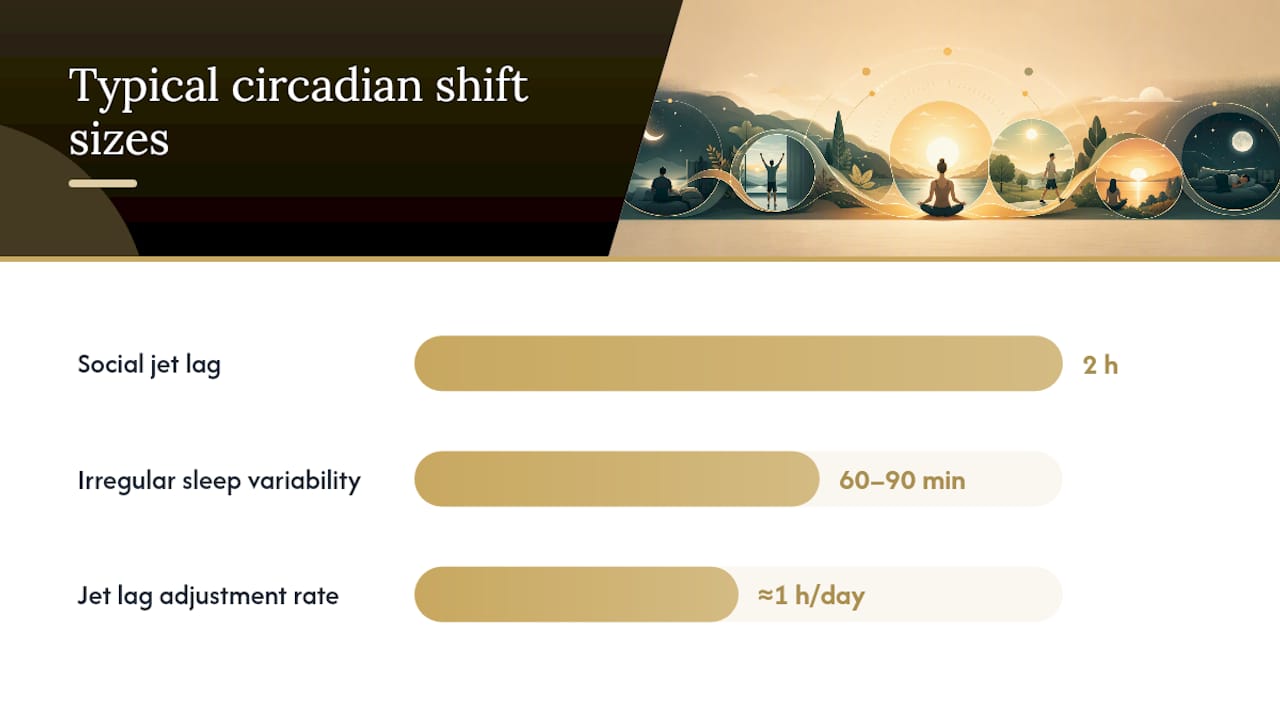
- Jet lag. Rapid travel across time zones creates a mismatch between the internal clock and the new local light-dark cycle; the SCN typically adjusts at roughly one hour per day.
- Irregular sleep schedules. Varying bedtime and wake time by more than 60–90 minutes weakens the amplitude of the circadian signal.
- Late-night light exposure. Blue-wavelength light after sunset suppresses melatonin secretion and delays the SCN’s sleep signal.
- Late meals. Eating close to bedtime sends a “daytime” metabolic signal to peripheral clocks even when the SCN is preparing for sleep.
- Chronic stress. Elevated cortisol disrupts the normal cortisol awakening response and blunts the SCN’s sensitivity to light cues.
- Medications and illness. Beta-blockers, corticosteroids, and some antidepressants can shift melatonin timing or alter clock gene expression.
A concrete contrast worth noting: a shift worker adapting to a permanent night schedule can, over several weeks, partially re-entrain the SCN to a nocturnal pattern. A traveler crossing eight time zones recovers faster because the target schedule is fixed and external cues are consistent. The mechanism differs, but the corrective tools overlap.
Social jet lag is the weekend version of this problem. Sleeping in two hours on Saturday and Sunday effectively moves your clock backward, creating the equivalent of a short-haul flight every week. Sustained recovery requires consistency across all seven days.
Step-by-step action plan for circadian rhythm restoration
The core principle here, supported by Sleep Foundation guidance, is incremental change. Abrupt schedule shifts destabilize the master clock further. Move in 15–30 minute increments per day.
Morning protocol (daily, non-negotiable)
- Wake at the same time every day. Set it once. Do not adjust it based on how you slept the night before.
- Get outside within 30–60 minutes of waking for 10–30 minutes of natural light. Overcast sky still delivers far more lux than indoor lighting. Yale School of Medicine research confirms morning sunlight as the primary entrainment tool.
- Eat breakfast within 60–90 minutes of waking. This synchronizes your metabolic clocks with your SCN signal.
- Do light movement in the morning if possible. A 10-minute walk doubles as a light exposure session and a cortisol-normalizing activity.
Daytime practices
- Schedule your largest meal at lunch, not dinner. Peripheral metabolic clocks respond to caloric load.
- Aim for at least 20–30 minutes of moderate exercise between 7 AM and 2 PM. Late-evening intense exercise delays sleep onset in many people.
- Maintain bright indoor lighting during work hours if outdoor access is limited.
Evening wind-down (60–90 minutes before bed)
- Dim all household lights to roughly 10% of daytime brightness. Blue-light glasses alone rarely fully prevent melatonin suppression when overall lighting remains bright.
- Stop screens or use a strict night-mode filter. A screen curfew is more reliable than filtering alone.
- Finish your last meal at least 2–3 hours before your target bedtime.
- Avoid alcohol. It fragments sleep architecture even when it speeds sleep onset.
Sleep environment
Keep your bedroom below 68°F (20°C), use blackout curtains, and address noise with earplugs or a white-noise device. A consistent pre-sleep ritual, even five minutes of slow breathing or reading physical print, signals the SCN that the light-dark transition is complete.
Napping rules during re-entrainment
Naps longer than 20 minutes or taken after 3 PM can blunt sleep pressure and stall recovery. If you need a nap, keep it to 10–20 minutes before 2 PM.
Two-week checklist
| Week | Priority actions | Milestone signal |
|---|---|---|
| Week 1 | Fix wake time, add morning light, shift dinner 30 min earlier | Feeling sleepy 15–30 min earlier than baseline |
| Week 2 | Add morning movement, dim lights by 9 PM, stop screens by 10 PM | Waking closer to alarm without grogginess |
| Weeks 3–8 | Hold all cues consistently; add meal timing precision | Stable sleep onset and wake time within 30 min daily |
Pro Tip: Use a wearable like an Oura Ring or a Garmin with sleep tracking to monitor your resting heart rate dip and HRV overnight. A deepening overnight HRV trend across two weeks is a reliable signal that your circadian amplitude is strengthening, without obsessing over each night’s data.
For shift workers: on days off, hold your work-schedule wake time rather than sleeping in. Use a 10,000-lux light box at the start of your intended “morning” to anchor the SCN regardless of the clock on the wall. For international travelers, begin shifting sleep and meal times 2–3 days before departure in 30-minute increments toward the destination time zone.
Clinical options: light therapy, melatonin, CBT-I, and prescriptions
Behavioral steps work for most people. When they do not, or when a diagnosed circadian rhythm disorder is present, clinical tools become appropriate. The NIH/NHLBI outlines behavioral routines, bright light therapy, and melatonin as the primary treatment categories, always individualized to the specific disorder.
Bright light therapy
A quality light box delivers 10,000 lux at roughly 16–24 inches. Morning sessions of 20–30 minutes are standard for advancing a delayed phase. Evening sessions are used for phase delay in advanced sleep phase disorder. Safety notes: avoid direct eye contact with the lamp, and consult a doctor if you have a history of bipolar disorder or retinal conditions, as high-intensity light can trigger manic episodes or worsen photosensitivity.

Typical cost: moderate price range for a consumer-grade 10,000-lux light therapy device.
Melatonin
Melatonin works as a phase-shifting signal, not a sedative. Clinically, low doses (0.5–1 mg) taken 5–6 hours before the desired sleep time are used to advance a delayed clock. Higher doses (3–10 mg) are common in supplements but are not necessarily more effective for phase shifting. PubMed-indexed trials support using melatonin under supervision for specific disorders, with timing precision mattering more than dose size.
Melatonin is sold as an unregulated supplement in the United States, so potency and purity may vary between brands. It interacts with blood thinners, immunosuppressants, and diabetes medications. Pregnant individuals and those with autoimmune conditions or a history of seizures should consult a physician before use.
CBT-I
Cognitive behavioral therapy for insomnia (CBT-I) addresses the psychological and behavioral patterns that perpetuate insomnia independent of circadian phase. It is the first-line treatment for chronic insomnia and is often combined with circadian interventions when both are present. Digital CBT-I programs (Sleepio, Somryst) cost $0–$500 depending on insurance coverage; in-person therapy runs $100–$250 per session.
Prescription options
For shift work disorder and narcolepsy-related excessive daytime sleepiness, wake-promoting agents are sometimes prescribed. These require specialist oversight and are not appropriate as a first step for general circadian disruption.
Safety warning: If you are pregnant, have elevated blood pressure, a psychiatric history, or take any prescription medication, discuss all circadian interventions, including melatonin and light therapy, with your physician before starting.
Pro Tip: Ask your doctor about a dim-light melatonin onset (DLMO) test before starting melatonin. This saliva or blood test identifies your actual melatonin phase and allows precise timing of supplementation, rather than guessing.
How long does recovery take, and what does it cost?
Setting realistic expectations prevents the most common failure mode: abandoning a protocol that was actually working.
Progress typically plateaus around weeks 4–6 if behavioral cues are inconsistent. If sleep timing has not shifted by at least 30 minutes after two weeks of strict protocol adherence, add a second zeitgeber (meal timing or a light box) rather than increasing melatonin dose.
When to see a doctor or sleep specialist
Behavioral steps cover the majority of circadian disruption cases. These red flags indicate you need a clinical evaluation:
- Sleep misalignment persists after 4–6 weeks of consistent behavioral effort.
- Excessive daytime sleepiness is causing near-misses while driving or operating machinery.
- You suspect sleep apnea (loud snoring, witnessed breathing pauses, waking with headaches).
- Mood changes, cognitive decline, or depressive symptoms have appeared alongside the sleep disruption.
- You are a shift worker with symptoms that have lasted more than three months.
What a clinician may order
- Sleep diary review (2 weeks of self-reported data you bring to the appointment).
- Actigraphy (a wrist-worn device worn for 1–2 weeks that objectively tracks rest-activity cycles).
- Polysomnography (overnight sleep study measuring brain waves, oxygen, and movement).
- Dim-light melatonin onset (DLMO) test to identify your actual circadian phase.
- Blood panel for thyroid function, cortisol, and vitamin D when metabolic causes are suspected.
Specialists involved include sleep medicine physicians, neurologists for suspected neurological causes, and psychiatrists when mood disorders are primary. Bring a two-week sleep log, your full medication list, your work schedule, and specific questions about phase assessment and treatment options.
Pro Tip: The American Academy of Sleep Medicine’s provider directory at sleepeducation.org can help you locate a board-certified sleep specialist in your area.
Why multiple zeitgebers produce stronger results than sleep hygiene alone
Single-cue interventions, like going to bed earlier without changing light exposure or meals, often fail because they address only the SCN while peripheral metabolic clocks remain out of phase. Research published in Frontiers in Neuroscience confirms that meal timing acts as a metabolic zeitgeber capable of shifting circadian phase independently of light, and that combined zeitgeber interventions produce more consistent phase shifts than isolated measures.
PubMed-indexed studies link light exposure timing and meal timing directly to measurable shifts in melatonin onset and sleep phase. UCLA Health reinforces this with practical guidance: daytime outdoor exposure, routine scheduling, and avoiding caffeine and alcohol near bedtime each reinforce the sleep-wake cycle through distinct mechanisms.
Aligning light, meals, activity, and social cues simultaneously produces more durable circadian entrainment than any single intervention. Multi-cue protocols supported by PubMed research show this consistently across study designs.
The practical takeaway: treat your circadian reset as a system-level intervention. Change light, meals, and movement together. Measure your progress with a sleep diary or wearable. If one cue is impossible to control on a given day, hold the others steady.
How stress and mental health affect your circadian recovery
Stress is not just a psychological experience. Elevated cortisol directly suppresses the SCN’s responsiveness to light and disrupts the normal cortisol awakening response, which is itself a circadian signal. Chronic psychological stress keeps the hypothalamic-pituitary-adrenal (HPA) axis activated, which fragments sleep architecture and delays melatonin onset.
Practical techniques that measurably support circadian recovery:
- Diaphragmatic breathing (4-7-8 pattern): Activates the parasympathetic nervous system within minutes, lowering cortisol and preparing the body for sleep-phase transition.
- Progressive muscle relaxation: Reduces physiological arousal in the 30–60 minutes before bed, supporting the evening cortisol decline the SCN needs.
- Morning journaling or structured worry time: Containing rumination to a fixed daytime window prevents the cognitive hyperarousal that delays sleep onset.
- Consistent social connection: Social zeitgebers, including regular mealtimes with others and predictable social schedules, reinforce circadian timing through behavioral cues.
Anxiety and depression frequently co-occur with circadian disruption, and the relationship runs both ways. Disrupted rhythms worsen mood; poor mood disrupts rhythms. If psychological symptoms are prominent, a mental health evaluation alongside circadian behavioral work is appropriate. The four-layer longevity protocol at TIMELESS addresses this directly through the Emotional layer, which targets stored trauma and nervous system dysregulation as biological age accelerators.
What you eat matters as much as when you eat it
Meal timing is a powerful zeitgeber, but the composition of what you eat also influences circadian gene expression and melatonin synthesis.
Foods that support circadian function:
- Tryptophan-rich foods (turkey, eggs, pumpkin seeds, tofu): Tryptophan is the precursor to serotonin and melatonin. Consuming them at dinner can support the evening melatonin rise.
- Complex carbohydrates at dinner (sweet potato, oats, legumes): Moderate insulin response in the evening facilitates tryptophan transport across the blood-brain barrier.
- Magnesium-rich foods (leafy greens, almonds, dark chocolate): Magnesium supports GABA receptor activity and is associated with improved sleep quality in observational data.
- Fermented foods (yogurt, kefir, kimchi): The gut microbiome has its own circadian oscillation. Disrupting it with poor diet worsens systemic circadian fragmentation.
Foods to limit or avoid:
- High-sugar, high-fat meals late in the evening send a strong metabolic “daytime” signal to peripheral clocks.
- Caffeine has a half-life of roughly 5–7 hours in most adults. A 3 PM coffee can still suppress adenosine signaling at 10 PM.
- Alcohol fragments REM sleep and suppresses melatonin secretion even at moderate doses.
Eating within a consistent 8–10 hour window, sometimes called time-restricted eating, aligns the metabolic clock with the SCN more reliably than three meals spread across 14–16 hours. This is not about caloric restriction. It is about giving your peripheral clocks a clear start and stop signal each day.
Managing social and work obligations during circadian recovery
The hardest part of circadian restoration is not the biology. It is the social calendar. Late dinners, evening events, irregular work shifts, and family obligations all create pressure to deviate from the protocol.
Practical strategies:
- Anchor your wake time, not your bedtime. You can negotiate bedtime with social obligations. Your wake time is non-negotiable. Holding it even after a late night is the single most effective way to prevent multi-day setbacks.
- Use light strategically at events. If you attend a late evening gathering, wear blue-light-blocking glasses after 9 PM and step outside for morning light the next day at your normal time.
- Communicate your schedule to close contacts. People who understand you are working on a health protocol are more likely to support earlier dinner times or respect your wind-down window.
- For shift workers: Request schedule predictability where possible. Rotating shifts are harder to adapt to than fixed night shifts because the clock never fully re-entrains. If rotation is unavoidable, use a light box and melatonin under medical guidance to minimize the phase disruption between rotations.
- For frequent travelers: Shift your sleep and meal schedule toward the destination time zone 2–3 days before departure. On arrival, get outdoor light at the local morning time immediately, regardless of how you feel.
The goal is not perfection. One late night does not erase two weeks of progress.
Common mistakes that stall circadian rhythm recovery
Most people who fail at circadian reset make the same errors. Knowing them in advance is half the fix.
- Sleeping in on weekends. Social jet lag resets the clock backward every week. Even 60–90 minutes of extra sleep on Saturday erases several days of progress.
- Using melatonin at the wrong time. Taking melatonin right before bed when you have a delayed phase does almost nothing for phase shifting. Timing, not dose, is what matters.
- Relying on blue-light glasses as the primary intervention. Filtering blue light while sitting in a brightly lit room still suppresses melatonin. Structural dimming of all household lights is more effective.
- Changing only one variable. Adjusting sleep time without changing meal timing or light exposure leaves peripheral clocks out of sync with the SCN.
- Abandoning the protocol after a bad night. One night of poor sleep is not a failure. The circadian system responds to patterns over days and weeks, not individual nights.
- Napping too late or too long. A 45-minute nap at 5 PM reduces sleep pressure enough to delay sleep onset by 1–2 hours, stalling the entire protocol.
- Ignoring the stress-cortisol connection. Treating circadian recovery as purely a sleep hygiene problem while chronic stress remains unaddressed is like fixing a leaking pipe without turning off the water supply.
The circadian rhythm is a four-layer problem, not just a sleep problem
Most circadian reset protocols address one layer: the physical. Fix the light, fix the meals, fix the sleep environment. That works, to a point. What I have observed across 15 years of longevity research is that the people who fully restore their circadian rhythm and sustain it are the ones who address all four layers simultaneously.
The TIMELESS framework treats circadian restoration as a Physical, Emotional, Spiritual, and Energetic intervention. Physically, we target cellular and mitochondrial function, because sleep architecture directly reverses biological aging at the epigenetic level. Emotionally, stored trauma and nervous system dysregulation keep the HPA axis activated, which fragments sleep regardless of how perfect your light protocol is. At the Spiritual layer, subconscious beliefs about aging, about needing less sleep as you get older, about stress being unavoidable, quietly undermine every behavioral intervention. And at the Energetic layer, the bioelectric field and meridian system carry timing information that conventional sleep science has only recently begun to measure.
The behavioral steps in this article are real and they work. But if you have been doing everything right for months and your clock still will not stabilize, the problem is not your bedtime. It is one of the other three layers. My own TruAge DNA methylation test confirmed a biological age of 23 at 41 years old. Circadian alignment was not a side project in that outcome. It was central to it.
The TIMELESS book and coaching program for guided circadian recovery
Behavioral protocols are free. Accountability and personalization are not, and for many people, that gap is exactly where progress stalls.

The TIMELESS: Reverse Your Age paperback ($29.99) is a 370-page blueprint that covers circadian restoration as part of the complete four-layer aging protocol, with specific protocols for the Physical, Emotional, Spiritual, and Energetic dimensions. It is the most complete self-directed resource available for readers who want the full system without a coach.
For readers who want verified results, the TIMELESS Vitality Intensive is an 8-week private coaching program at $7,000, guaranteed to reverse biological age by at least 10 years in 6 months as confirmed by TruAge DNA methylation testing, or every dollar is refunded. No other longevity program offers that level of accountability. Book a free Vitality Diagnosis call to find out whether the program is the right fit for your situation.
Sources
- Can you change your circadian rhythm? — Sleep Foundation
- Circadian rhythm — Cleveland Clinic
- How to reset your circadian rhythm — Yale School of Medicine
- Circadian Rhythm Disorders Treatment — NHLBI (NIH)
- Circadian rhythms — UCLA Health
- Frontiers in Neuroscience: circadian entrainment and metabolic timing
This article is general information, not a substitute for advice from a qualified doctor. Consult a qualified healthcare professional about your own circumstances before acting on anything here.
FAQ
How quickly can you restore a disrupted circadian rhythm?
Sleep timing typically shifts within 3–14 days of consistent behavioral changes. Stable, robust entrainment takes 2–8 weeks of holding all core cues, including wake time, morning light, and meal timing, every day.
Is melatonin effective for circadian rhythm restoration?
Low-dose melatonin (0.5–1 mg) taken 5–6 hours before the desired sleep time can shift a delayed circadian phase, but timing matters more than dose. It works best as part of a combined protocol, not as a standalone fix.
What is the single most important step to reset your body clock?
A fixed wake time, held consistently every day including weekends, is the highest-leverage single action. It anchors the SCN’s timing signal and prevents the social jet lag that resets progress each week.
When should you see a doctor about circadian disruption?
Seek clinical evaluation if misalignment persists after 4–6 weeks of consistent behavioral effort, if excessive daytime sleepiness is affecting safety, or if mood and cognitive symptoms have developed alongside the sleep disruption.
How does the TIMELESS protocol address circadian rhythm recovery?
The TIMELESS four-layer protocol treats circadian restoration across the Physical (epigenetic, mitochondrial), Emotional (nervous system regulation), Spiritual (subconscious beliefs about aging), and Energetic layers simultaneously. The TIMELESS book and 8-week coaching program provide a structured, DNA-verified path to complete recovery.