
Why the Lymphatic System Slows Aging (and How to Fix It)
Discover why the lymphatic system slows aging and learn effective strategies to restore lymphatic flow for improved health and vitality.
Why the Lymphatic System Slows Aging (and How to Fix It)
Slowed lymphatic pumping is a primary, remediable driver of biological aging. When lymphatic contractility declines, waste clearance stalls, immune trafficking breaks down, and chronic low-grade inflammation accelerates tissue damage across every organ system. The good news: restoring lymphatic flow reduces that inflammatory burden, and preclinical studies show measurable improvements in clearance, cognition, and tissue outcomes when lymphatic function is recovered.
Here is what the evidence shows and what you can do about it today:
- Mechanism: Aging reduces lymphatic contraction amplitude and frequency, valve function degrades, and extracellular matrix stiffening converts a dynamic pump into a stagnant channel.
- Evidence: VEGF-C administration in aged rodents improved meningeal lymphatic drainage and cognitive readouts; DNA-methylation clocks like TruAge can track biological-age shifts as interventions take effect.
- Action: Movement, diaphragmatic breathing, and sleep optimization are start-today interventions; manual lymphatic drainage and compression require a clinician; VEGF-C biologics remain experimental.
Table of Contents
- Why aging breaks your lymphatic pump at the cellular level
- How impaired lymph flow accelerates biological aging
- What the strongest studies actually show
- Evidence-backed interventions available in the US right now
- How to measure your progress and what timeline to expect
- How lymphatic repair fits into the TIMELESS four-layer protocol
- Contraindications and when to see a clinician
- Key Takeaways
- Why I put lymphatic repair at the center of longevity work
- The TIMELESS Vitality Intensive gives you a verified path forward
- Selected sources and tools for deeper research
- FAQ
Why aging breaks your lymphatic pump at the cellular level
The lymphatic system is a rhythm-driven pump, not a passive drain. Aging disrupts that rhythm at every structural level, and the consequences compound fast.
Lymphatic muscle cells atrophy in the thoracic duct by age 65–70, and the elastic matrix that supports phasic contractions degrades alongside them. Endothelial junctions remodel, glycocalyx thickness drops, and oxidative stress increases vessel permeability. The result is a system that can no longer respond to stretch or flow the way it did at 30.
Statistic: Near-infrared dynamic imaging in aged rats showed a greater than 50% reduction in CSF-to-lymph flow rate compared to young animals, a measurable functional collapse that mirrors what structural studies predict.
The molecular driver most practitioners miss is the NOS shift. Aged lymphatic vessels show reduced eNOS and elevated iNOS, which undermines both tonic and phasic contractility. eNOS supports normal flow-mediated dilation; iNOS drives inflammatory signaling. That swap is not cosmetic. It explains why interventions that restore eNOS responsiveness, such as aerobic exercise and nitric-oxide-supporting breathwork, can produce rapid functional gains.
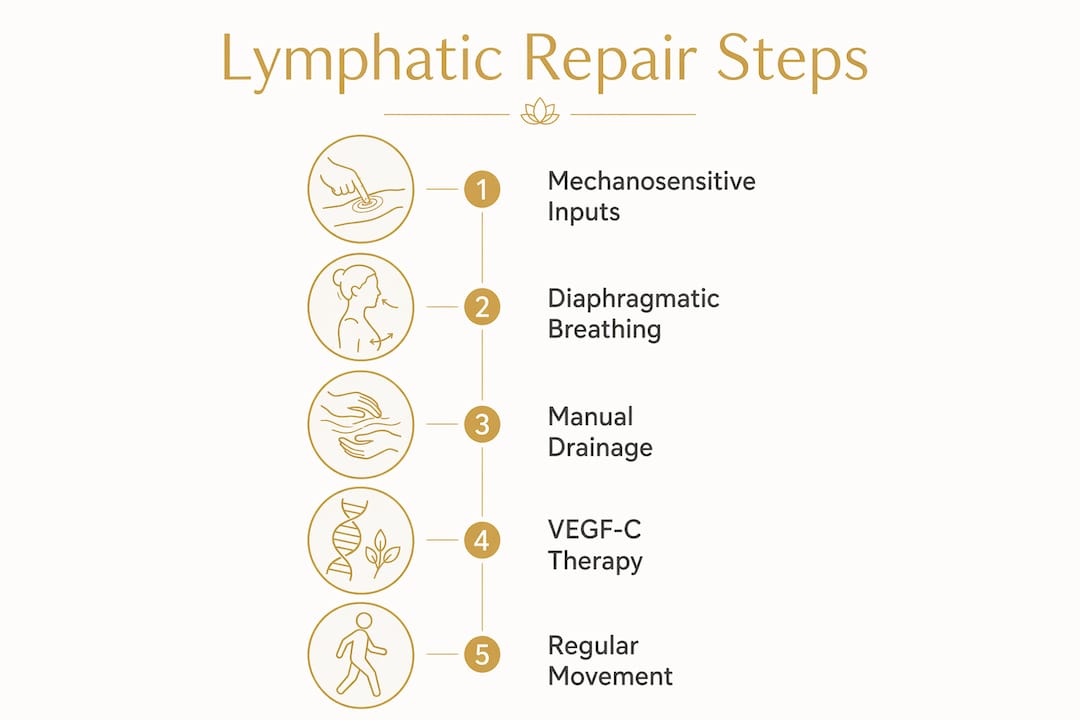
Pro Tip: Restore mechanosensitive inputs before manual drainage. Movement and deep diaphragmatic breathing prime the stretch receptors that trigger lymphatic contractions; without that priming, manual work has less substrate to work with.
How impaired lymph flow accelerates biological aging
Lymphatic failure does not stay local. When clearance slows, the downstream effects hit every tissue that depends on immune surveillance and waste removal.
- Joints: Lymphatic regression in synovial tissue precedes cartilage loss. Blocking lymphangiogenesis in experimental arthritis accelerated joint tissue destruction; restoring drainage reduced local macrophage accumulation and slowed degeneration.
- Cardiovascular system: Impaired lipid and debris clearance allows inflammatory residue to persist in vessel walls. Inducing lymphangiogenesis in obese mouse models improved glucose homeostasis and reduced local inflammation, linking lymphatic repair directly to metabolic and cardiovascular outcomes.
- Brain: The glymphatic system depends on working meningeal lymphatics to clear amyloid-beta and tau during sleep. When meningeal drainage declines, those proteins accumulate, and cognitive resilience drops.
- Immune system: Aging lymph nodes develop fibrosis, lipomatosis, and reduced germinal centers, cutting the adaptive immune response at its organizational core.
The cross-cutting consequence is inflammaging: chronic, low-grade systemic inflammation that accelerates epigenetic aging across tissues simultaneously. Lymphatic dysfunction is not one cause among many. It is a central amplifier that explains why cardiovascular disease, osteoarthritis, and neurodegeneration tend to cluster in the same aging body. Restoring immune system function through lymphatic repair addresses that amplifier directly.
What the strongest studies actually show

The most compelling evidence is preclinical. That is not a dismissal; it is a precise statement about where the science stands.
| Model | Intervention | Key Outcome | Evidence Level |
|---|---|---|---|
| Aged mice | VEGF-C administration | Improved meningeal CSF clearance; cognitive benefit | Preclinical |
| Aged rats | Near-infrared imaging | Greater than 50% reduction in CSF-to-lymph flow rate documented | Preclinical/observational |
| Obese mouse model | Induced lymphangiogenesis | Reduced macrophage load; improved glucose homeostasis | Preclinical |
| Experimental arthritis | Lymphangiogenesis blockade | Accelerated joint tissue loss (confirms drainage is protective) | Preclinical |
| Human thoracic duct | Structural analysis | Muscle atrophy and elastic matrix loss confirmed by age 65–70 | Human anatomical |
“The shift from an actively pumping lymphatic system to one of stagnation is a major, under-recognized determinant of resilience; lymphatic enhancement is now viewed as a core gerotherapeutic strategy.” — Ageing and the lymphatic system
The VEGF-C findings in aged rodents are the most discussed in longevity circles, and for good reason: they show a mechanistic path from lymphatic repair to neuroprotection. Translation to humans is an open research priority, not a closed case. Human trials are underway, but no peer-reviewed human RCT has yet confirmed the cognitive benefit. That gap matters when you are designing a protocol.
Evidence-backed interventions available in the US right now
Prioritize in this order: what you can start today, what requires a clinician, and what is still experimental.
- Aerobic movement (strong evidence): 30 minutes of brisk walking, rebounding, or cycling, 5 days per week. Muscle contractions drive lymphatic pumping mechanically; this is the highest-leverage daily input. Contraindication: active deep vein thrombosis.
- Deep diaphragmatic breathing (strong evidence): 10 minutes of slow, full-belly breathing, twice daily. Thoracic pressure changes are a primary driver of central lymphatic flow. Pair with movement for compounding effect.
- Sleep optimization (strong/moderate evidence): 7–9 hours with consistent sleep timing. The glymphatic system clears amyloid-beta and tau primarily during deep sleep; poor sleep architecture is a direct lymphatic clearance deficit.
- Manual lymphatic drainage (moderate evidence): Seek a certified lymphedema therapist. Sessions of 45–60 minutes, weekly or biweekly, produce symptomatic relief and measurable limb-volume changes. Contraindicated in active infection, untreated DVT, and unstable cardiac disease.
- Compression garments (moderate evidence): Prescribed by a clinician for chronic lymphedema or post-surgical edema. Not appropriate as a self-prescribed daily intervention without assessment.
- Targeted physiotherapy (moderate evidence): A licensed physical therapist trained in lymphatic rehabilitation can design a program combining movement, breathing, and manual techniques. Available across the US through most hospital systems and private practices.
- VEGF-C biologics and lymphatic microsurgery (preclinical/experimental): Do not self-administer. These remain in clinical trials or are reserved for severe lymphedema cases. Watch for trial enrollment opportunities through ClinicalTrials.gov.
Pro Tip: Sequence matters. Do 5 minutes of diaphragmatic breathing before manual drainage or a lymphatic-focused workout. This restores mechanosensitivity in the collecting vessels and primes the pump before you add external pressure or load.
For non-supplement interventions that support lymphatic health alongside these modalities, the evidence base is growing and accessible.
How to measure your progress and what timeline to expect
DNA-methylation clocks, specifically TruAge, give you the most direct read on biological-age change. Pair that with inflammatory markers (hs-CRP, IL-6) and functional lymphatic measures for a composite picture.
Statistic: Given the greater than 50% functional decline in lymphatic flow documented in aged animal models, early intervention windows matter; even partial restoration of pump function can meaningfully reduce inflammatory load.
Testing cadence:
- Baseline: TruAge methylation test, hs-CRP, IL-6, limb circumference or subjective symptom score.
- 3 months: Functional reassessment (symptom relief, sleep quality, energy), repeat hs-CRP.
- 6 months: Repeat TruAge and full inflammatory panel. This is the window where consistent intervention produces measurable methylation shifts.
- 12 months: Maintenance assessment; adjust protocol intensity based on results.
Expected outcomes by window: Weeks 1–4 bring reduced puffiness and improved sleep depth. By month 3, lymphatic tone improves and symptomatic relief is typical with consistent practice. At 6 months, biomarker and methylation changes become detectable when the protocol has been followed with real consistency. The interaction between energy metabolism and lymphatic function means metabolic markers often shift in parallel.
How lymphatic repair fits into the TIMELESS four-layer protocol
Aging is a four-layer problem. Most protocols address one layer. TIMELESS addresses all four simultaneously, and lymphatic repair is a multiplier across every layer.
- Physical layer: Daily movement and breathing restore eNOS responsiveness and mechanical pump function. This is the cellular and mitochondrial foundation.
- Emotional layer: Chronic sympathetic activation (stored trauma, nervous system dysregulation) suppresses lymphatic contractility. Somatic therapy, trauma-informed breathwork, and vagal toning reduce sympathetic tone and restore the parasympathetic conditions under which lymphatic vessels contract most efficiently.
- Spiritual layer: Identity-level beliefs about aging (“I’m just getting older”) create behavioral patterns that reduce movement, worsen sleep, and increase stress load. Guided journaling and identity work shift those subconscious programs. The four-layer protocol details this sequencing in full.
- Energetic layer: Grounding practices and directed breathwork support bioelectric field regulation, which influences cellular signaling in lymphatic endothelium.
Weekly template (minimum viable version):
- Monday/Wednesday/Friday: 30-minute aerobic movement + 10-minute diaphragmatic breathing (Physical)
- Tuesday/Thursday: 20-minute somatic breathwork or trauma-release practice (Emotional)
- Daily, 10 minutes: Identity journaling or guided visualization (Spiritual)
- Evening, 5 minutes: Grounding or slow coherent breathing before sleep (Energetic)
For clients with limited time, prioritize Physical first (movement + breathing), then Emotional (nervous system regulation), because those two layers produce the fastest measurable lymphatic response.
Contraindications and when to see a clinician
Most self-care lymphatic practices are safe. A few situations require clinician oversight before you start.
Absolute contraindications for self-directed lymphatic work:
- Active infection or acute inflammation in the affected area
- Untreated deep vein thrombosis
- Unstable cardiac disease or acute heart failure
- Active, uncontrolled cancer in the drainage region
Red-flag symptoms requiring urgent evaluation:
- Sudden unilateral limb swelling with no clear cause
- Acute pain combined with swelling and warmth
- Fever with localized swelling (possible lymphangitis)
Compression garments are contraindicated in arterial insufficiency; always get ankle-brachial index assessment before applying compression to the lower extremities. Manual lymphatic drainage should not be performed over open wounds, radiation-damaged skin, or active thrombosis sites.
Referral guidance: Seek a certified lymphedema therapist (CLT) for any chronic or complex swelling. For systemic lymphatic aging concerns in the context of a longevity protocol, a vascular medicine specialist or lymphology clinic is the appropriate escalation point.
Key Takeaways
Lymphatic decline is a central, addressable driver of biological aging: restoring pump function reduces inflammaging, supports immune trafficking, and produces measurable biomarker shifts within 6 months of consistent intervention.
| Point | Details |
|---|---|
| Pump failure is structural | Muscle atrophy and eNOS/iNOS shifts cause greater than 50% flow decline in aged models. |
| Inflammaging is the downstream risk | Impaired clearance drives joint, cardiovascular, and cognitive aging simultaneously. |
| Start-today interventions work | Aerobic movement and diaphragmatic breathing have strong evidence and zero cost. |
| Measure with TruAge at 6 months | DNA-methylation clocks detect biological-age shifts when interventions are consistent. |
| Timeless - Reverse Your Age | The TIMELESS four-layer protocol integrates lymphatic repair across Physical, Emotional, Spiritual, and Energetic layers with a DNA-verified guarantee. |
Why I put lymphatic repair at the center of longevity work
Most longevity practitioners treat the lymphatic system as a footnote. I treat it as infrastructure. Here is why that distinction changes everything.
When I look at the biology of aging, I see a system that fails in clusters, not in isolation. Joints, brain, heart, and immune function all decline together, and the common thread is almost always impaired clearance and chronic inflammation. The lymphatic system sits at the intersection of all of them. Fix the pump, and you reduce the inflammatory load that is quietly aging every tissue in the body.
The four-layer framing matters here because lymphatic function is not purely physical. Chronic sympathetic activation from unresolved emotional stress directly suppresses lymphatic contractility. Identity-level beliefs about aging reduce the movement behaviors that keep the pump working. Energetic dysregulation affects the bioelectric environment that lymphatic endothelium depends on. You cannot fix a system that operates across all four layers by only addressing one.
The practitioners I have worked with who see the fastest biological-age reversal are the ones who treat lymphatic repair as a daily practice, not a monthly appointment. Movement, breathing, sleep, and nervous system regulation, done consistently, produce results that show up on a TruAge test.
The TIMELESS Vitality Intensive gives you a verified path forward
If you have read this far, you already know that lymphatic repair is not a single intervention. It is a protocol. The TIMELESS Vitality Intensive is an 8-week private coaching program built on exactly this framework, and it comes with the only DNA-verified guarantee in the longevity space: reverse your biological age by 10 years in 6 months, confirmed by TruAge methylation testing, or every dollar is refunded.
Three ways to get started right now. Download the free 14-upgrades guide at reverseyourage.org/14-upgrades for an immediate action checklist. Pick up the TIMELESS: Reverse Your Age book for $29.99 at the TIMELESS book page for the full 370-page protocol. Or book a free Vitality Diagnosis call to get a personalized assessment and see whether the coaching program fits your situation.
Selected sources and tools for deeper research
- Reduced lymphatic function contributes to age-related disease (review, animal study) — Core mechanistic review linking lymphatic pump decline to osteoarthritis, cardiovascular disease, and metabolic dysfunction. Essential reading for clinicians.
- Hydrodynamic regulation of lymphatic transport and the impact of aging (mechanistic study) — Documents eNOS/iNOS shifts and pressure/stretch-dependent impairments in aged thoracic duct; explains why restoring mechanosensitivity is the first clinical priority.
- Ageing and the lymphatic system: Implications for immunity, brain health, and possible therapeutic interventions (review) — Frames lymphatic enhancement as a gerotherapeutic strategy; covers meningeal lymphatics and VEGF-C translational potential.
- Lymphatic Senescence: Current Updates and Perspectives (review) — Covers glycocalyx dysfunction, oxidative stress, and altered nerve/muscle fibers in aged lymphatic vessels; useful for cellular-level protocol design.
- Aging-related changes in lymph nodes (review) — Structural and functional changes in lymph node architecture with age; relevant for immune trafficking and vaccine response context.
- TruAge DNA methylation testing (biomarker service) — Available in the US; provides biological-age readout via epigenetic clock. Use at baseline and 6-month intervals to verify protocol outcomes.
Research gaps to watch: Long-term maintenance data after lymphatic interventions in humans are absent from the literature. Human VEGF-C trials are the most anticipated near-term development in this field.
FAQ
Why does the lymphatic system slow down with age?
Lymphatic muscle cells atrophy, extracellular matrix stiffens, and a shift from eNOS to iNOS expression impairs flow-mediated contractility, collectively reducing pump amplitude and frequency with advancing age.
Can you actually reverse lymphatic aging?
Preclinical studies show that VEGF-C administration and mechanical interventions restore measurable clearance and cognitive outcomes in aged rodents; in humans, consistent movement, breathing, and sleep optimization produce functional improvements and inflammatory-marker changes within months.
How does lymphatic health affect brain aging?
Meningeal lymphatics clear amyloid-beta and tau from the brain during sleep; when that drainage declines with age, protein accumulation accelerates and cognitive resilience drops, making sleep optimization a direct neuroprotective strategy.
What is the best way to start promoting lymphatic drainage today?
Daily aerobic movement (30 minutes) paired with 10 minutes of deep diaphragmatic breathing is the highest-evidence, zero-cost starting point; this combination mechanically drives lymphatic contractions and restores stretch-mediated pump responsiveness.
How does the TIMELESS protocol address lymphatic aging?
The TIMELESS four-layer protocol integrates physical interventions (movement, breathing) with emotional nervous system regulation, spiritual identity work, and energetic practices to restore lymphatic function across all the biological layers that control it simultaneously.