Red Light Therapy: Evidence, Limits, and Its Four Layer Role
Evidence based red light therapy: what trials support it, safe dosing and limits, and how it fits a four layer DNA verified longevity plan.
Red Light Therapy: Evidence, Limits, and Its Four Layer Role
Red light therapy, known in Hungarian as vörös fény terápia, reliably supports skin collagen production and can ease certain musculoskeletal pain conditions by stimulating mitochondrial activity in cells. The evidence is moderate for specific targets like knee osteoarthritis disability and hair density in androgenetic alopecia, and weak for most other claims you see in marketing copy. It’s low risk when you protect your eyes and check with a doctor if you have specific medical conditions, but dosing and device quality determine whether you get real results or just a warm feeling on your skin.
TL;DR:
- Red light therapy is most effective for improving skin collagen, reducing knee osteoarthritis disability, increasing hair density, and relieving burning mouth syndrome pain.
- Proper dosing depends on balancing light wavelength, session duration, and avoiding overexposure, which can suppress cellular activity instead of stimulating it.
- Clinical devices offer validated irradiance and supervised protocols, while home panels often lack transparent specifications and may underdose due to improper distance.
- Safety precautions include eye protection, caution with photosensitizing medications, and consultation with a doctor for active tumors, pregnancy, or existing medical conditions.
- Red light therapy works best as part of a broader, multi-layered anti-aging protocol that addresses physical, emotional, spiritual, and energetic factors.
Table of Contents
- What Is Vörös Fény Terápia and How Does It Work?
- What the Research Actually Shows
- Safety Rules and Who Should Skip It
- Clinic Devices vs Home Panels: What’s the Real Difference?
- How to Use Red Light Therapy: Practical Dosing Guidance
- How Photobiomodulation Fits Into the TIMELESS Protocol
- Combining Light Therapy With Other Treatments Safely
- Keeping Your Device Safe and Effective Over Time
- What the Research Actually Tells Us About Red Light Therapy
- Ready for Measurable, DNA-Verified Results?
- Sources
- FAQ
What Is Vörös Fény Terápia and How Does It Work?
Vörös fény terápia is the Hungarian term for red light therapy, also called photobiomodulation (PBM) or, in older research, low level laser therapy (LLLT). All three names point to the same process: using specific wavelengths of red and near infrared light to trigger a biological response inside your cells, not on the surface of your skin.
The mechanism starts inside your mitochondria. Photons at these wavelengths get absorbed by an enzyme called cytochrome c oxidase, which sits in the mitochondrial membrane and drives ATP production. When that enzyme absorbs light, your cells produce more energy, and that energy shift triggers a cascade of secondary effects, including brief increases in reactive oxygen species and nitric oxide that act as signaling molecules. Those signals switch on genes tied to collagen production, tissue repair, and inflammation control.
Wavelength determines how deep the light travels:
- Red light (roughly 630 to 680 nm) penetrates shallow tissue and works best for skin, wound healing, and surface inflammation.
- Near infrared light (roughly 800 to 880 nm) reaches deeper into muscle, joints, and connective tissue.
- Most clinical devices combine both bands to treat surface and deep tissue in the same session.
Here’s the detail most people miss: more light is not always better. PBM follows what researchers call the Arndt–Schulz biphasic dose response, meaning small to moderate doses stimulate cellular activity while excessive doses actually suppress it. Overdoing your sessions can cancel out the benefit you’re chasing.
Quick fact: A mechanistic review covering multiple medical disciplines found PBM’s core action window sits in the red to near-infrared light range, with effects driven by mitochondrial signaling rather than surface heating, which is why device marketing claims often outpace what the biology can actually deliver.
What the Research Actually Shows
The most rigorous synthesis of PBM evidence is an umbrella review that included many meta-analyses and thousands of participants. It found moderate-certainty evidence supporting a specific, short list of outcomes, not a universal health benefit.
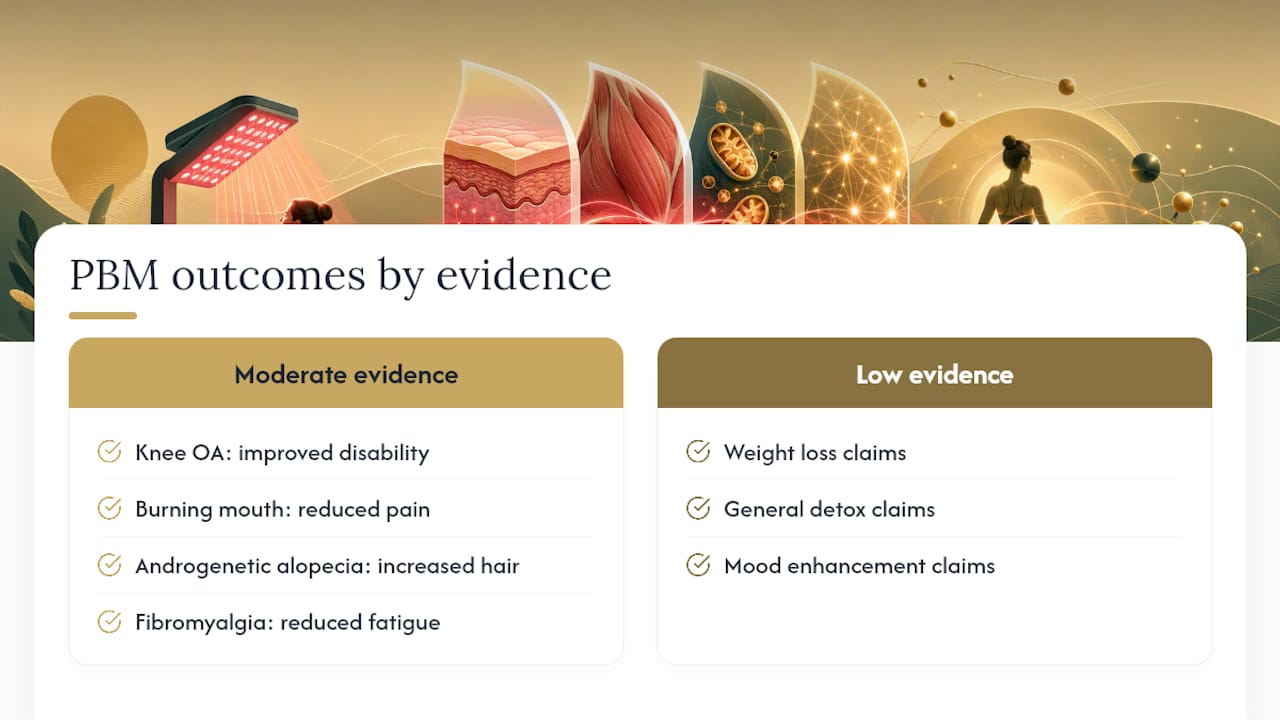
The strongest evidence supports PBM benefits for selected conditions such as improved disability in knee osteoarthritis, reduced pain in burning mouth syndrome, increased hair density in androgenetic alopecia, reduced fatigue in fibromyalgia, and modest improvements in cognitive function.
Everything outside that list, including weight loss, general detoxification, and broad mood enhancement claims, sits in low or very low certainty territory according to the same umbrella review. That doesn’t mean PBM never helps with those things. It means the trial evidence isn’t strong enough yet to say so with confidence, and a chunk of the enthusiasm floating around online exceeds what the data supports.
Part of the problem is protocol heterogeneity. Trials use different wavelengths, different fluence levels, different session lengths, and different treatment schedules, which makes it hard to compare results across studies or draw a single dosing standard. A dermatology-focused clinical summary notes that PBM can measurably stimulate collagen-related gene activity, visible through profilometry and ultrasound imaging, but it works best as an adjunct to established skin care, not a replacement for it.
Timelines matter here too. Skin and pain outcomes in the strongest trials generally showed change over weeks to a few months of consistent sessions, not overnight. If you’re expecting a single session to fix chronic joint pain, you’re setting yourself up for disappointment regardless of how good your device is.
Safety Rules and Who Should Skip It
Red light therapy carries a low overall risk profile compared to many medical interventions, according to a Cleveland Clinic overview of the treatment. That doesn’t mean it’s risk-free for everyone.
Minor side effects are the most common issue you’ll encounter:
- Transient redness or mild skin irritation after a session, usually resolving within hours.
- Eye strain or discomfort if you look directly at the light source without protection.
- Occasional headache with extended near infrared exposure, particularly at close range.
Eye protection deserves its own line because it’s the rule people skip most often. Never stare directly into a red light or NIR panel. Use protective goggles rated for the device’s wavelength range, especially with higher powered clinical units.
Certain conditions call for a conversation with your doctor before you start:
- Active malignancy at the treatment site. Stimulating cellular activity near a tumor site is not something to experiment with on your own.
- Photosensitizing medications. Certain antibiotics, acne treatments, and other drugs increase your skin’s sensitivity to light exposure.
- Pregnancy. Data on PBM safety during pregnancy is thin, so caution and medical guidance apply here.
If you notice unexpected symptoms, blistering, unusual pain, or irritation that doesn’t fade within a day, stop sessions and talk to a clinician before continuing. That’s not an alarmist warning, it’s just how you treat any intervention that changes cellular activity in your body.
Clinic Devices vs Home Panels: What’s the Real Difference?
The gap between a professional PBM device and the panel you buy online usually comes down to three things: verified irradiance, dose control, and supervision.
- Clinical devices deliver measured, consistent output. Clinic-grade panels and lasers come with documented irradiance (measured in mW/cm²) and validated treatment protocols, so the practitioner knows exactly how much energy reaches your tissue in a given session.
- Home panels often lack transparent specs. Many consumer devices skip published irradiance data entirely, or list numbers measured at a distance that doesn’t match how you’ll actually use the device at home.
- Distance sensitivity causes underdosing. Light intensity drops sharply as you move away from the panel, and consumer guidance on home devices points to inconsistent distance as one of the most common reasons people don’t see results with panels that should otherwise work.
- Supervision matters for medical conditions. If you’re treating a diagnosed condition like osteoarthritis or a chronic pain disorder, a clinic setting gives you diagnostic oversight and a practitioner who can adjust your protocol based on how you respond, something a home panel simply can’t do.
Choose a clinic when you’re managing a diagnosed medical condition, when you want a practitioner to confirm the protocol matches your specific case, or when your insurance or referring physician recommends supervised treatment. Choose a home panel for general skin maintenance or muscle recovery once you understand its actual output and commit to consistent use. The device itself isn’t the deciding factor. Verified dosing information is.
How to Use Red Light Therapy: Practical Dosing Guidance
Two numbers matter more than anything else when you’re planning a session: irradiance and fluence. Irradiance is how much light power hits your skin per second, measured in milliwatts per square centimeter (mW/cm²). Fluence is your total dose for the session, measured in joules per square centimeter (J/cm²). Multiply irradiance by time, and you get fluence.
Clinical literature commonly reports effective fluence within a range suitable for many skin and soft tissue targets, though the exact amount depends on the condition and wavelength involved. You can calculate your session time with a simple formula: seconds equals (fluence in J/cm² multiplied by 1,000) divided by your device’s irradiance in mW/cm².
Here’s how that plays out in practice:
- Face and skin sessions: Use the red band (630 to 680 nm) for 10 to 15 minutes per session, three to five times a week, positioned at the distance your device manufacturer specifies.
- Muscle and joint recovery: Use the near infrared band (800 to 880 nm) for 10 to 20 minutes, holding a consistent distance from the panel, three to four times weekly for several weeks before judging results.
- Hair density support: Use a device specifically designed and tested for scalp application, following the manufacturer’s session length, since scalp protocols differ from skin or joint protocols in both wavelength mix and duration.
Give any protocol at least four to eight weeks of consistent use before deciding whether it’s working. This isn’t a same-day fix, and the bone health dosing guidance from clinical practitioners reinforces that treatment frequency and consistency drive outcomes more than any single session’s intensity.
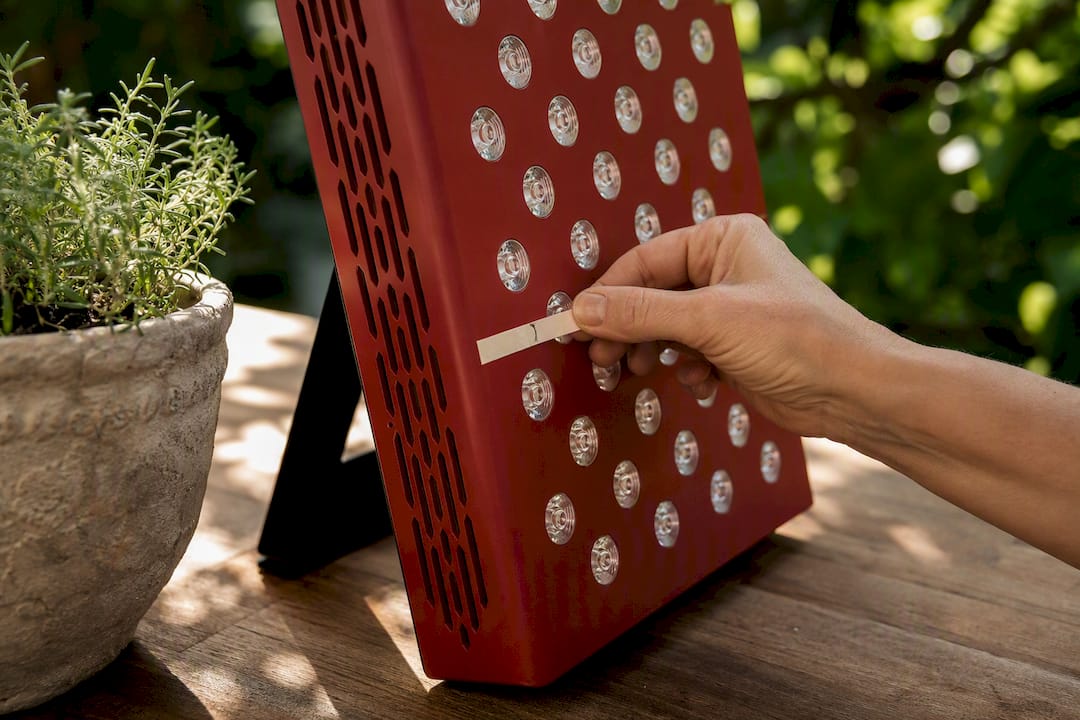
Pro Tip: Mark your device’s exact distance from your skin with a piece of tape or a fixed stand. Moving even a few inches farther away can cut your effective dose dramatically, which is the single biggest reason home users report inconsistent results.
How Photobiomodulation Fits Into the TIMELESS Protocol
I’ve spent 15 years researching biological aging, and my own TruAge DNA methylation test came back with a biological age of 23 at a chronological age of 41. That result didn’t come from a single tool. It came from treating aging as the four-layer problem it actually is.
Photobiomodulation is a real, evidence-backed intervention. It belongs squarely in the Physical layer of aging, the layer that covers mitochondrial function, cellular energy, and epigenetic signaling. A mechanistic review confirms PBM’s action on cytochrome c oxidase produces plausible, measurable cellular effects. But here’s what most protocols get wrong: they stop there.
Aging isn’t only a physical problem. It’s also:
- Emotional — stored trauma and nervous system dysregulation that keep your body in chronic stress states.
- Spiritual — subconscious beliefs about aging that shape how your body responds to every intervention you try.
- Energetic — bioelectric field and meridian disruptions that most protocols never even measure.
Stimulating your mitochondria with red light while ignoring the other three layers is like upgrading one component in a computer running outdated software on every other system. The TIMELESS four-layer protocol addresses all four simultaneously, which is why it’s built to produce measurable, DNA-verified results rather than isolated cellular effects.
Combining Light Therapy With Other Treatments Safely
Red light therapy rarely works in isolation, and that’s actually good news. Pairing it with the right complementary treatments tends to amplify results rather than create risk, as long as you understand the interactions.
For skin goals, PBM pairs well with topical retinoids and standard skincare routines, since the light stimulates collagen synthesis while topicals address surface texture and pigmentation through different mechanisms. For pain and joint conditions, combining PBM with physical therapy or targeted exercise tends to outperform either intervention alone, since the light supports tissue repair while movement restores function and range of motion. For recovery after intense exercise, PBM sessions timed a few hours after training, paired with adequate hydration and sleep, work with your body’s natural repair window rather than against it.
Where you need real caution is combining PBM with treatments that also affect light sensitivity. Certain acne medications, chemical peels, and some prescription drugs increase photosensitivity, and stacking those with red light exposure can increase irritation risk. If you’re using any prescription topical or oral medication, especially anything with a photosensitivity warning on the label, talk to your prescribing doctor before adding light sessions to your routine.
The broader point is this: PBM works best as one tool among several, not a stand-alone fix. That’s precisely the thinking behind treating aging and recovery as a multi-layer challenge rather than a single-intervention project.
Keeping Your Device Safe and Effective Over Time
A red light panel doesn’t stay accurate forever. LEDs degrade gradually, which means the irradiance your device delivered on day one can drop measurably after months of regular use, even if the light still looks just as bright to your eyes.
A few habits protect both your safety and your results:
- Clean the panel surface regularly with a soft, dry cloth. Dust and skin oil buildup on the LED lens reduces effective light output over time.
- Check for physical damage like cracked lenses or exposed wiring before every few sessions, particularly if you travel with a portable device.
- Note any change in warmth or brightness. A device that suddenly runs hotter or dimmer than usual may be signaling LED degradation or an electrical issue.
- Follow the manufacturer’s replacement timeline for panels with a stated LED lifespan, since output curves aren’t linear. Many units still produce visible light well after their effective therapeutic dose has dropped.
- Retest your session distance periodically. If you’ve recalibrated where you sit or stand, your effective fluence changes even if nothing else about your routine has.
Clinical settings solve this problem with routine equipment calibration and irradiance testing built into their maintenance schedule. Home users rarely have access to that kind of verification, which is exactly why treating your device’s specs as fixed forever is a mistake. A panel that delivered a solid dose a year ago may be underdosing you today without any obvious warning sign.
What the Research Actually Tells Us About Red Light Therapy
Most of the red light therapy conversation online treats it like a miracle switch. That’s backwards. The umbrella review data is honest about where PBM helps and where it doesn’t, and the honest version is more useful than the hype version, even if it’s less exciting.
Here’s what I think people consistently get wrong: they treat PBM as a destination instead of a component. Improving mitochondrial ATP output is real and measurable, but mitochondria don’t operate in isolation from your nervous system, your subconscious stress patterns, or your body’s bioelectric signaling. Treating one layer while ignoring the other three explains why so many people plateau with red light panels after a few months. The cellular signal is there, but the rest of the system isn’t cooperating.
If you’re going to use PBM, use it with clear expectations: skin and specific pain conditions have the strongest support, dosing consistency matters more than device price, and it should function as one lever in a broader protocol rather than the whole strategy. That’s the difference between chasing a trend and building something measurable.
— E. Christian Trejo
Ready for Measurable, DNA-Verified Results?
Red light therapy can support your mitochondria. It can’t rewrite your emotional patterns, your subconscious beliefs about aging, or your body’s bioelectric field, and those three layers are exactly where most anti-aging efforts quietly fail. The TIMELESS book lays out the complete four-layer protocol across 370 pages, built from 15 years of research and tested across 40 countries, priced at $29.99.
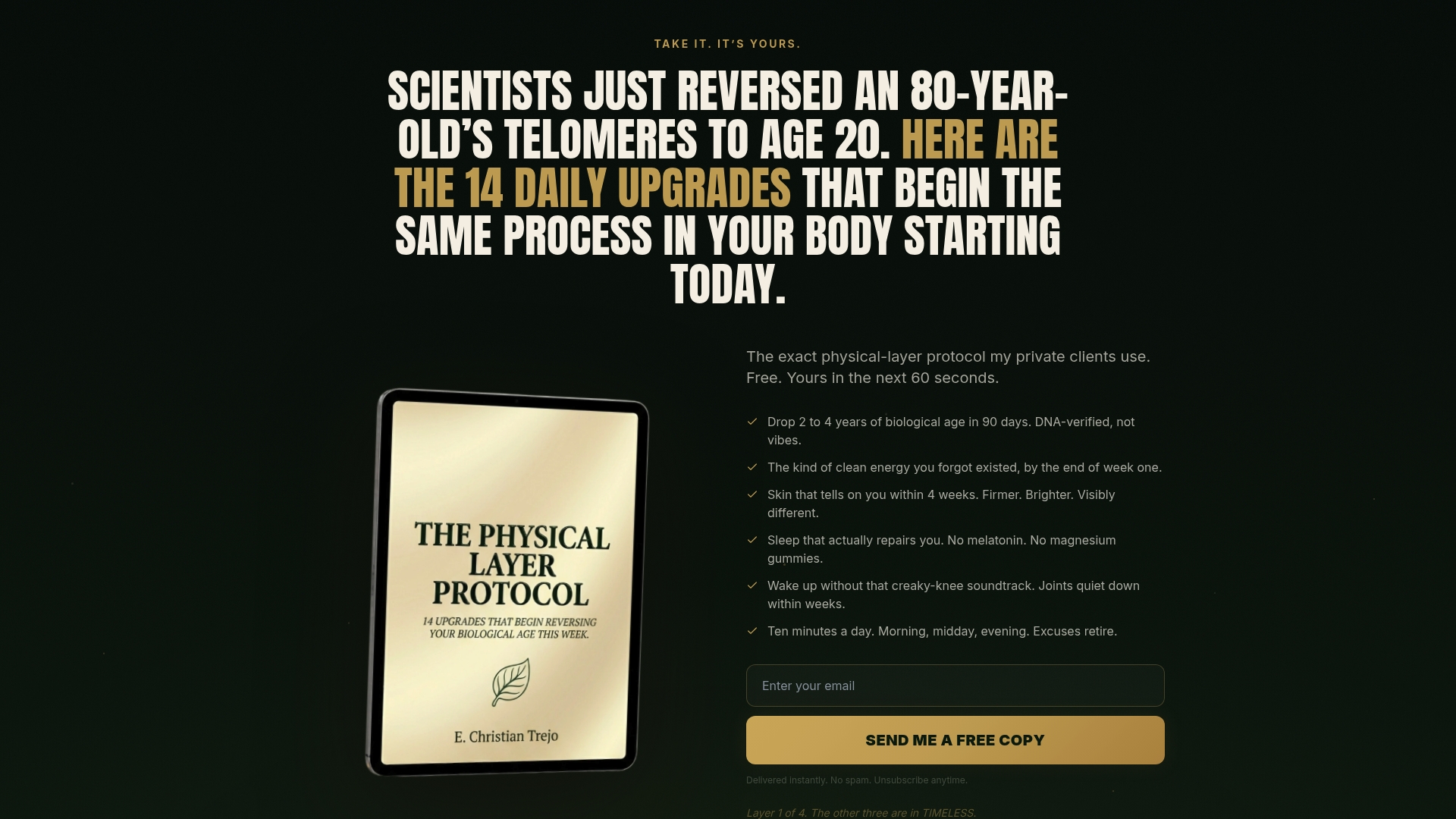
If you want personalized guidance instead of a self-directed approach, the TIMELESS Vitality Intensive is an 8-week private coaching program priced at $7,000 that comes with a guarantee found nowhere else in the longevity space: reverse your biological age by at least 10 years in 6 months, verified by TruAge DNA methylation testing, or you get every dollar back. Start with the free guide covering 14 upgrades if you want a no-cost first step, or book a free Vitality Diagnosis call to find out if the coaching program is right for your situation. Red light therapy is a tool. TIMELESS is the protocol that makes sure that tool actually produces a number you can verify.
Selected Studies and Reviews to Read Next
For deeper reading, start with the umbrella review of PBM outcomes, the mechanistic review on PBM across medical disciplines, the PMC review on PBM application and dosimetry, and the Cleveland Clinic consumer overview.
This article is general information, not a substitute for advice from a qualified doctor. Consult a qualified healthcare professional about your own circumstances before acting on anything here.
Sources
- Effects of photobiomodulation on multiple health outcomes: an umbrella review of randomized clinical trials
- From light to healing: photobiomodulation therapy in medical disciplines
- Photobiomodulation (PBM) application and mechanisms — review (PMC)
- Red light therapy — Cleveland Clinic
FAQ
What Is Vörösfény Terápia?
Vörösfény terápia is the Hungarian term for red light therapy, a treatment using specific red and near infrared wavelengths to stimulate mitochondrial activity in cells, also known scientifically as photobiomodulation.
What Is a Red Light Therapy Lamp?
A red light therapy lamp is a device, typically LED-based, that emits light in the 630 to 680 nm (red) or 800 to 880 nm (near infrared) range at a controlled irradiance to deliver a therapeutic dose to skin or deeper tissue.
What Effect Does Red Light Have on the Body?
Red light is absorbed by cytochrome c oxidase in your mitochondria, boosting ATP production and triggering signaling that can support collagen synthesis, tissue repair, and reduced inflammation in specific conditions.
What Is Red Light Therapy Good For?
The strongest evidence supports red light therapy for skin collagen improvement, reduced disability in knee osteoarthritis, hair density in androgenetic alopecia, and burning mouth syndrome pain, based on a large umbrella review of clinical trials.
Can Red Light Therapy Help With Longevity, Not Just Skin or Pain?
It supports the Physical layer of aging through mitochondrial stimulation, but measurable biological age reversal requires addressing the Emotional, Spiritual, and Energetic layers too, which is the core premise behind the TIMELESS four-layer protocol.