
Lower Cortisol in 1–2 Weeks, or Use the Four Layer TIMELESS Protocol
Start a seven day checklist to stabilize sleep and blood sugar. See changes in 1–2 weeks, plus when the four layer TIMELESS protocol applies.
Lower Cortisol in 1–2 Weeks, or Use the Four Layer TIMELESS Protocol
Consistent sleep, diaphragmatic breathing, and stable blood sugar are the three fastest natural levers for lowering cortisol, and all three start working within days. Supplements like ashwagandha can support that foundation but never replace it. If you notice rapid weight change, unusual bruising, or muscle weakness alongside your stress symptoms, talk to a clinician before trying anything else.
TL;DR:
- Consistent wake time and morning light exposure are crucial for resetting your circadian cortisol rhythm within days.
- Daily moderate exercise and stable blood sugar through balanced meals support long-term cortisol reduction, avoiding overtraining and refined carbs.
- Combining diaphragmatic breathing, outdoor time, and social contact can rapidly lower cortisol levels by activating the vagus nerve and calming the nervous system.
- Supplements like ashwagandha may help, but only as an adjunct to foundational habits, with measurable effects appearing within 4 to 6 weeks.
- Persistent symptoms or rapid weight gain, bruising, or muscle weakness warrant medical consultation before self-managing cortisol levels.
Table of Contents
- Kortizol Csökkentés Természetesen: The 7-Day Starting Checklist
- Sleep, Light, and Movement: The Lifestyle Foundation
- Diet and Supplements: What Actually Moves the Needle
- Nervous-System Regulation: The Practices That Downregulate Stress Directly
- When to Test Cortisol and When to See a Doctor
- Realistic Timeline: What to Expect Week by Week
- Beyond Breathing: Mindfulness and Cognitive Strategies That Work
- Why Who You’re Around Changes Your Cortisol Numbers
- Environmental Noise and Light: The Stressors You Don’t Notice
- The Four-Layer Reason Most Cortisol Advice Falls Short
- A Faster Path Than Guessing Alone
- Sources
- FAQ
Kortizol Csökkentés Természetesen: The 7-Day Starting Checklist
You don’t need a lab test to start bringing cortisol down. You need a week of deliberate repetition. Kortizol csökkentés természetesen, or natural cortisol reduction, works best as a stacked set of small habits rather than one dramatic change. Here’s the order that matters most in week one:
- Fix your wake time first. Get up within the same 30 minute window every day and get outside within 15 minutes of waking, even on cloudy days. This is the single biggest lever for resetting your circadian cortisol curve.
- Breathe on a schedule, not just when stressed. Do two 5 minute diaphragmatic breathing sessions daily, one mid-morning and one before dinner. Inhale for 4 counts, exhale for 6, and let your belly expand rather than your chest.
- Eat protein within an hour of waking. A blood sugar dip in the morning triggers a cortisol spike to compensate, so 25 to 30 grams of protein at breakfast blunts that response before it starts.
- Walk daily, skip the extra HIIT. A 20 to 30 minute walk, especially outdoors, lowers stress hormones without adding the training load your body may already be struggling to recover from.
- Cut caffeine after 2 PM and hydrate first thing. Late caffeine extends cortisol elevation into the evening, and mild dehydration alone can raise it.
- Add one fermented food daily. Kefir, sauerkraut, or plain yogurt support the gut microbiome, which communicates directly with your stress response.
Sleep, Light, and Movement: The Lifestyle Foundation
Cortisol runs on a daily rhythm, not a static number, and that rhythm is set primarily by sleep and light exposure. The Cleveland Clinic notes that restoring consistent quality sleep is one of the primary ways to realign that rhythm in people who don’t have an underlying condition like Cushing syndrome. Morning light does the actual resetting: 10 to 15 minutes of outdoor light within an hour of waking anchors your circadian clock, and if you live somewhere with limited winter daylight, a 10,000 lux light box for 20 to 30 minutes in the morning is a reasonable substitute.
Exercise is where people get it backwards. Moderate aerobic work and resistance training with real recovery days lower baseline cortisol over time. Daily high-intensity intervals without adequate rest tend to push it the other direction, especially for someone already running on a depleted nervous system.
- Favor 3 to 4 moderate sessions weekly over daily maximum effort
- Build in at least some full rest days between resistance sessions
- Track sleep and recovery, not just workout volume
- Use short naps (under 30 minutes) if you’re behind on sleep debt, not as a replacement for it
Pro Tip: If you wear a fitness tracker, watch your resting heart rate trend over 2 weeks. A rising baseline while your training stays the same is often the earliest sign of overtraining before cortisol symptoms show up anywhere else.
Diet and Supplements: What Actually Moves the Needle
Blood sugar stability is the quiet variable behind most cortisol advice you’ve read. Every time glucose crashes, your adrenal glands release cortisol to bring it back up, so a diet full of refined carbs without enough protein or fat creates repeated mini-spikes throughout the day. Building meals around a protein source, a fat source, and slow-digesting carbohydrates keeps that curve flat.
Foods worth prioritizing:
- Magnesium-rich vegetables like spinach and Swiss chard, since magnesium is a cofactor in HPA-axis regulation
- Oily fish such as salmon or sardines two to three times weekly for omega-3s
- Fermented foods, which the Stanford Medicine fermented-food study linked to greater microbiome diversity and lower inflammation markers
- High-cocoa dark chocolate in small amounts, which contains polyphenols that may modulate local cortisol activity in tissue, an effect distinct from lowering it in the bloodstream
On the reduction side: refined sugar, alcohol beyond light amounts, and caffeine after early afternoon all extend cortisol elevation past its natural window.
Among cortisol lowering herbs, ashwagandha has the strongest research base. Randomized trials show it can meaningfully reduce cortisol in some populations, though results vary by dose and product quality. Rhodiola, lemon balm, and omega-3 supplements show supporting evidence too, but Healthline’s review of the evidence is clear that these act as adjuncts, not standalone fixes. A partner breakdown of adaptogen research reaches a similar conclusion: the data supports modest benefit, not a cure. Anyone on thyroid medication, immunosuppressants, or sedatives should check with a clinician before adding ashwagandha, since it can interact with all three.

Nervous-System Regulation: The Practices That Downregulate Stress Directly
Diet and sleep set the stage, but your nervous system needs its own direct intervention. This is where diaphragmatic breathing, mindfulness, and outdoor time earn their place as ways to reduce cortisol that work in minutes, not weeks.
- Diaphragmatic breathing, twice daily. Sit upright, place one hand on your belly, and breathe so that hand rises more than your chest. Five to ten minutes stimulates the vagus nerve and shifts you out of a sympathetic state almost immediately, a mechanism Henry Ford Health points to as foundational for cortisol reduction.
- Short mindfulness sessions. Even 10 minutes of seated meditation or progressive muscle relaxation shows up in reviewed research on mindfulness and stress biomarkers as a reproducible way to lower cortisol over repeated sessions.
- Time outdoors, unstructured. What’s sometimes called forest bathing measurably lowers stress hormones in multiple trials, and you don’t need a forest. A park bench for 20 minutes without your phone does most of the work.
- Real social contact. A phone call with someone who actually knows you counts as a nervous-system intervention, not a nicety.
Pro Tip: Pair your breathing session with the same physical trigger every day, like sitting in the same chair. The brain learns the association fast, and within two weeks your body starts downregulating almost automatically once you sit down.
If none of this moves the needle after several weeks, or if you suspect the root cause is old trauma rather than current circumstances, that’s a sign to consider trauma-informed therapy rather than more lifestyle tweaks.
When to Test Cortisol and When to See a Doctor
Testing is more nuanced than people expect. A single morning blood draw captures one moment in a hormone that swings throughout the day, while multiple salivary samples taken across a day, or a 24 hour urine collection, give a fuller picture of your actual pattern. This is why clinical reviews of cortisol regulation generally favor multi-sample testing over a single snapshot when HPA-axis dysfunction is suspected.
See a doctor rather than continuing to self-manage if you notice:
- Rapid, unexplained weight gain, especially around the face and midsection
- Purple stretch marks (striae) on the abdomen
- Unusual muscle weakness, especially in the thighs
- Symptoms that persist despite consistent sleep and stress work
Tell your clinician about any corticosteroid use, birth control, or chronic conditions before testing, since several medications alter cortisol readings independent of your actual stress load.
Realistic Timeline: What to Expect Week by Week
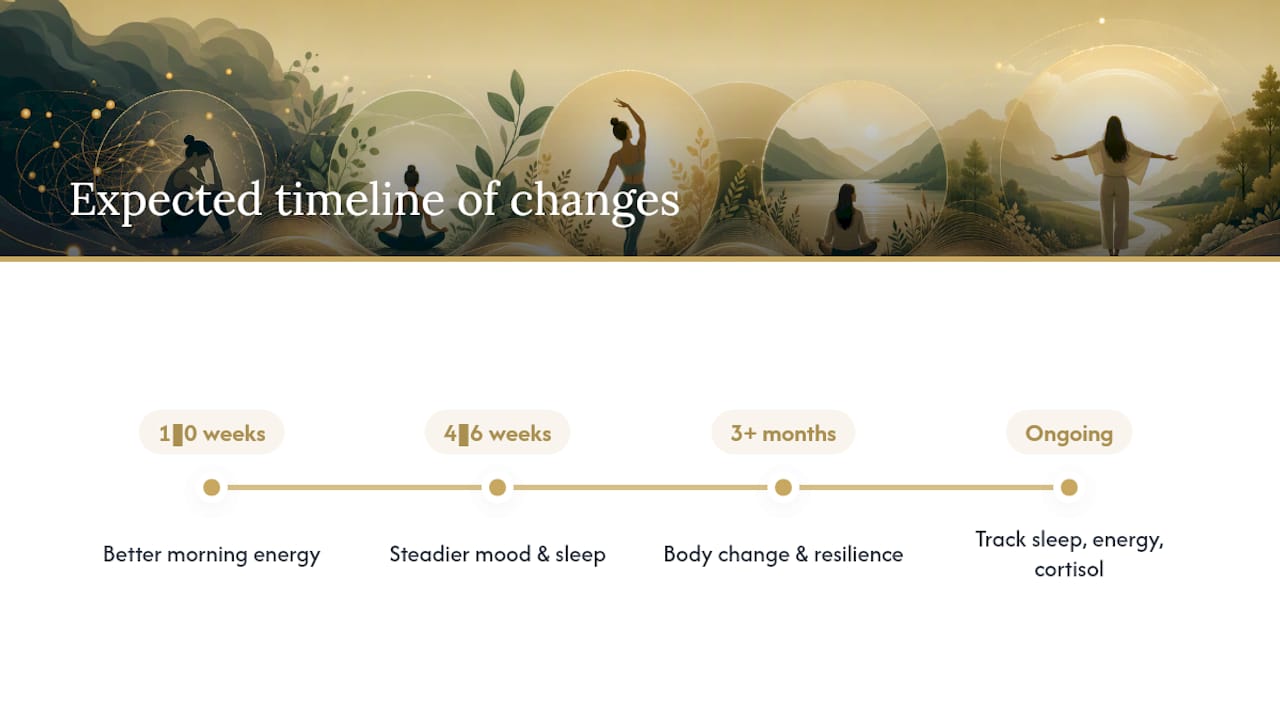
Expect subjective changes, better morning energy, less afternoon crash, within 1 to 2 weeks of consistent sleep and breathing practice. That’s usually the nervous system responding faster than any biomarker moves.
By 4 to 6 weeks, if you’ve added ashwagandha or another adaptogen alongside a stable routine, you should notice measurable benefits: steadier mood, fewer stress-triggered cravings, more consistent sleep quality. This is also roughly when most adaptogen trials measure their effects.
At 3 months and beyond, deeper changes show up, including body composition shifts and more resilient stress responses to actual triggers, not just quieter days. Track your progress with a simple sleep log, a daily 1 to 10 energy rating, and, if a clinician recommends it, periodic salivary cortisol sampling to confirm what you’re already feeling.
Beyond Breathing: Mindfulness and Cognitive Strategies That Work
Breathing calms your body in the moment, but the thoughts that keep triggering stress responses need their own intervention. Cognitive behavioral strategies, specifically identifying the automatic thoughts that precede a stress spike and testing whether they’re actually true, address the trigger rather than just the symptom.
A simple version you can do without a therapist: when you notice tension rising, write down the thought behind it, ask whether you’d believe it if a friend said it, and write a more accurate version. This sounds almost too simple, but it interrupts the rumination loop that keeps cortisol elevated long after the original stressor has passed.
Structured mindfulness meditation, 10 to 20 minutes daily using a body scan or loving-kindness format, builds on this by training attention away from threat-scanning altogether. The research on mindfulness and health outcomes supports both approaches as reproducible, not just anecdotally helpful.
Journaling before bed, specifically naming three things that went acceptably rather than perfectly that day, works for a similar reason: it counters the negativity bias that keeps your stress response primed. None of these require special training. They require repetition, which is exactly why most people abandon them after a few days and never see the effect build.
Why Who You’re Around Changes Your Cortisol Numbers
Social isolation raises baseline cortisol, and it does so independent of how objectively stressful your life circumstances are. This is one of the more underappreciated ways to reduce cortisol levels, because it doesn’t feel like a health intervention. It feels like just calling a friend.

Chronic loneliness keeps the nervous system in a low-grade vigilant state, essentially treating disconnection itself as a threat signal. Depression and anxiety compound this: both are associated with dysregulated HPA-axis activity, which means the relationship runs in both directions. Elevated cortisol worsens mood, and worsened mood tends to reduce the social contact that would otherwise bring cortisol back down.
The fix isn’t complicated, but it is specific. Surface-level social media interaction doesn’t produce the same effect as in-person or voice-to-voice contact. What matters is contact where you feel actually seen, not just present. If you’re managing a mental health condition alongside chronic stress, that’s also a signal the emotional layer of your stress response, not just the physical habits, needs direct attention, something a purely diet-and-exercise approach tends to miss entirely.
Environmental Noise and Light: The Stressors You Don’t Notice
Cortisol responds to your environment even when nothing about your day changed. Chronic noise exposure, traffic outside your window, an open-plan office, a neighbor’s television through the wall, keeps the nervous system in a low simmer of vigilance whether or not you consciously register the sound.
Light pollution works similarly but through a different channel. Artificial light at night, especially blue-spectrum light from screens and streetlights, suppresses the melatonin release that should be signaling your cortisol curve to drop for the night. The result is a cortisol rhythm that stays elevated later into the evening than it should.
Practical mitigation is straightforward:
- Use blackout curtains or an eye mask if outdoor light reaches your bedroom
- Switch to warm, dim lighting after sunset instead of overhead white light
- Try white noise or earplugs if traffic or neighbor noise disrupts your sleep onset
- Keep screens out of the bedroom, or use night mode starting at least an hour before bed
None of these require major renovation. A $15 pair of blackout curtains often does more for your evening cortisol curve than another supplement will.
The Four-Layer Reason Most Cortisol Advice Falls Short
Most cortisol advice treats stress as a single-layer problem: fix the sleep, fix the diet. Done. Fifteen years of research into biological aging convinced me that’s incomplete. Chronic cortisol elevation is a four-layer problem, and addressing only one layer is why so many people follow every tip in this article and still feel stuck.
The physical layer covers what we’ve walked through: sleep, diet, exercise, cellular and mitochondrial health. The emotional layer is stored trauma and nervous system dysregulation, the reason some people breathe perfectly and meditate daily yet stay wired. The spiritual layer is subconscious belief, including the belief that aging and stress are simply things that happen to you rather than processes you can direct. The energetic layer involves the body’s bioelectric field and meridian systems, rarely addressed by conventional stress protocols at all.
TIMELESS is built to work all four simultaneously, which is why I built it after my own TruAge DNA methylation testing confirmed a biological age of 23 at a chronological 41. The TIMELESS book at $29.99 is the self-directed entry point. If your stress pattern feels rooted in something deeper than habits, the free guide is a lower-commitment starting place before considering the full coaching program.
— E. Christian Trejo
A Faster Path Than Guessing Alone
Everything in this guide works, but doing it alone means guessing which layer is actually driving your cortisol and hoping you picked right. Timeless - Reverse Your Age was built specifically to remove that guesswork by addressing all four layers, physical, emotional, spiritual, and energetic at once, instead of asking you to stack a dozen disconnected habits and hope they add up.

For readers who want the complete framework in book form, the TIMELESS book lays out the full 370-page protocol for $29.99. If your stress and aging markers feel more entrenched, the TIMELESS Vitality Intensive is an 8-week, 1-on-1 coaching program at $7,000, backed by a DNA-verified guarantee: 10 years of biological age reversal in 6 months, confirmed by TruAge methylation testing, or you get a full refund. No other longevity program stakes that kind of accountability on your results. If you want to talk through which option fits before committing, book a free diagnosis call and we’ll walk through your specific case together.
This article is general information, not a substitute for advice from a qualified doctor. Consult a qualified healthcare professional about your own circumstances before acting on anything here.
Sources
- Cortisol — Cleveland Clinic
- Ways to lower cortisol — Healthline
- Clinical overview of cortisol regulation — NCBI Bookshelf
FAQ
Is ashwagandha good for lowering cortisol?
Yes, moderate evidence from randomized trials shows ashwagandha can reduce cortisol in some people, but it works best alongside sleep and stress management, not as a replacement for them.
How can I measure my cortisol level at home?
At-home saliva test kits exist and measure cortisol at specific times of day, but they capture single snapshots of a hormone that fluctuates constantly, so results are best interpreted with a clinician rather than alone.
Which vitamins help reduce cortisol?
Magnesium and omega-3 fatty acids have the most consistent supporting evidence, both acting as cofactors and modulators in the stress response rather than direct cortisol blockers.
What is the best way to lower cortisol naturally?
There’s no single best method. Consistent sleep, diaphragmatic breathing, and stable blood sugar form the foundation, and for people whose stress feels rooted in deeper patterns, an integrated approach like the TIMELESS four-layer protocol addresses physical, emotional, spiritual, and energetic drivers together.
How long does it take to see results from natural cortisol reduction?
Most people notice subjective improvements like better sleep and energy within 1 to 2 weeks, with adaptogens and routine changes showing measurable benefits by 4 to 6 weeks and deeper metabolic shifts appearing after 3 months.