
How Burnout Affects DNA Methylation and Biological Age
Discover how burnout uniquely impacts DNA methylation and influences biological age, revealing insights for health interventions and resilience.
How Burnout Affects DNA Methylation and Biological Age
Burnout is associated with gene-specific DNA methylation changes, not a uniform genome-wide shift, and those changes track directly with symptom severity. A 2026 comprehensive review confirms altered methylation in three stress-responsive genes across human cohorts: BDNF, NR3C1, and SLC6A4. The evidence is real, replicable, and relevant to anyone tracking biological age.
Bottom-line verdict:
- BDNF promoter hypermethylation correlates with lower serum BDNF protein and greater burnout severity
- NR3C1 methylation shifts with HPA-axis dysregulation and cortisone levels
- SLC6A4 methylation moderates the job stress-to-burnout pathway
- Evidence comes from human cohorts and small intervention studies; directions vary by gene, CpG site, and tissue
- Methylation is plastic. Targeted interventions can shift these marks
Key Takeaways
Burnout drives gene-specific DNA methylation changes in BDNF, NR3C1, and SLC6A4 that track with symptom severity, but epigenetic clocks do not yet reliably capture these localized shifts.
| Point | Details |
|---|---|
| Gene-specific changes confirmed | Human studies show methylation shifts in BDNF, NR3C1, and SLC6A4 that correlate with burnout severity. |
| SLC6A4 variance explained | Work stress and burnout together explained 43% of SLC6A4 methylation variance in a nurse cohort. |
| Clocks show mixed results | A 2025 cohort of 296 individuals found no mediation by GrimAge, PhenoAge, or Skin&Blood clocks between work stress and burnout. |
| Methylation is reversible | Intervention studies show MBI score improvements correlate with methylation shifts at stress-responsive loci. |
| Timeless - Reverse Your Age | The TIMELESS four-layer protocol addresses all biological mechanisms linked to burnout-driven methylation changes, verified by TruAge testing. |
Table of Contents
- How does burnout affect DNA methylation? The human gene-level evidence
- What biological pathways connect chronic stress to methylation changes?
- How is DNA methylation measured, and what limits the conclusions?
- Do burnout-related methylation changes accelerate biological aging?
- Can burnout-related methylation changes be reversed?
- What should you do now if you are worried about burnout and biological age?
- Why this matters more than most longevity researchers admit
- Verified programs for readers who want measurable reversal
- Sources
- FAQ
How does burnout affect DNA methylation? The human gene-level evidence
The clearest human data centers on three genes. A cross-sectional study of 59 burnout patients and 70 controls found CpG-specific methylation differences in both NR3C1 and SLC6A4. One SLC6A4 CpG moderated the job stress-to-burnout association, and average NR3C1 methylation was negatively associated with cortisone, linking epigenetic marks directly to HPA-axis output.
A separate observational study found increased methylation at BDNF promoter regions in burnout subjects, with that hypermethylation correlating with burnout severity scores and negatively with serum BDNF protein. Lower BDNF protein means reduced neurotrophic support, which maps onto the cognitive and emotional symptoms burnout patients report.
A field study of shift-working nurses adds an occupational angle: nurses in high-stress environments showed substantially lower methylation at certain SLC6A4 CpGs compared to low-stress peers, and a multifactor model including burnout and work stress explained a significant portion of methylation variance in that cohort.
Why do studies sometimes report opposite methylation directions? CpG sites within the same gene can respond differently. Tissue type matters too: blood-derived methylation reflects peripheral immune cells, not neurons. Cell-type composition shifts under chronic stress, which can mimic or mask true methylation changes if not statistically adjusted.
What biological pathways connect chronic stress to methylation changes?
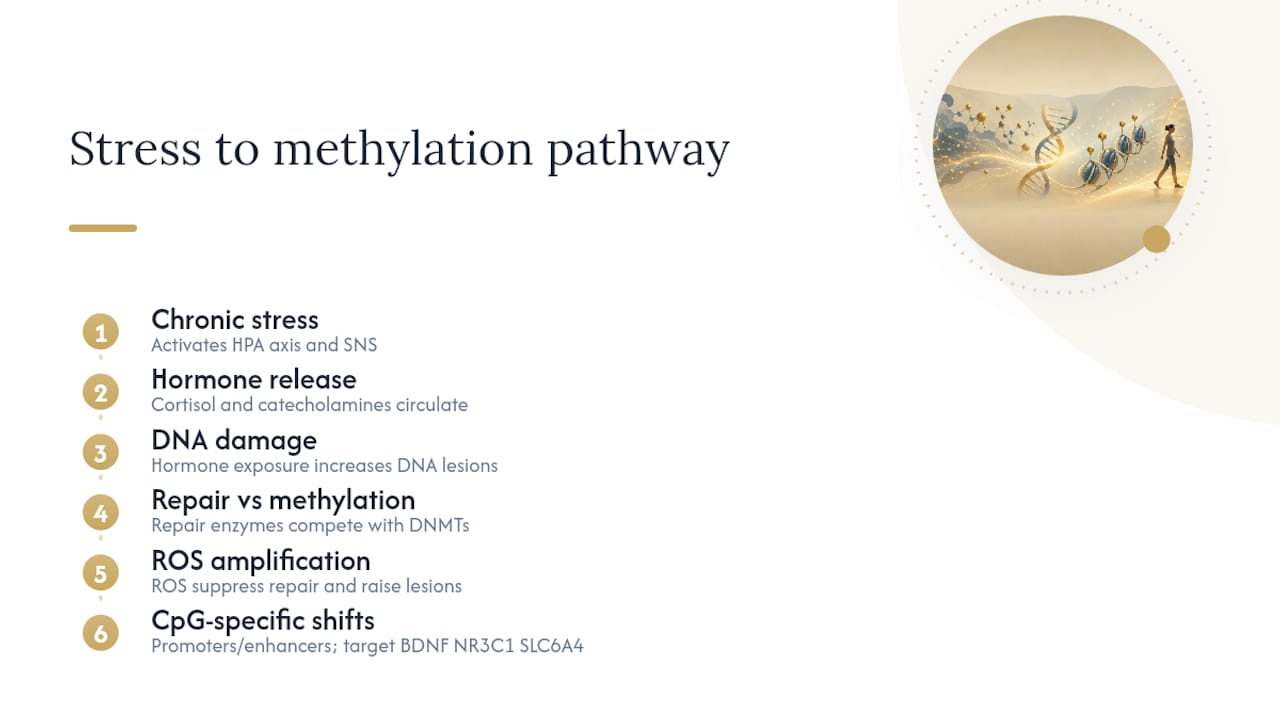
Chronic stress activates the HPA axis and the sympathetic nervous system, producing cortisol and catecholamines that reach every cell in the body. In vitro research shows that even short-term exposure to physiological concentrations of cortisol or norepinephrine produces multi-fold increases in DNA damage in cultured cells, and blocking glucocorticoid or beta-adrenergic receptors prevents the effect.
That DNA damage matters because repair enzymes and DNA methyltransferases compete for access to the same genomic regions. When repair is overwhelmed, methylation patterns at key regulatory CpGs can shift. A review of psychological stress and oxidative DNA damage describes a compounding mechanism: elevated reactive oxygen species (ROS) suppress DNA repair while simultaneously increasing lesions, creating a “double-whammy” that raises the probability of methylation errors becoming fixed.
Noncoding RNAs add another regulatory layer. miRNAs and lncRNAs respond to stress and can modulate glucocorticoid receptor expression and local epigenetic states in a tissue- and time-specific way. Sex-specific differences in these ncRNA responses partly explain why burnout studies report different methylation directions in male and female cohorts.
Pro Tip: Methylation shifts from burnout are almost always CpG- and region-specific, concentrated in gene promoters and enhancers. A global methylation assay will miss them. Targeted profiling of BDNF, NR3C1, and SLC6A4 promoter CpGs gives far more signal than a broad methylation percentage.
How is DNA methylation measured, and what limits the conclusions?
Measurement choices shape findings as much as biology does. Blood and saliva are the practical options for human research, but both are proxies for what is happening in the brain or adrenal tissue where stress biology is most active.
Key caveats every reader should understand:
- Cell-type composition: Chronic stress shifts the ratio of immune cell subtypes in blood. Without statistical adjustment, apparent methylation changes may reflect cell-type shifts rather than true epigenetic reprogramming.
- Platform differences: The Illumina EPIC array covers over 850,000 CpG sites genome-wide; targeted bisulfite sequencing or pyrosequencing focuses on specific loci with higher precision. Results from these platforms are not always directly comparable.
- Cross-sectional vs. longitudinal: Most burnout methylation studies are cross-sectional. They show association, not causation. Longitudinal sampling before and after burnout onset is rare and methodologically demanding.
- Sample size: The largest studies in this space involve fewer than 200 participants. Effect sizes should be interpreted with that in mind.
Consumer DNA methylation tests can estimate biological age, but they cannot diagnose burnout-related methylation changes at specific loci. A single-timepoint clock score tells you where you are, not what caused it. For readers considering DNA methylation testing to verify age reversal, the meaningful measure is pre/post change on a standardized protocol, with cell-composition adjustment reported.
Do burnout-related methylation changes accelerate biological aging?
The honest answer is: not clearly, at least not through epigenetic clocks. A 2025 longitudinal cohort analysis of 296 employed individuals found that Skin&Blood, PhenoAge, and GrimAge clock measures did not mediate the relationship between work stress, hair glucocorticoids, and burnout symptoms. The clocks were not significantly associated with work stress or burnout in that sample.
This null finding does not mean burnout is harmless to biological age. It means current clocks may not capture the localized, gene-level methylation changes most relevant to stress pathways. First-generation clocks like Horvath’s were trained on chronological age prediction; second-generation clocks like GrimAge were trained on mortality risk. Neither was designed to detect the promoter-level CpG shifts in BDNF or NR3C1 that burnout studies consistently report.
The practical implication: clock scores are useful population-level tools, but they can miss biologically meaningful changes in stress-responsive genes. Targeted CpG profiling alongside a clock gives a more complete picture for anyone managing epigenetic aging from childhood or chronic stress.
Can burnout-related methylation changes be reversed?
Methylation is plastic. Small human and animal studies show that targeted interventions can shift both symptom scores and methylation at stress-responsive loci. Here is what the intervention evidence looks like:
- Acupuncture: A small study of 11 burnout patients reported significant improvements in Maslach Burnout Inventory (MBI) scores alongside CpG methylation changes in genes tied to dopaminergic signaling and steroid synthesis after treatment.
- Acute stress protocols: A 2025 within-subjects lab study found both hyper- and hypomethylation at specific CpGs in salivary DNA within 90 minutes of an acute stressor, with psychological stress reactivity (not cortisol) predicting post-stress methylation changes. Rapid dynamics mean rapid reversibility is plausible.
- Therapeutic programs: Studies using validated burnout measures show that programs improving MBI scores correlate with methylation shifts at stress-responsive loci, though causality requires longitudinal confirmation.
Pro Tip: Before/after methylation profiling is the only way to verify that an intervention actually changed your epigenetic marks, not just your symptom score. Use the same assay platform at both timepoints and request cell-composition adjustment in the analysis.
The TIMELESS four-layer protocol maps directly onto these biological mechanisms. The Physical layer targets cellular, epigenetic, and mitochondrial repair. The Emotional layer addresses nervous system dysregulation and stored trauma, which are primary drivers of HPA-axis overactivation. The Spiritual layer works on identity and subconscious beliefs about aging. The Energetic layer addresses the bioelectric field and meridian system. Aging is a four-layer problem. Most protocols address one. TIMELESS addresses all four simultaneously, with outcomes verified by TruAge DNA methylation testing.

What should you do now if you are worried about burnout and biological age?
Prioritize these steps in order:
- Get a clinical burnout assessment. Use a validated instrument like the MBI or the Oldenburg Burnout Inventory with a clinician. Self-diagnosis misses severity gradations that matter for treatment planning.
- Measure validated biomarkers. Hair cortisol, salivary cortisol awakening response, and inflammatory markers (CRP, IL-6) give objective HPA-axis data before you invest in methylation testing.
- Consider targeted DNAm testing as part of a structured protocol. A single consumer clock score has limited diagnostic value. Pre/post testing on a standardized intervention, with cell-composition adjustment, is where the signal lives. Review how to reduce cellular aging markers for a practical framework.
- Commit to interventions that improve MBI scores. The intervention evidence links symptom improvement to methylation shifts. Cognitive behavioral therapy, structured sleep, HPA-regulating exercise, and nervous system regulation practices all have supporting data.
- Seek professional guidance if symptoms are severe. Burnout at clinical severity warrants medical evaluation, not just a wellness protocol.
Why this matters more than most longevity researchers admit
The burnout-methylation research is still young, and most longevity protocols ignore it entirely. That is a mistake. My TruAge DNA methylation test confirmed a biological age of 23 at chronological age 41. That result did not come from optimizing one variable. It came from addressing all four layers of aging simultaneously, including the Emotional layer where burnout lives.
Gene-specific methylation changes in BDNF, NR3C1, and SLC6A4 are not abstract. They represent suppressed neuroplasticity, dysregulated stress response, and altered serotonin signaling. Treating only the Physical layer while ignoring nervous system dysregulation leaves the HPA axis chronically overactivated, which means the epigenetic marks keep accumulating. Durable reversal requires all four layers working together.
Methylation is not destiny. The plasticity data is clear. What you need is a protocol precise enough to measure the change and structured enough to produce it.
Verified programs for readers who want measurable reversal
The TIMELESS book and coaching program were built specifically for what this research describes: a multi-layer biological problem that requires a verified, structured solution.

The Timeless: Reverse Your Age book ($29.99) gives you the complete 370-page four-layer blueprint, including the epigenetic and HPA-axis protocols grounded in the same science covered here. For readers who want personalized guidance with a DNA-verified outcome, the TIMELESS Vitality Intensive is an 8-week private coaching program backed by a guarantee: reverse your biological age by at least 10 years in 6 months, confirmed by TruAge DNA methylation testing, or receive a full refund. No other longevity program offers that accountability. Book a free Vitality Diagnosis call to find out if you qualify.
Sources
- Genetic and Epigenetic Factors Associated with Burnout Syndrome: A Comprehensive Review
- Epigenetic regulation of the HPA axis in burnout (Journal of Affective Disorders)
- BDNF methylation and burnout (Nature Psychiatry / Translational Psychiatry article)
- Induction of DNA damage, alteration of DNA repair and transcriptional activation by stress hormones
- Psychological stress, oxidative DNA damage, and impaired DNA repair mechanisms (review)
- Work stress and SLC6A4 promoter methylation in nurses (PLOS One, 2012)
- Work-related stress and burnout: Is epigenetic aging the missing link? | Clinical Epigenetics (2025)
This article is general information, not a substitute for advice from a qualified doctor. Consult a qualified healthcare professional about your own circumstances before acting on anything here.
FAQ
Does burnout permanently change your DNA methylation?
No. Methylation is plastic. Intervention studies show that targeted therapies correlating with improved burnout scores also produce measurable methylation shifts at stress-responsive loci, suggesting these changes are reversible with structured protocols.
Which genes are most consistently affected by burnout-related methylation changes?
BDNF, NR3C1, and SLC6A4 show the most replicated findings across human cohort studies, with methylation changes at specific CpG sites in their promoter regions correlating with burnout severity and HPA-axis markers.
Can an epigenetic clock test tell you if burnout has aged you?
Current clocks like GrimAge, PhenoAge, and Skin&Blood did not mediate the burnout-stress relationship in a 2025 cohort of 296 individuals. Targeted CpG profiling at stress-responsive gene promoters provides more relevant signal than a single clock score.
How quickly can DNA methylation change under stress?
A 2025 lab study found both hyper- and hypomethylation at specific CpGs in salivary DNA within 90 minutes of an acute stressor, with psychological stress reactivity predicting the direction and magnitude of change.
What is the most evidence-aligned first step for someone with burnout?
Start with a validated clinical burnout assessment (MBI or Oldenburg Burnout Inventory) and objective HPA-axis biomarkers before investing in methylation testing. Symptom-level improvement through structured intervention is the most reliable path to measurable epigenetic change.