
How Alcohol Affects Biological Age: A DNA-Clock Guide
Discover how alcohol affects biological age with DNA clocks. Learn key insights from studies and take actionable steps to reverse aging.
How Alcohol Affects Biological Age: A DNA-Clock Guide
Regular alcohol intake accelerates biological age as measured by DNA-methylation clocks, and GrimAge V2 is the most sensitive tool to detect it. A Framingham-based study found that each additional standard drink per day links to roughly a 0.43-year increase in GrimAge acceleration and a 0.71-year increase in PhenoAge acceleration in middle-aged adults. That is not a rounding error. That is measurable, documented biological aging you can track and reverse. Your immediate next step: get a baseline TruAge DNA methylation test, then make a measured, medically guided reduction in your intake. Everything else in this guide builds from that starting point.
Key facts before you read on:
- GrimAge and GrimAge V2 show stronger associations with alcohol use than older clocks like Horvath or Hannum
- The National Institute on Aging recommends men limit to moderate levels and women to lower levels, with even lower recommended limits for adults over 40
- The TIMELESS four-layer protocol, verified by TruAge testing, is a program that aims to achieve significant biological-age reversal within 6 months with a satisfaction guarantee
Table of Contents
- How alcohol drives biological aging through measurable pathways
- What DNA-methylation clocks reveal about alcohol’s aging effect
- How dose, pattern, and personal factors change your risk
- How to measure alcohol’s effect on your own biological age
- Evidence-based steps to reduce alcohol’s impact, mapped to the TIMELESS protocol
- Safety guidance: when to get medical help before changing your drinking
- Key Takeaways
- Why the four-layer lens changes everything about alcohol and aging
- What Timeless - Reverse Your Age offers readers ready to act
- Useful sources
- FAQ
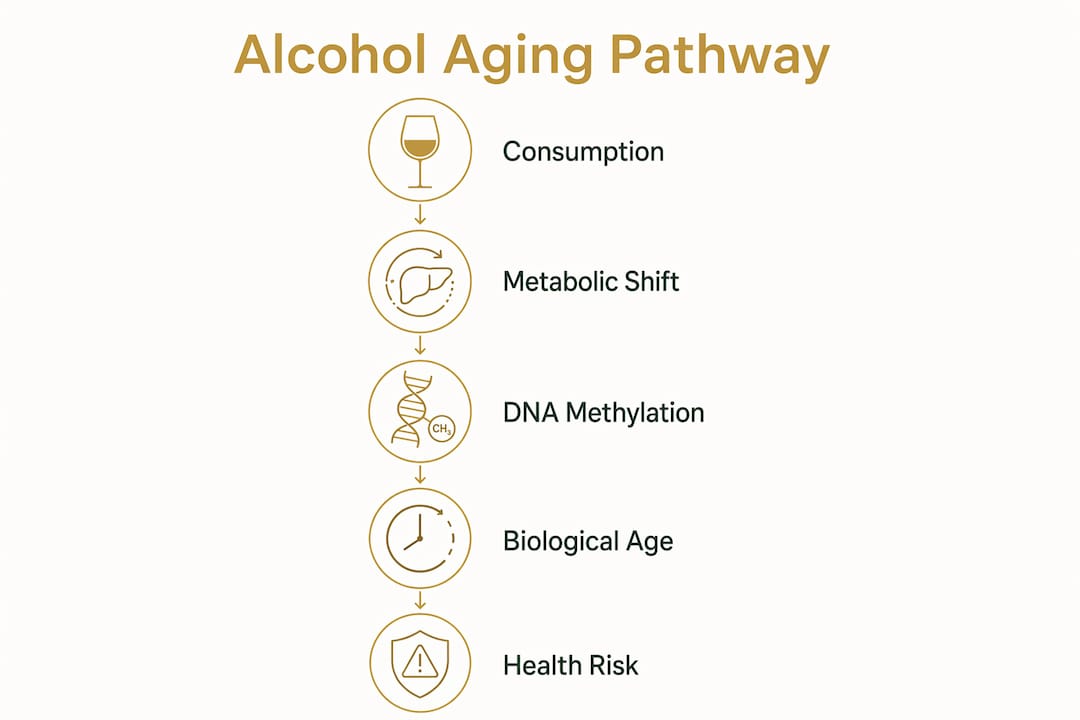
How alcohol drives biological aging through measurable pathways
Alcohol accelerates aging through several routes you can measure in a lab. Understanding them tells you exactly which biomarkers to watch.
The core mechanisms:
- Oxidative stress and acetaldehyde toxicity: When your liver metabolizes ethanol, it produces acetaldehyde, a reactive compound that depletes glutathione, generates reactive oxygen species, and damages mitochondria and DNA
- Chronic inflammation: Alcohol elevates C-reactive protein (CRP) and GDF-15, a plasma protein surrogate captured directly by GrimAge V2’s clock components
- Telomere attrition: Mendelian randomization analyses link genetically predicted alcohol use disorder to shorter telomere length, a direct marker of cellular aging
- Immune dysregulation: Persistent alcohol exposure shifts immune signaling toward a pro-inflammatory state, accelerating the same pathways that drive age-related disease
- Nervous-system stress rebound: Using alcohol to decompress produces a cortisol rebound that compounds metabolic stress across the Physical and Emotional layers of aging
After 40, the pharmacokinetics shift against you. NIAAA documents that reduced muscle mass and total body water mean the same number of drinks produces a higher blood alcohol concentration than it did at 30. Greater effective dose, greater biological stress, faster clock acceleration.
What DNA-methylation clocks reveal about alcohol’s aging effect
GrimAge V2 is the clock to use if you want to detect alcohol-related biological aging. It incorporates DNAm surrogates for plasma proteins, including GDF-15, that are directly tied to alcohol metabolism pathways. Older clocks like Horvath and Hannum were built primarily to track chronological age and show weaker, less consistent associations with lifestyle stressors like alcohol.

| Clock | Sensitivity to alcohol | Best use case | Timeline to detect change | Primary signals captured |
|---|---|---|---|---|
| GrimAge V2 | Highest | Lifestyle-impact tracking, chronic use | 3–6 months | GDF-15, plasma proteins, mortality risk |
| GrimAge (original) | High | Mortality prediction, chronic exposure | 3–6 months | Plasma protein surrogates, smoking |
| PhenoAge | Moderate | Clinical biomarker composite | 6+ months | Blood chemistry composites |
| Horvath | Low | Developmental/tissue aging | — | Pan-tissue methylation |
| Hannum | Low | Blood-based chronological tracking | — | Blood cell methylation |
A study of 2,316 women found that lifetime average alcohol consumption had the strongest link to GrimAgeAccel, stronger than recent use alone. That matters for interpretation: a single recent-use report understates cumulative damage. A large UK Biobank analysis confirmed positive associations between alcohol consumption and both AgeAccelGrim and AgeAccelPheno across more than 8,000 individuals.
Pro Tip: A shift of 0.3–1 year on a single GrimAge retest is within measurement noise. Look for directional consistency across two retests, not a single data point. A 1.5-year or greater shift in the same direction across two tests is a meaningful signal.
How dose, pattern, and personal factors change your risk
Total ethanol volume is the dominant driver of methylation-age acceleration. Beverage type matters far less than total load. Public health reviewers now confirm that the old “wine is cardioprotective” narrative collapses when socioeconomic confounders are properly controlled.
Risk gradient by pattern (directional, not exact):
- Non-drinker: Baseline GrimAge/PhenoAge trajectory
- Light/moderate (within NIA limits): Modest acceleration; individual variation is high
- Binge drinking (5+ drinks for men, 4+ for women per occasion): Consistent association with higher all-cause mortality and measurable GrimAge acceleration
- Chronic heavy use: Strongest GrimAge/PhenoAge acceleration and telomere shortening; Mendelian randomization data link higher consumption to shorter lifespan, approximately 1.09 fewer years per logged drinks per week in European cohorts
Individual modifiers that amplify risk:
- Age over 40 (higher effective BAC per drink)
- Female sex (greater sensitivity per unit of ethanol)
- Lower muscle mass and body water
- ADH1B genetic variants affecting acetaldehyde clearance
- Medications that interact with alcohol (sedatives, anticoagulants, metformin)
Pro Tip: Log every drink for 30 days using standard-drink definitions (14g of pure ethanol = 1 standard drink). Calculate your weekly dose in standard drinks. This number is the input you correlate against your methylation-test results.
How to measure alcohol’s effect on your own biological age
Use a baseline TruAge DNA methylation test with a controlled drinking log, then retest at 3 and 6 months. That cadence balances biological plausibility with measurement noise and is the same one used in TIMELESS coaching.
Step-by-step measurement setup:
- Prepare your baseline: Fast for 4 hours before blood draw; note all medications and supplements; record your 30-day average drink log
- Choose GrimAge V2 as your primary clock for alcohol-related tracking; request PhenoAge as a secondary composite
- Log drinks daily for the full 30–90 days between tests using standard-drink units
- Control confounders: Keep sleep, weight, and exercise consistent; note any infections or major stressors during the window
- Retest at 3 months for directionality; retest at 6 months for magnitude confirmation
| Timepoint | What to expect | Confounders to watch |
|---|---|---|
| Baseline | Reference methylation age | Medications, recent illness, smoking |
| 3 months | Directional signal (improvement or worsening) | Sleep disruption, weight change |
| 6 months | Magnitude confirmation; meaningful reversal detectable | Sustained behavior change required |
Learn more about DNA methylation testing cadence and how TruAge verifies biological-age reversal.
Evidence-based steps to reduce alcohol’s impact, mapped to the TIMELESS protocol
Reducing alcohol intake lowers biological-age acceleration. Pairing that reduction with the TIMELESS four-layer protocol makes the gains durable and measurable by DNA testing. Addressing only the physical layer is why most programs fail to hold results.
Immediate actions:
- Log current intake and set a specific weekly reduction target
- Replace evening alcohol rituals with non-alcoholic alternatives that serve the same decompression function
- Add sleep architecture support since alcohol fragments deep sleep and compounds methylation-age acceleration
| Step | TIMELESS Layer | Goal |
|---|---|---|
| Reduce intake, support liver detox pathways | Physical | Lower CRP, GDF-15, oxidative stress markers |
| Address nervous-system dysregulation driving drinking | Emotional | Break the stress-alcohol-rebound cycle |
| Rewrite identity beliefs about aging and alcohol | Spiritual | Sustain behavior change at the subconscious level |
| Breath and biofield practices for stress regulation | Energetic | Reduce cortisol rebound without alcohol |
The four-layer longevity protocol explains why each layer is non-negotiable. Aging is a four-layer problem. Most protocols address one.
Pro Tip: Pair your measurement cadence with community accountability. Behavioral anchors and social accountability are among the strongest predictors of sustained alcohol reduction.
Safety guidance: when to get medical help before changing your drinking
Do not stop alcohol abruptly if you drink heavily every day. Withdrawal from alcohol dependence can cause seizures and life-threatening autonomic instability. This is not a protocol you manage alone.
Seek medical evaluation before changing your pattern if you:
- Drink 4 or more drinks daily (men) or 3 or more daily (women) on most days
- Have experienced prior withdrawal symptoms (shaking, sweating, anxiety upon stopping)
- Have liver disease, cardiovascular conditions, or psychiatric diagnoses
- Take sedatives, opioids, anticoagulants, or diabetes medications
- Are pregnant or planning pregnancy
NIAAA guidance specifically flags older adults as higher-risk for medication interactions and fall-related injuries. Light-to-moderate drinkers can typically taper with primary-care guidance. Heavy drinkers need supervised medical detox first.
Key Takeaways
Regular alcohol intake measurably accelerates biological age via GrimAge V2 methylation clocks, and the effect is reversible with sustained reduction verified by TruAge retesting.
| Point | Details |
|---|---|
| Alcohol accelerates biological age | Each additional daily drink links to a measurable increase in GrimAge and PhenoAge acceleration metrics indicating accelerated biological aging. |
| GrimAge V2 is the right clock | It captures plasma-protein surrogates tied directly to alcohol pathways, making it more sensitive than Horvath or Hannum. |
| Test, log, retest | Baseline TruAge test plus a 30-day drink log, then retest at 3 and 6 months to confirm directional improvement. |
| Four layers, not one | Physical reduction alone rarely holds; the TIMELESS protocol addresses Emotional, Spiritual, and Energetic drivers simultaneously. |
| Timeless - Reverse Your Age | The only program that guarantees 10 years of biological-age reversal in 6 months, verified by TruAge, or a full refund. |
Why the four-layer lens changes everything about alcohol and aging
Most longevity programs tell you to drink less. That is correct and insufficient. What I have seen across thousands of practitioners in 40 countries is that alcohol reduction without addressing the emotional and energetic drivers behind drinking produces short-term results that collapse within months. The methylation clock does not lie about this. Clients who pair physical reduction with nervous-system work, identity reframing, and energetic regulation show sustained GrimAge improvement at 6 months. Those who only cut drinks often plateau or regress.
My own TruAge result, a biological age of 23 at chronological age 41, was not built on abstinence alone. It was built on addressing all four layers simultaneously. The Physical layer handles the biochemistry. The Emotional layer addresses why alcohol became a coping tool in the first place. The Spiritual layer rewrites the subconscious belief that you need alcohol to relax or socialize. The Energetic layer gives your nervous system a real alternative. When clients reduce alcohol and work all four layers, the methylation data reflects it. That is the difference between a temporary number and a permanent biological shift.
What Timeless - Reverse Your Age offers readers ready to act
You now have the evidence. The question is whether you measure it and do something with it.
Timeless - Reverse Your Age is built for exactly this moment. The TIMELESS Vitality Intensive is an 8-week private coaching program that includes a baseline TruAge DNA methylation test, a personalized four-layer plan, and a private community and guided practices. The guarantee is specific: 10 years of biological-age reversal in 6 months, verified by TruAge, or every dollar is refunded. No other longevity program in the world offers that level of accountability. For readers who prefer to start with the full science, the TIMELESS book is a 370-page blueprint for $29.99. For those ready for personalized guidance, book a free Vitality Diagnosis call to find out if the coaching program is the right fit.
Useful sources
The claims in this guide draw from peer-reviewed epigenetic research, NIAAA and NIA clinical guidance, and TruAge-verified program data.
| Source | Type | Primary use in this guide |
|---|---|---|
| Framingham-based study | Peer-reviewed | Per-drink GrimAge/PhenoAge acceleration figures |
| PMC — Causality-enriched clocks | Peer-reviewed | GrimAge V2 sensitivity and clock comparison |
| PMC — Women’s cohort, lifetime use | Peer-reviewed | Lifetime vs. recent use and GrimAgeAccel |
| PMC — UK Biobank biological aging | Peer-reviewed | Large-scale GrimAge/PhenoAge associations |
| Molecular Psychiatry — Telomere MR | Peer-reviewed | AUD and telomere shortening (causal analysis) |
| Scientific Reports — Lifespan MR | Peer-reviewed | Alcohol and lifespan reduction |
| NIAAA — Aging and alcohol | Clinical guidance | Age-related pharmacokinetics, safety |
| National Institute on Aging | Clinical guidance | Dosing limits, medication interactions |
| NCBI — All-cause mortality review | Systematic review | Binge drinking and mortality evidence |
| Timeless blog — DNA methylation testing | Program evidence | Testing cadence and TruAge verification |
FAQ
Does alcohol always increase biological age?
Regular and heavy alcohol use consistently associates with accelerated GrimAge and PhenoAge scores. Light drinking without binge episodes shows a weaker and less consistent signal, though total ethanol load remains the primary driver.
Which DNA methylation clock best detects alcohol-related aging?
GrimAge V2 is the most sensitive clock for detecting alcohol-related biological aging because it incorporates plasma-protein surrogates, including GDF-15, that are directly tied to alcohol metabolism pathways.
How long does it take to see methylation-age improvement after reducing alcohol?
Directional improvement can appear at 3 months; meaningful magnitude confirmation typically requires a 6-month retest, which is the cadence used in the TIMELESS Vitality Intensive.
Is it safe to stop drinking abruptly?
Not if you drink heavily every day. Abrupt cessation in dependent drinkers can cause seizures and life-threatening withdrawal. Seek medical supervision before stopping; call SAMHSA at 1-800-662-4357 for immediate referral.
Can the TIMELESS protocol reverse alcohol-related biological aging?
The TIMELESS Vitality Intensive addresses all four layers driving alcohol-related aging and guarantees at least 10 years of biological-age reversal in 6 months, verified by TruAge DNA methylation testing, or a full refund.
This article is general information, not medical advice. Confirm any changes to your alcohol intake or health protocol with a qualified physician, particularly if you have a history of heavy drinking, withdrawal symptoms, or medical conditions.