
DNA Methylation Age Tests: Read the Clocks, Act on All 4 Layers
See what DNA methylation age and pace clocks reveal, how to track change without overreading one result, and how TIMELESS acts on all four aging layers.
DNA Methylation Age Tests: Read the Clocks, Act on All 4 Layers
A DNA methylation biological age test reports an estimated epigenetic age, and often a pace-of-aging score, that compares your cellular wear against your calendar age. Treat that first number as a baseline, not a verdict. The real value comes from retesting over time and pairing your results with an intervention plan that works on more than one layer of aging at once.
TL;DR:
- Use DunedinPACE or a comparable pace clock for feedback, retesting after three to six months; broader age clocks need six to twelve months.
- Keep the same clock and provider for your baseline and retests, because switching systems can mimic progress; move to annual testing after two or three results establish a trend.
- Log illness, sleep, travel, stress, exercise, and medication changes with each sample, since these factors can temporarily shift methylation results.
- Generation 2+ clocks, including DunedinPACE and GrimAge family measures, responded consistently in intervention research, but a single result is not a medical diagnosis.
- Choose measurable actions across physical, emotional, spiritual, and energetic factors rather than relying on one fix, then compare them with your next test.
Table of Contents
- What your methylation report actually shows you
- Which clocks actually matter for tracking your progress
- Single readings versus real change: filtering out the noise
- Turning your results into a four-layer action plan
- What the research actually says about clock responsiveness
- Your testing schedule, mapped out
- Why we built TIMELESS around DNA-verified outcomes
- Start with the book or go deeper with coaching
- FAQ
- Sources
What your methylation report actually shows you
Your report centers on a handful of core outputs, and knowing what each one measures changes how you read the whole document. The biological age estimate is a composite number derived from methylation patterns at specific sites across your genome. Age acceleration (or deceleration) tells you whether that number sits above or below your chronological age. Pace-of-aging metrics go further: instead of a snapshot, they estimate how fast you are currently aging, year over year.
Consumer-style reports increasingly draw on named clocks rather than one generic score. You may see references to PCGrimAge or GrimAge, built to predict mortality risk and lifestyle exposures, OMICmAge, which blends multiple molecular layers to separate real aging signal from transient inflammation, and DunedinPACE, built specifically to track the speed of biological change rather than a single-point age estimate.
Some reports also break results into organ or system-level scores.
- A single low organ score is worth noting but not panicking over.
- A pattern across two or three systems deserves real attention.
- Multi-omic scores like OMICmAge are more useful than single-clock organ breakdowns when you have access to them.
Which clocks actually matter for tracking your progress
Not every epigenetic clock was built for the same job, and that distinction matters more than most reports explain. First-generation clocks were trained to predict chronological age itself, which makes them decent for a one-time snapshot but poor at detecting whether an intervention worked. Generation 2+ clocks and pace clocks were built differently: they’re trained against mortality, disease, and functional outcomes, which makes them far more sensitive to real biological change.

DunedinPACE has an intraclass correlation above 0.90, meaning repeated measurements on the same person stay remarkably consistent, which is exactly what you want from a tool meant to detect whether your protocol is working rather than just measurement noise.
For coaching and behavior-change tracking, we recommend following reliable generation 2+ clocks and pace clocks over first-generation ones.
- Use DunedinPACE or a comparable pace clock as your primary feedback signal between retests.
- Use GrimAge-family or PCGrimAge scores for a longer-horizon view of risk-adjusted biological age.
- Stick with the same clock and the same testing provider every time you retest, since switching clocks or labs introduces variability that looks like progress or regression but is actually just a different measurement system.
Single readings versus real change: filtering out the noise
A single methylation reading is a snapshot taken under whatever conditions your body happened to be in that week. Illness, poor sleep, travel, acute stress, and even recent intense exercise can all shift methylation patterns temporarily, which means one test can look alarming or encouraging without reflecting your true trajectory at all.
This is why we never ask you to judge a protocol off a single number. A workable minimal testing protocol looks like this:
- Take a baseline test before starting any intervention.
- Retest at three to six months if you’re tracking a pace metric like DunedinPACE, since pace clocks respond faster to behavior change.
- Retest at six to twelve months for broader age-estimate clocks, which move more slowly and need a longer window to show a reliable shift.
Log four things with every test: any illness in the prior month, travel or major schedule disruption, significant stress events, and any medication or supplement changes. This context turns a confusing number into something you can actually interpret.
Pro Tip: Keep a simple note in your phone the day you collect your sample, three lines on sleep, stress, and anything unusual, so you’re not reconstructing it from memory months later.
Turning your results into a four-layer action plan
Here’s where most people go wrong: they see one number and chase one fix. Aging is a four-layer problem, and most protocols only address one. We built TIMELESS to address all four layers simultaneously, because a report flagging accelerated aging rarely has a single-layer cause.
- Physical (cellular, epigenetic, mitochondrial): a report showing accelerated pace alongside poor metabolic markers points here first. Prioritize sleep consistency and a Mediterranean-style dietary pattern, which has been associated with reductions in epigenetic age acceleration across several controlled studies.
- Emotional (stored trauma, nervous system dysregulation): unresolved trauma has a documented relationship with accelerated biological age, and addressing it has shown reversal potential in our own tracking. Nervous system regulation work belongs here, not in a supplement stack.
- Spiritual (identity and subconscious beliefs about aging): what you believe about your own aging timeline shapes behavior in ways that compound. This layer needs identity-level work, not willpower.
- Energetic (bioelectric field, meridians): subtle but real, and often the layer people skip entirely.
Combine small shifts across all four layers rather than hunting for one hack that moves the needle alone.
Pro Tip: Pick three measurable actions, one per layer at minimum, before your next test window opens, so you have something concrete to compare against your retest.
Your first-step checklist: choose three measurable actions, decide whether you’ll follow the book’s blueprint on your own or work with a coach, and set a calendar reminder for your next test date now, not after you forget.
What the research actually says about clock responsiveness
Pooled intervention research gives us a clearer picture than any single study could. A 2026 analysis in Nature Medicine compared responsiveness across sixteen DNAm biomarkers and found that generation 2+ biomarkers, including GrimAgeV2, PCPhenoAge, PCGrimAge, and DunedinPACE, showed consistent, significant decreases across intervention studies, with DunedinPACE showing the largest and most consistent decrease of the group.
That’s the encouraging half. The sobering half comes from a review on epigenetic clocks as personal biomarkers, which found that population-level strength doesn’t automatically translate into individual-level certainty. Reproducibility, tissue specificity, and the lack of a clinical gold standard all complicate reading your single result as a diagnosis.
- Use clock changes as feedback inside a structured program.
- Never treat a single number as a standalone medical diagnosis.
- Weight pace clocks heavier for near-term feedback, age estimates heavier for long-term direction.
Your testing schedule, mapped out
Keep this simple and repeatable:
- Baseline test before you start any intervention.
- Retest at three to six months using a pace metric like DunedinPACE for early feedback.
- Retest at six to twelve months for age-estimate clocks, which need more time to show reliable movement.
- Shift to annual testing once you have two to three data points establishing your trend. Our own guidance on testing frequency walks through this in more detail.
Keep sample conditions as consistent as possible: same provider, same collection window, same general health state. Record sleep quality, any infection, major life events, and medication changes between every test so you can explain a surprising number instead of guessing at it.
Why we built TIMELESS around DNA-verified outcomes
My last TruAge test showed a significant gap between my biological and chronological age. That gap didn’t come from one supplement or one lucky test. It came from working all four layers at once over years, then verifying the result with the same kind of methylation testing we’re asking you to interpret here.
That’s why the Vitality Intensive integrates testing directly into coaching rather than treating it as a separate add-on. A single data point tells you where you stand. A guided, tested program tells you whether what you’re doing is actually working, which is the entire point of retesting in the first place.
— E. Christian Trejo
Start with the book or go deeper with coaching
If you want the complete four-layer framework in one place, our book, TIMELESS: Reverse Your Age, walks through the Physical, Emotional, Spiritual, and Energetic protocols in full, priced at $29.99.
For readers who want hands-on guidance interpreting their own results, the TIMELESS Vitality Intensive is an eight-week private coaching program that pairs TruAge DNA methylation testing with personalized four-layer interventions, priced at $7,000.
- The Vitality Intensive includes a DNA-verified guarantee of biological age reversal in a set timeframe or a refund. This program offers a unique level of scientific accountability in the longevity space.
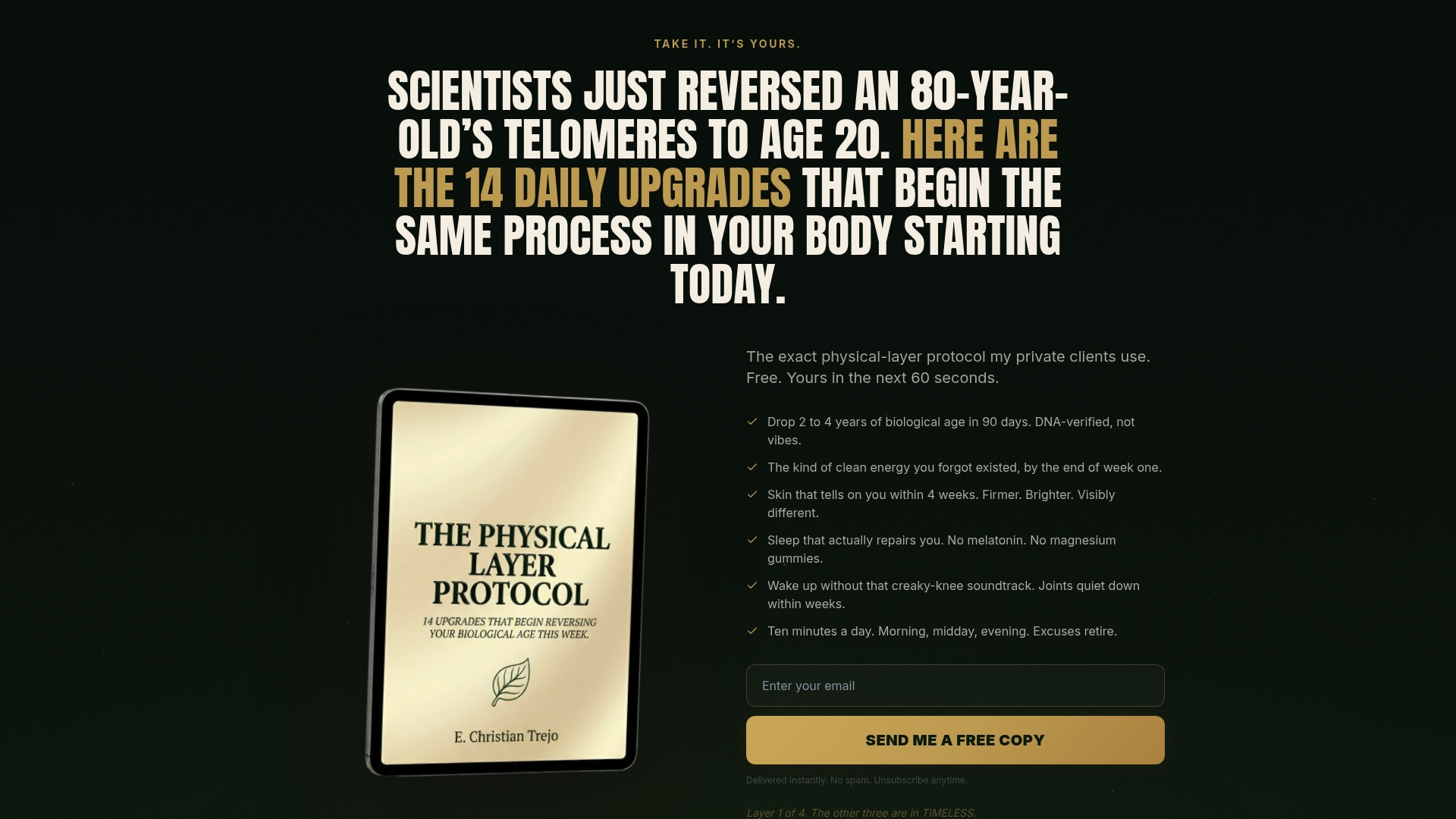
- Not ready for a full program yet? Start with our free guide covering fourteen upgrades you can apply before your next test.
- Want a bigger challenge with real stakes? Our TIMELESS Challenge runs for a $50,000 prize.
FAQ
What does a high biological age score actually mean?
A biological age reading above your chronological age suggests your cells show more accumulated wear than expected for your calendar age, based on methylation patterns tied to mortality and disease risk. It is a signal to act on, not a diagnosis, and it should be confirmed with a retest before you draw firm conclusions.
How often should I retest my DNA methylation age?
Retest pace metrics like DunedinPACE every three to six months and broader age-estimate clocks every six to twelve months, then shift to annual testing once you have an established trend. Keep the same provider and clock each time for comparable results.
Can lifestyle changes actually reverse epigenetic age?
Several controlled studies have linked Mediterranean-style dietary patterns and other nutrition interventions to reductions in epigenetic age acceleration, and pooled research shows generation 2+ clocks respond consistently to longevity protocols. Results vary by individual, which is why we recommend an integrated, multi-layer approach rather than a single lifestyle tweak.
Why does TIMELESS use four layers instead of just diet and exercise?
Most longevity protocols address only the physical layer, cellular, epigenetic, and mitochondrial health, and leave emotional, spiritual, and energetic contributors to aging untouched. We built TIMELESS to work all four layers simultaneously, which is why our Vitality Intensive pairs coaching across all four with DNA-verified testing to confirm the result.
Sources
- DunedinPACE (Moffitt/Caspi / Duke)
- Responsiveness of epigenetic aging biomarkers to longevity interventions in humans | Nature Medicine (2026)
- Population Science to the Clinic? Limits of Epigenetic Clocks as Personal Biomarkers (PMC)
- Examining nutrition strategies to influence DNA methylation and epigenetic clocks: a systematic review (Frontiers, 2024)