
From Weekly to 36 Months: Four Layer Biological Age Test Frequency
Retest biological age by method: wearables weekly; blood panels 3–6 months; epigenetic clocks 12–36 months. Require three tests to confirm a trend.
From Weekly to 36 Months: Four Layer Biological Age Test Frequency
Wearable-derived estimates can be tracked continuously and reviewed weekly. Blood-based biomarker scores need roughly 3 to 12 months between tests to show real change. Epigenetic clocks require 12 to 36 months, depending on which clock you use. In every case, one test is a snapshot; only three or more measurements over time reveal an actual trend, which is why the sample schedules further down this page matter more than any single number you get back.
TL;DR:
- Blood-based biomarker scores can show meaningful change within three to six months, making frequent testing valuable during active health improvements.
- Epigenetic clocks need 12 to 36 months even under optimal conditions, and a minimum of three measurements over time are required to confirm genuine trends.
- Wearable data provides continuous updates, but its readings are better suited for trend tracking rather than precise age estimation, with weekly review being most practical.
- Functional physical tests should be repeated every four to eight weeks since they are inexpensive and closely linked to real-world health outcomes.
- Cost and biological responsiveness influence testing frequency, with cheaper, faster methods providing feedback, and expensive, slower tests serving as confirmation tools.
Table of Contents
- How Often Should You Test Biological Age? It Depends on the Method
- What Are the Recommended Retest Intervals for Each Test Type?
- How Do You Tell Real Change from Measurement Noise?
- Sample Testing Schedules You Can Start This Month
- Why the TIMELESS Protocol Pairs Testing With Four Layers, Not One
- Why Longitudinal Trends Beat a Single Test
- Which Test Type Should You Prioritize First?
- How Much Should Cost Shape Your Testing Frequency?
- Author Perspective: A Scientist’s View on Testing Frequency and Emotional Budgeting
- How to Get Verified, Coached Biological Age Reversal
- Sources
- FAQ
How Often Should You Test Biological Age? It Depends on the Method
The question “biológiai kor teszt gyakoriság,” or biological age test frequency, doesn’t have one answer because “biological age” isn’t one test. It’s a category name for at least four distinct measurement families, each moving at a different biological speed. Treating them the same way is the single most common mistake in this space.
Epigenetic clocks measure chemical tags on your DNA called methylation patterns. These clocks estimate biological age from blood or saliva and are the closest thing this field has to a scientific standard, though no single method is universally recognized as the gold standard. Some clocks, like DunedinPACE, are built to detect the pace of aging over shorter windows and can show meaningful movement in 6 to 12 months. Others, like PhenoAge and GrimAge, are absolute-age estimators. They’re slower to shift and are better suited to confirming change over 18 to 36 months rather than chasing quarterly swings.
Blood-based composite scores combine standard clinical markers (glucose, lipids, inflammatory markers, kidney and liver function panels) into an algorithmic age estimate. These respond faster than epigenetic clocks because the underlying biomarkers, like fasting glucose or CRP, genuinely shift within weeks of a real lifestyle change. That responsiveness is exactly why Superage’s retest guidance puts these panels on a 3 to 6 month cadence for people actively working on their metabolic health.
Wearable-derived estimates (heart rate variability, resting heart rate, sleep architecture, VO2 max proxies) update continuously. They’re the only category where daily or weekly review makes sense, because the underlying sensor data refreshes constantly and costs nothing extra to check. The trade-off is precision. Wearables are excellent at spotting directional trends and terrible at giving you a precise “biological age” number you can bank on.
Functional and physical tests (grip strength, single-leg balance time, sit-to-stand repetitions, walking speed) sit closest to real-world outcomes. Because these are behavioral tests rather than lab assays, you can repeat them every 4 to 8 weeks without the noise problem that plagues frequent blood draws.
A few practical factors shape how often any of this makes sense for you:
- Turnaround time. Wearable data is instant. Blood panels typically return in days. Epigenetic clock results often take 2 to 6 weeks depending on the lab.
- Cost. Functional tests are free. Blood panels run from modest self-pay lab fees to full concierge panels. Epigenetic clocks are the most expensive category, which alone argues for spacing them out.
- Measurement precision. Epigenetic clocks carry real technical variability between samples, even from the same person on the same day. A single result can shift by what looks like “years” purely from lab noise, which is precisely why retesting on a fixed schedule, and reading the trend rather than the number, matters more than the individual score.
- Biological timeframe of change. Metabolic markers move faster than DNA methylation patterns, so expecting an epigenetic clock to reflect a two-month diet change the way a blood panel would is a setup for disappointment.
Knowing what each test actually measures is the first step. The next is matching the retest interval to what that specific test is capable of detecting.
What Are the Recommended Retest Intervals for Each Test Type?
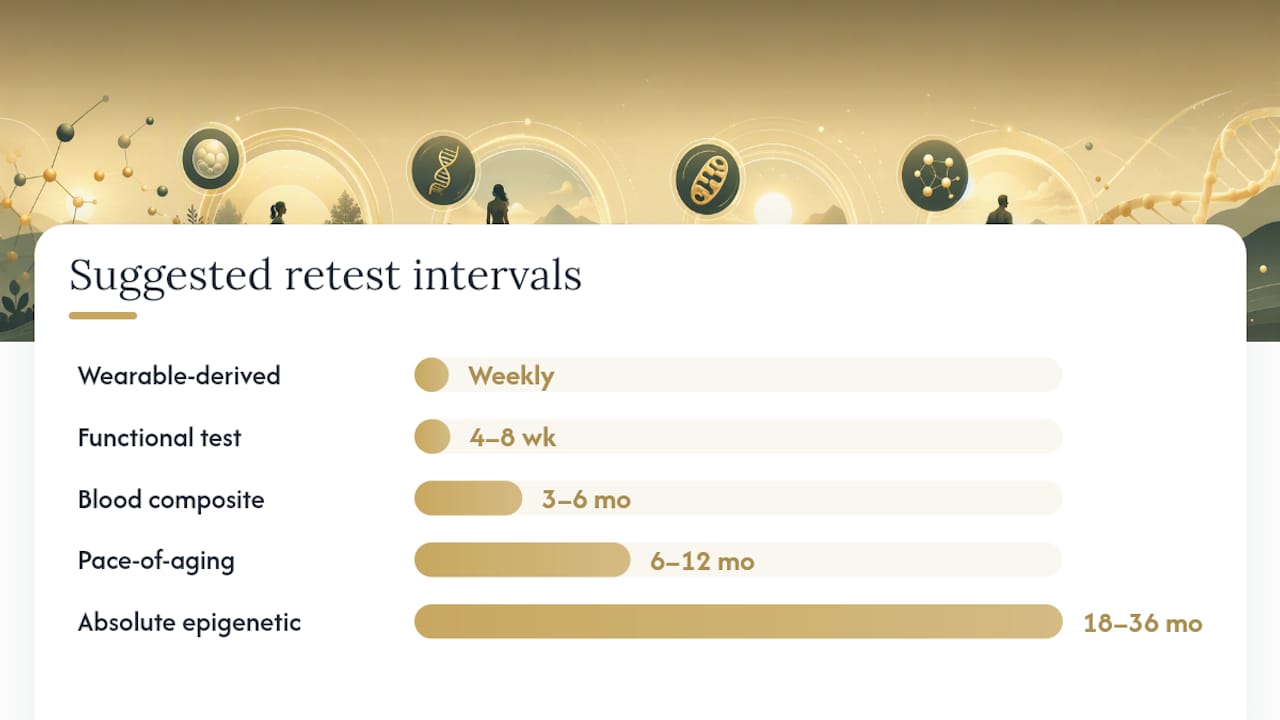
Your retest interval should be set by two things: which test you’re using, and what you’re trying to find out. A baseline check, an optimization phase, and validating a specific intervention all call for different cadences, and confusing them is how people end up either wasting money on tests too frequent to be meaningful, or missing real change because they waited too long.
Here’s a working framework:
- Baseline goal. Run one of each test type once, at the start, before changing anything. This is your anchor point, not a trend, so don’t overreact to it.
- Optimization goal (you’re actively changing diet, training, sleep, or supplementation). Wearables continuously; blood-based scores every 3 to 6 months; a pace-of-aging clock like DunedinPACE every 6 to 12 months if budget allows.
- Intervention validation goal (you’re testing whether a specific protocol worked). Test immediately before starting, again at 6 months, and again at 12 to 18 months, layering blood markers with at least one epigenetic checkpoint at the final interval.
- High-risk or medically complex monitoring. Coordinate frequency with a clinician, since abnormal biomarkers here may call for tighter intervals on the clinical panels specifically, independent of your biological age curiosity.
- Confirmatory or reassurance goal (you already made changes and want lab proof). Wait the full 18 to 36 months for an absolute epigenetic clock like GrimAge or PhenoAge. Testing sooner mostly measures noise, not progress.
Speed up testing when you start a new medication, enter a structured clinical trial, or begin an intensive program with measurable physiological targets, since these are the situations where a shorter feedback loop actually changes your next decision. Step back on frequency when nothing in your routine has changed, when a result was flagged as an outlier you can’t explain, or when cost is genuinely limiting adherence to the plan, since a skipped test beats an abandoned monitoring habit.
The Superage trend-versus-single-score guidance is blunt about this: three measurements minimum before you trust a direction. One test is a photograph. Three tests are a movie, and movies are what actually tell you whether a protocol is working.
Here’s how the major categories compare on cost and pacing:
| Test type | Typical cost range | Suggested minimum retest interval |
|---|---|---|
| Wearable-derived estimate | Included with device you already own | Continuous, review weekly |
| Functional/physical test | Free (self-administered) | Every 4 to 8 weeks |
| Blood-based composite score | Moderate, lab-panel pricing | Every 3 to 6 months |
| Pace-of-aging clock (e.g., DunedinPACE type) | Higher, specialty lab pricing | Every 6 to 12 months |
| Absolute epigenetic clock (e.g., PhenoAge, GrimAge type) | Highest of the categories | Every 18 to 36 months |
Notice the pattern: cost and biological responsiveness move together. The tests that respond fastest to real change also tend to be the cheapest and easiest to repeat, which is not a coincidence. It’s why a hybrid strategy, cheap and frequent for feedback, expensive and rare for confirmation, outperforms any single-test approach.
How Do You Tell Real Change from Measurement Noise?
Most people overreact to a single bad, or suspiciously good, result. A biological age score that jumps two years between two tests taken a month apart is almost never a real physiological shift. It’s usually a combination of assay variability, a different lab batch, or a change in your pre-test state, like sleep debt, dehydration, illness, or a hard training session the day before.
This is where methodological consistency stops being a nice-to-have and becomes the difference between useful data and noise you can’t interpret. The comprehensive review of biological age measurement methods makes the same point from the research side: different labs, different processing pipelines, and different reference populations all introduce variability that has nothing to do with your actual aging trajectory.
Before you retest, lock down these variables so each measurement is actually comparable to the last one:
- Use the same lab and the same test brand every time. Switching providers resets your baseline, even if both claim to measure the same clock.
- Test at a consistent time of day, since circadian rhythm affects several blood markers meaningfully.
- Match fasting status exactly. A fasted panel and a fed panel are not comparable, full stop.
- Avoid testing within 48 to 72 hours of unusual physical stress: intense exercise, illness, travel, or major sleep disruption.
- Log context notes with every test (sleep, stress, recent illness, medication changes) so an outlier has an explanation instead of a mystery.
How many data points do you actually need before you believe a trend? Practitioners generally treat three or more measurements spread across 6 to 24 months as the minimum to separate a real trajectory from statistical wobble. For a pace-of-aging clock, a consistent shift across two consecutive tests, taken 6 to 12 months apart, is a reasonable signal worth acting on. For an absolute epigenetic clock like GrimAge, wait for the full 18 to 36 month window before drawing conclusions, since a single early swing is more likely to be assay noise than proof of anything.
Pro Tip: Keep a simple spreadsheet with test date, lab or device used, fasting status, and any unusual context (illness, travel, poor sleep) next to every result. Six months from now, that context column will tell you more than the number itself.
When should you bring in a clinician instead of just adjusting your own routine? Any biomarker that falls into a clinically abnormal range, regardless of what your composite biological age score says, deserves a conversation with a doctor rather than a lifestyle tweak. Clinical overviews are consistent on this point: biological age testing is genuinely informative for risk awareness and motivation, but it is not yet standardized enough to serve as routine diagnostic care on its own. Use it to guide direction. Use a clinician to interpret anything that looks medically concerning.
Sample Testing Schedules You Can Start This Month
Pick the profile closest to your situation and use it as written, then adjust the specific months to match when you can realistically get testing done.
- Minimal plan (younger, low-risk readers, mostly curious). Baseline functional test and a blood-based composite score now. Repeat the functional test every 8 weeks for feedback, and the blood panel once a year. Skip epigenetic clocks unless you’re specifically chasing a number for motivation, since the cost rarely matches the value at this risk level.
- Optimization plan (midlife readers, roughly 40 to 60, actively working on health). Wearable tracking continuously. Blood-based composite score every 4 months. A pace-of-aging epigenetic clock like DunedinPACE at month 0 and again at month 9 to 12, giving you two data points aligned with the interval where that clock type is designed to show movement.
- Intervention validation plan (readers running an intensive protocol and want proof it worked). Full baseline panel across all four categories at month 0. Blood markers and wearable trends reviewed monthly. Second full check-in at month 6. Final confirmatory round, including an absolute clock like GrimAge or PhenoAge, at month 12 to 18. This layered approach is exactly the structure behind reducing measurable cellular aging markers rather than guessing whether a protocol worked.
- Monitoring plan (older readers or anyone medically complex). Coordinate blood panel frequency directly with your physician, since clinical risk markers may need tighter intervals independent of biological age curiosity. Layer in a functional test every 6 to 8 weeks as a low-cost, low-risk way to track trajectory between clinical visits, and consider an epigenetic clock only once every 24 to 36 months given both cost and the slower pace of change at this stage.
Whichever plan you pick, the mechanics don’t change: cheap and frequent for feedback, expensive and rare for confirmation. If you want a longer explanation of how to layer wearables, routine bloodwork, and periodic molecular tests without overspending or overreacting, this breakdown of combining testing methods walks through the logic in more detail.
Why the TIMELESS Protocol Pairs Testing With Four Layers, Not One
Most anti-aging advice treats biological age as a purely physical problem: fix the cells, fix the number. That’s incomplete, and it’s a big part of why so many people test, intervene, and retest without seeing the shift they expected.
I’m E. Christian Trejo. My most recent TruAge DNA methylation test put my biological age at 23 against a chronological age of 41, verified through the same methylation testing standard referenced throughout this article. That result didn’t come from optimizing one variable. It came from addressing aging as a 4-layer problem, because that’s what it actually is.
- Physical layer: cellular health, epigenetic markers, mitochondrial function. This is what most programs, and most of the tests described above, actually measure.
- Emotional layer: stored trauma and nervous system dysregulation, which drive chronic cortisol and inflammatory load that shows up directly in blood-based aging biomarkers.
- Spiritual layer: your identity and subconscious beliefs about aging itself, which shape behavior in ways that outlast any 12-week program.
- Energetic layer: your bioelectric field and meridian function, an aspect almost no conventional protocol even attempts to address.
Most protocols address one layer, usually the physical one, and stop. TIMELESS addresses all four simultaneously, which is the entire reason the four-layer longevity framework exists as a distinct approach rather than another supplement stack.
Here’s how that maps onto the testing calendar you just read: the TIMELESS Vitality Intensive is structured as an 8-week private coaching engagement, but the DNA-verified guarantee attached to it is built around the same 6-month confirmatory window that blood-based and pace-of-aging clocks need to show real movement. That is not a coincidence. The program pacing follows the biology, not the other way around, with baseline, 6-month, and 12-month checkpoints verified through TruAge DNA methylation testing rather than a self-reported feeling of progress.
Why Longitudinal Trends Beat a Single Test
A single biological age score answers “where am I today,” which is nearly useless without context. It can’t tell you whether you’re improving, declining, or simply catching your body on an unusually good or bad week. That distinction only comes from a trend line built across at least three separate measurements spread over 6 to 18 months.
Think of it the way you’d think of a stock price. One day’s closing number tells you almost nothing about the company’s health. A chart across two years tells you everything about its direction. Biological age works the same way, and the noise in any single test, from lab variability to a bad night’s sleep, gets averaged out once you have enough points to draw a real line.
This is precisely why the framing throughout this article centers on schedules and intervals rather than “the one test to take.” A test taken once, however sophisticated the underlying science, is a photograph. A test taken on a fixed schedule, using the same method every time, becomes a movie of how your body is actually aging, and that movie is the only version of this data that should change what you do next.
Which Test Type Should You Prioritize First?
If you’re starting from zero, prioritize a wearable for continuous feedback and a blood-based composite score for medium-term validation before spending money on an epigenetic clock. Wearables are already sitting on most people’s wrists doing nothing more than counting steps, so putting that data to work costs nothing extra.
Blood-based scores come next because the underlying biomarkers, glucose, lipids, inflammatory markers, respond to real behavior change within months, giving you fast enough feedback to know if a new habit is working before you lose motivation. Epigenetic clocks, especially absolute-age types like PhenoAge or GrimAge, belong later in the sequence, reserved for confirming change over the 18 to 36 month window where they’re actually built to be accurate. Emerging multi-omic approaches show real promise for prediction accuracy, but they also carry higher cost and validation questions that argue for conservative, infrequent use rather than routine quarterly testing.
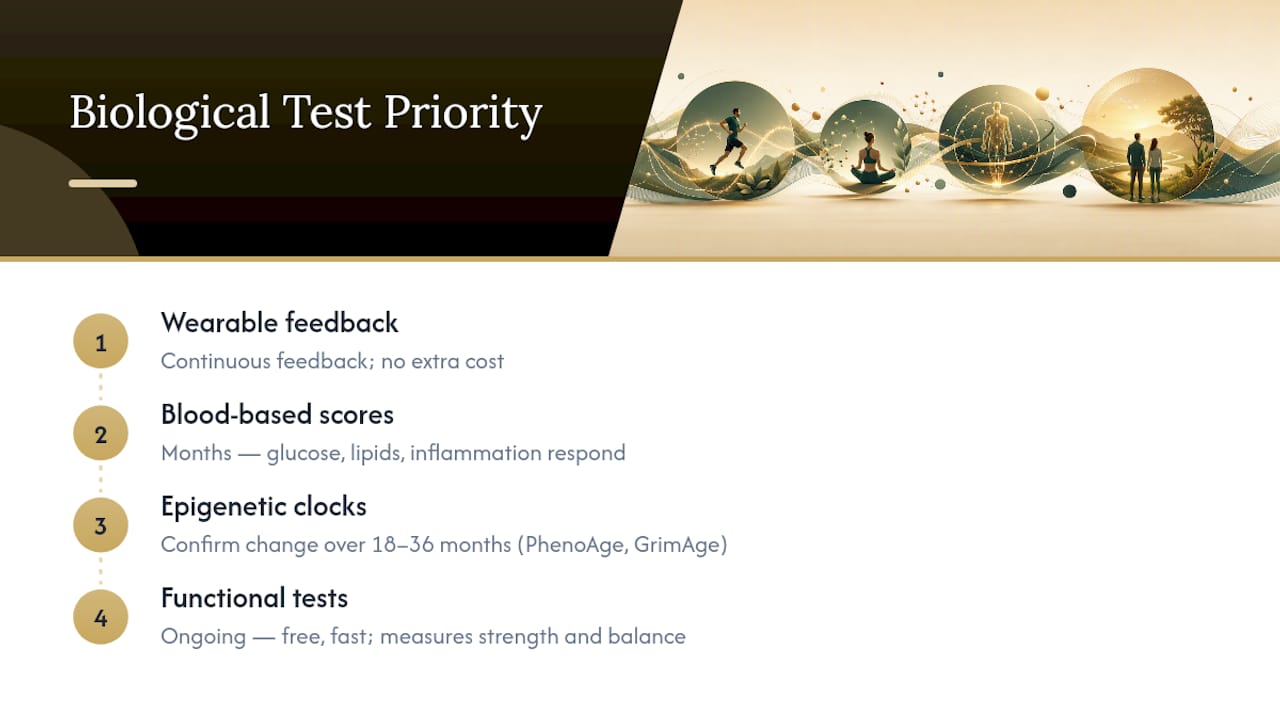
Functional tests deserve a permanent spot in this sequence regardless of budget, since they’re free, fast, and directly tied to real-world outcomes like strength and balance that matter independent of any lab number.
How Much Should Cost Shape Your Testing Frequency?
Cost is the practical constraint that decides more testing schedules than any scientific ideal does. Expensive epigenetic clocks limit how often most people can realistically repeat testing, which is exactly why a hybrid strategy tends to outperform a purist approach that leans entirely on one method.
The most cost-efficient version of this looks like: continuous wearable tracking (already paid for), frequent blood-based composite scores (moderate, recurring cost), and infrequent epigenetic clock testing reserved for confirmation rather than tracking. This isn’t a compromise. It’s the structure that Superage’s retest scheduling guidance points to directly, because it matches spending to the speed at which each test type actually generates new information.
Access matters too. Blood panels and functional tests are widely available through standard labs or at home. Advanced epigenetic and multi-omic clocks are still concentrated among specialty providers, which affects both cost and turnaround time. If your budget only allows for one lab-based test this year, a blood-based composite score run twice, six months apart, will teach you more about your trajectory than a single expensive epigenetic clock run once.
Author Perspective: A Scientist’s View on Testing Frequency and Emotional Budgeting
People treat their biological age number the way they treat a bathroom scale, checking obsessively and letting one bad reading ruin their week. That’s backwards, and it’s the fastest way to abandon a monitoring plan that would have worked fine if you’d just left it alone for a few more months.
I care about trends, not numbers. A single test result is a data point, not a verdict. Chase the direction across three or more measurements and ignore the noise between them.
Budget your emotional energy the same way you’d budget money. Don’t check an expensive epigenetic clock every month expecting drama. Pair cheap, frequent tracking, wearables and simple functional tests, with sparse, infrequent confirmatory molecular testing. The cheap layer keeps you honest week to week. The expensive layer confirms the story every year or two. That combination protects both your wallet and your peace of mind, and it’s the only version of this practice I’ve seen actually stick.
— E. Christian Trejo
How to Get Verified, Coached Biological Age Reversal
Testing tells you where you stand. It doesn’t tell you what to do about it, and that gap is where most people stall out after their first result comes back. Timeless - Reverse Your Age exists specifically to close that gap, and unlike generic wellness advice, every claim it makes is tied to a lab-verifiable outcome instead of a feeling.

Three ways to start, depending on how much support you want. Grab the free 14-upgrades guide if you want a no-cost starting point built around actionable shifts you can make this week. Buy the TIMELESS: Reverse Your Age book for $29.99 if you want the full 370-page blueprint covering all four layers, physical, emotional, spiritual, and energetic, in one structured resource. Or book a free Vitality Diagnosis call if you want personal guidance into the 8-week TIMELESS Vitality Intensive coaching program.
That coaching program carries a guarantee no other longevity program offers: reverse your biological age by at least 10 years in 6 months, verified through TruAge DNA methylation testing, or you get every dollar back. Verification is based on the same methylation testing standard used throughout this article to measure real biological change, applied to your own results before and after the program. If you want to see how a structured, verified program compares to going it alone, start with the free guide and decide from there.
Sources
The interval recommendations in this article draw on a mix of peer-reviewed methodology and clinical background, worth reading directly if you want to go deeper than a single article can cover.
The comprehensive review on biological age measurement methods walks through epigenetic, proteomic, and metabolomic approaches side by side and explains why no single method has become a universal standard yet. For a clinical framing of what biological age can and can’t tell you right now, the Cleveland Clinic’s overview of biological age is a solid, plainly written starting point, and the National Institute on Aging offers broader background on how aging biomarkers are studied at the population level.
For practical, consumer-facing interval guidance that lines up closely with the schedules in this article, Superage’s retest timing breakdown is worth bookmarking, and their piece on functional at-home testing is useful if you want a zero-cost way to start tracking trends this week.
This article is general information, not a substitute for advice from a qualified doctor. Consult a qualified healthcare professional about your own circumstances before acting on anything here.
- Review: methods to measure biological age (PMC)
- Cleveland Clinic — biological age overview
- OMICmAge/EMRAge multi-omic aging biomarker study (Nature Aging, 2026)
FAQ
How Often Should You Take a Biological Age Test?
It depends on the test. Wearable data can be reviewed continuously, blood-based composite scores every 3 to 6 months, and epigenetic clocks every 12 to 36 months depending on which clock type you use.
Can One Biological Age Test Result Be Trusted?
Not on its own. A single result is affected by lab variability and your state that day, so at least three measurements spread across 6 to 18 months are needed to confirm a real trend.
Which Biological Age Test Responds Fastest to Lifestyle Changes?
Blood-based composite scores and wearable-derived estimates respond fastest, often showing detectable change within a few months, while absolute epigenetic clocks like GrimAge and PhenoAge typically need 18 to 36 months to show reliable movement.
Is Biological Age Testing Covered by Standard Medical Care?
No. Clinical sources note that biological age testing is informative for risk awareness but is not yet a standardized part of routine medical care, so any abnormal biomarker should still be discussed with a clinician.
Does TIMELESS Verify Biological Age Reversal With Lab Testing?
Yes. The TIMELESS Vitality Intensive uses TruAge DNA methylation testing to verify results, backing its guarantee of reversing biological age by at least 10 years in 6 months or a full refund.