
CGM and Longevity: Meal Tests Inside TIMELESS’s Four Layers
Learn how continuous glucose monitoring guides meal experiments and targets set with clinicians in TIMELESS’s longevity protocol with four layers.
CGM and Longevity: Meal Tests Inside TIMELESS’s Four Layers
Continuous glucose monitoring is a precision biofeedback tool that can expose glucose patterns tied to cellular aging, and it works. The evidence is strongest for people with diabetes or prediabetes, where CGM initiation is linked to lower mortality, and promising but still developing for healthy people chasing metabolic optimization. We treat CGM as the measurement layer inside a larger protocol, not the protocol itself.
TL;DR:
- Most sensors run for 10 to 14 days, read interstitial fluid several minutes behind blood glucose, and may lose accuracy near wear’s end.
- Start with 3 to 5 days of normal eating, change one variable at a time, then repeat the same meal or habit to confirm results.
- A 2026 review of 23 studies found glucose and adherence improvements among people without diabetes, with benefits concentrated in prediabetes rather than fully healthy groups.
- Among 12,729 matched patients with type 2 diabetes who used insulin, CGM initiation was associated with a 0.79 mortality hazard ratio and fewer cardiovascular events.
- The suggested postmeal rise of 30 to 40 mg/dL and return to baseline within 60 to 90 minutes is a discussion target, not a diagnosis.
Table of Contents
- What CGM measures and why these metrics matter
- How CGM-observed glucose patterns relate to aging biology
- How to turn CGM data into longevity-relevant changes
- What the research actually shows
- Where CGM fits inside a four-layer longevity protocol
- Our honest take on CGM’s place in longevity work
- Your next step: guide, book, or guided coaching
- FAQ
- Sources
What CGM measures and why these metrics matter
A CGM sensor sits under the skin and reads glucose in the interstitial fluid, the thin layer of fluid surrounding your cells, not in blood directly. That creates a short lag behind blood glucose readings, usually a few minutes, which matters when you are trying to time an exact spike.
The National Institutes of Diabetes and Digestive and Kidney Diseases describes three device categories relevant here: real-time CGM (rtCGM), which streams data continuously, over-the-counter CGM (OTC-CGM), available without a prescription in many markets, and professional CGM, used short-term under clinical supervision. The 2026 ADA Standards of Care now frame all three as tools worth considering well beyond insulin-treated diabetes.
Four numbers do the real work:
- Time in Range (TIR): the percentage of the day glucose stays within a healthy band.
- Time Above Range (TAR): how often glucose runs high, a marker tied to glycation damage.
- Coefficient of Variation (CV%): how much glucose swings up and down, independent of the average.
- Postprandial spike: the peak rise after a meal, often the most actionable signal of all.
Sensors typically run 10 to 14 days per wear and need no fingerstick calibration on most current models, though accuracy drifts near the edges of the sensor’s life.
How CGM-observed glucose patterns relate to aging biology
Glucose spikes do not just raise a number. Repeated high excursions accelerate the formation of advanced glycation end-products, compounds that stiffen tissue and provoke oxidative stress. That stress damages the endothelium, the lining of your blood vessels, and feeds the low-grade inflammation that shows up in nearly every model of accelerated biological aging.
A 2026 systematic review and meta-analysis found that CGM use improved mean blood glucose, with benefits concentrated mostly in people with prediabetes. That matters because the same analysis found no significant change in BMI, meaning the benefit shows up in glucose control itself, not necessarily in weight.
This is why variability and spikes deserve attention even when your HbA1c looks normal. Stanford researchers observed diabetic-level glucose spikes in people with no diabetes diagnosis, hidden entirely from a standard annual blood panel. A single average number can mask the exact pattern doing the damage.
How to turn CGM data into longevity-relevant changes
CGM only earns its place in a longevity practice when you use it to run small, structured experiments instead of passively watching a graph.
- Observe: wear the sensor for 3 to 5 days eating normally to establish your baseline TIR, TAR, and CV%.
- Test: change one variable, a specific meal, a fasting window, or a sleep habit, and keep everything else constant.
- Modify: adjust based on what the data shows, whether that means meal sequencing, walking after eating, or shifting your eating window earlier.
- Confirm: repeat the same meal or habit after the change to verify the pattern actually shifted.
A full sprint usually runs about 14 days, long enough to test two or three variables without losing the thread.
Specific tactics worth testing: eating fiber and protein before carbohydrates, taking a 10 to 15 minute walk within 30 minutes of a meal, and progressively narrowing your eating window if time-restricted eating fits your schedule. Sleep debt and acute stress both raise fasting and postprandial glucose independent of what you eat, so a bad night’s sleep is worth flagging as a confounder before you blame the meal.
As a practitioner convention, not a clinical rule, many practitioners aim to keep postprandial rises in the range of 30 to 40 mg/dL, returning to baseline within 60 to 90 minutes. Treat that as a working target to discuss with a clinician, not a diagnosis.
Pro Tip: Ignore the first 15 minutes of alarms after a meal. Sensor lag and the natural first-phase insulin response both create noise that looks dramatic but resolves on its own.
What the research actually shows
The research supporting CGM for longevity-focused use splits cleanly along two lines: strong for diabetes management, encouraging but early for everyone else.
- The 2026 meta-analysis of 23 studies found meaningful glucose improvement and better behavioral adherence in non-diabetic users, with benefits concentrated in prediabetic participants rather than fully healthy ones.
- A Veterans Affairs cohort of 12,729 matched patients found that starting CGM in insulin-treated type 2 diabetes was associated with a mortality hazard ratio of 0.79, alongside fewer cardiovascular events.
- The 2026 ADA Standards of Care now recommend considering CGM at diabetes onset and at any point it could meaningfully improve management, a notable widening of who the technology is built for.
A mortality hazard ratio of 0.79 in a matched cohort of insulin-treated type 2 diabetics is a meaningful signal, but it describes a specific clinical population, not a guarantee that CGM extends lifespan in healthy adults. The honest read: CGM is clinically proven where disease already exists, and mechanistically promising, not yet proven, as a longevity tool for normoglycemic people.
Where CGM fits inside a four-layer longevity protocol
Aging is a four-layer problem: physical, emotional, spiritual, and energetic. Most programs address one layer, usually physical, and call it complete. CGM is powerful precisely because it feeds data into more than one layer at once.
On the physical layer, CGM calibrates diet, fasting windows, and the cellular and mitochondrial interventions that depend on stable glucose. On the emotional layer, it exposes glucose spikes tied to stress and poor sleep, data that supports the nervous-system regulation work stored trauma often requires. We treat its connection to the spiritual and energetic layers, identity-level beliefs about aging and the body’s bioelectric signaling, as hypothesis-generating: physiological signals worth watching, not proof of mechanism.
Our view, built on 15 years of research and testing across 40 countries, is that CGM becomes most useful when paired with the full picture: DNA methylation testing, structured coaching, and a program that tracks testing cadence across all four layers.

Our honest take on CGM’s place in longevity work
CGM is a tool, not a cure. We have watched people treat a flat glucose curve as proof they have solved aging, and that is a mistake. The device measures one biomarker extremely well. It says nothing about stored emotional stress, your beliefs about getting older, or the energetic patterns that show up in bioelectric measures.
Where CGM earns its keep is combined with other interventions across all four layers, verified over time with objective testing rather than how a graph makes you feel. Pair the data with a professional who can interpret it alongside your full biomarker picture, not in isolation.
— E. Christian Trejo
Your next step: guide, book, or guided coaching
If you want to put CGM data to work inside a complete framework, start with the free guide at Reverseyourage, which outlines 14 upgrades across all four aging layers.
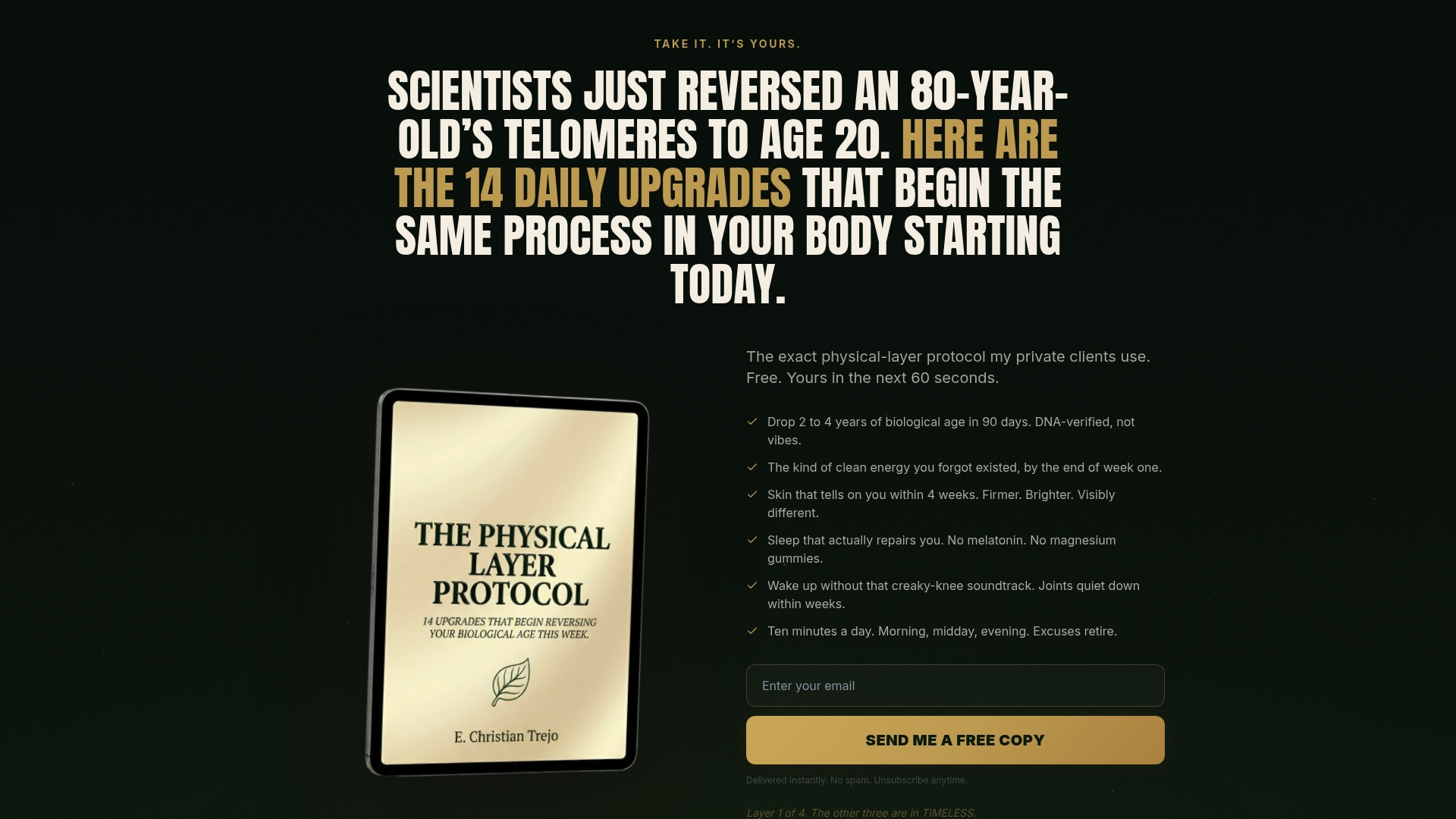
For the full system, our book, TIMELESS: Reverse Your Age, lays out the complete 370-page blueprint for $29.99, covering the physical, emotional, spiritual, and energetic protocol in depth.
- Free guide: 14 practical upgrades at Reverseyourage.
- The book: the full four-layer blueprint, $29.99.
- TIMELESS Vitality Intensive: 8-week private coaching, $7,000, with wearable and lab data (including CGM) integrated into a DNA-verified guarantee: 10 years of biological age reversal in 6 months, or every dollar refunded.
If you want structured, high-performance habit work alongside your glucose data, our vetted partner’s precision lifestyle tactics for high performers are worth a look too. For full guided integration, explore the TIMELESS Vitality Intensive and get your biological age independently verified.
This article is general information, not a substitute for advice from a qualified doctor. Consult a qualified healthcare professional about your own circumstances before acting on anything here.
FAQ
Does CGM work for people without diabetes?
Yes, within limits. A 2026 meta-analysis found CGM improved mean glucose and adherence in non-diabetic participants, though the benefit concentrated in people with prediabetes rather than fully healthy adults.
What is a healthy Time in Range target?
There is no single universal number, since targets depend on your clinical category and goals. Work with a clinician to set a personalized TIR, TAR, and CV% target rather than relying on a generic figure.
Can CGM data actually slow biological aging?
CGM can reveal glucose patterns, like postprandial spikes and high variability, that are mechanistically linked to glycation and inflammation, both tied to aging biology. It has not been shown on its own to change biological age; it works best as feedback inside a broader program like our four-layer TIMELESS protocol.
How does TIMELESS use CGM data differently?
We treat CGM as one feedback stream inside a four-layer protocol covering physical, emotional, spiritual, and energetic aging, verified with DNA methylation testing rather than glucose data alone. The TIMELESS Vitality Intensive integrates this data with coaching and a guarantee of 10 years of biological age reversal in 6 months or a full refund.
Is a prescription required to use a CGM?
It depends on the device and your market: some CGMs are sold over-the-counter while others require a prescription, a distinction the 2026 ADA Standards of Care formally recognize as separate device categories. Check availability and requirements with a local pharmacy or clinician before purchasing.
Sources
- Continuous glucose monitoring in non-diabetic populations: systematic review and meta-analysis (2026)
- Standards of Care in Diabetes—2026 (ADA)
- Initiation of Continuous Glucose Monitoring and Mortality in Type 2 Diabetes (cohort study)
- Continuous glucose monitoring — NIDDK