
The Right Way to Upgrade Your Wellness Routine with Biological Testing
Transform your wellness routine with biological testing. Discover essential blood markers and functional tests for lasting health improvements.
The Right Way to Upgrade Your Wellness Routine with Biological Testing
If you want to upgrade your wellness routine with biological testing, start with one blood draw and one functional test: ApoB, Lp(a), fasting insulin with HOMA-IR, HbA1c, hsCRP, vitamin D, and an omega-3 index, paired with either a DEXA scan or a VO2 max test. Add a baseline epigenetic clock like TruAge if you want a long-term benchmark, not a verdict. That is the whole starting move.
Do this part now: book the blood draw this week, through your primary care doctor or a direct-to-consumer lab, and schedule a clinician consult to walk through whatever three markers come back abnormal. Clinician-ordered panels usually take 3 to 7 days to return. Direct-to-consumer labs run similar turnaround but skip the waiting room, which matters if your doctor’s next opening is six weeks out.
- Blood priority panel: ApoB, Lp(a), fasting insulin/HOMA-IR, HbA1c, hsCRP, vitamin D, omega-3 index
- One functional test: DEXA (body composition, bone density) or VO2 max (cardiorespiratory fitness)
- Optional baseline: an epigenetic clock like TruAge, used once now and again after real intervention
Pro Tip: Don’t order every test on this list in week one if cost is tight. Get the blood panel first. It’s cheaper, faster, and tells you which functional test actually matters for your situation.
Key Takeaways
Biological testing only upgrades your wellness routine when results feed a prioritized, four-layer intervention plan with a defined retest date.
| Point | Details |
|---|---|
| Start with the priority panel | Order ApoB, Lp(a), fasting insulin/HOMA-IR, HbA1c, hsCRP, vitamin D, and omega-3 index first. |
| Pair blood work with one functional test | Choose DEXA for body composition or VO2 max for cardiorespiratory fitness, based on budget. |
| Use epigenetic clocks as benchmarks, not verdicts | Test once at baseline, then again after 6 to 12 months of real intervention. |
| Narrow results to three levers | Clinician-led interpretation that isolates the top three abnormal markers drives better compliance than a long supplement list. |
| Address all four aging layers | Timeless maps test results across physical, emotional, spiritual, and energetic interventions, verified through a TruAge methylation retest. |
This article is general information, not a substitute for advice from a qualified doctor. Consult a qualified healthcare professional about your own circumstances before acting on anything here.
Table of Contents
- Which Tests And Biomarkers Actually Matter For Your Upgraded Wellness Routine
- Epigenetic Testing Vs Physical Testing: How Do You Use Both?
- How Should You Prioritize Tests For Your Goals And Budget?
- How Do You Turn Test Results Into An Actual Upgrade Plan?
- A Four-Layer Approach To Turning Your Test Results Into Real Change
- What The Testing Obsession Gets Wrong
- Ready To Turn Your Numbers Into A Verified Age Reversal?
- Sources
- FAQ
Which Tests And Biomarkers Actually Matter For Your Upgraded Wellness Routine
Most people get this backward. They chase a biological age number before they know if their arteries are quietly loading plaque. Physical health tests like VO2 max, grip strength, blood pressure, ApoB, and HbA1c with fasting insulin rank among the strongest, most actionable predictors of longevity available, and they’re all modifiable through lifestyle and clinical work, according to Keep Health’s review of biological testing. That’s the filter for every test on this list: does it change what you do tomorrow?
Here’s what each marker is actually telling you:
- ApoB: counts atherogenic particles directly, a better predictor of cardiovascular risk than standard LDL cholesterol.
- Fasting insulin/HOMA-IR: flags metabolic dysfunction years before HbA1c or fasting glucose move.
- hsCRP: measures systemic inflammation, the slow fire behind most chronic disease.
- Vitamin D and omega-3 index: two of the cheapest, most common deficiencies, and both are fixable in weeks.
- Ferritin and B12: confirm nutrient sufficiency, especially relevant if you’re fatigued and can’t explain why.
- Full thyroid panel: energy, metabolism, and mood all run through this system, and standard checkups often miss it.
Functional testing fills the gap blood work can’t touch. DEXA scans reveal body composition and bone density in ways a bathroom scale never will. VO2 max measures cardiorespiratory fitness, one of the single best predictors of how long and how well you’ll live. Grip strength, oddly, correlates with mortality risk across large populations, and it takes ninety seconds to measure.
Advanced options like microbiome panels, full hormone workups, toxin screens, and epigenetic clocks earn their cost only when they change your plan. A microbiome test that just confirms “eat more fiber” wasn’t worth the money. Order these once your blood priority panel and one functional test are done, not before. For availability, your primary care doctor can order most of this, though a private lab or a reputable direct-to-consumer service fills gaps when insurance coverage is thin, particularly for ApoB and omega-3 index, which many standard panels skip entirely.
Epigenetic Testing Vs Physical Testing: How Do You Use Both?
These two categories measure completely different things, and confusing them wastes money. Epigenetic clocks estimate molecular and cellular aging, a snapshot of how your DNA methylation pattern compares to population averages. Physical and blood tests measure current system function right now, this month, based on what you ate, how you slept, and whether you trained this week.
That distinction changes how you use each one. An epigenetic test like TruAge works best as a baseline marker for program accountability. You take it once before you change anything, then again after 6 to 12 months of real intervention, because functional markers and biomarker trajectories predict outcomes better than any single snapshot. Physical and blood tests, by contrast, reward short-term action. ApoB, fasting insulin, and hsCRP respond to diet and training changes within 8 to 12 weeks, making them your quarterly monitoring tool.
A biological age number is a benchmark, not a scoreboard. If you retest your epigenetic clock every eight weeks hoping to see movement, you’re measuring noise, not signal. The number only means something when you’ve given your body enough time to actually change.
The mistake I see constantly: someone gets a biological age of 45 at chronological age 38, panics, and starts five supplements at once with no plan to isolate what worked. Use the epigenetic number to set a direction. Use your quarterly blood work to steer.
- Epigenetic clock: baseline now, retest at 6 to 12 months
- Blood and functional markers: retest every quarter while actively intervening
- Never judge a protocol’s success on epigenetic movement alone before six months have passed
How Should You Prioritize Tests For Your Goals And Budget?
Not everyone needs the same starting panel. Your primary goal, current risk level, budget, and access to a clinician versus a direct-to-consumer lab should decide your order of operations, not a generic checklist.
Four axes determine your path: what you’re optimizing for (cardiovascular risk, metabolic health, athletic performance, or general longevity), your baseline risk (family history, current symptoms, age), your budget, and your time horizon for seeing results.
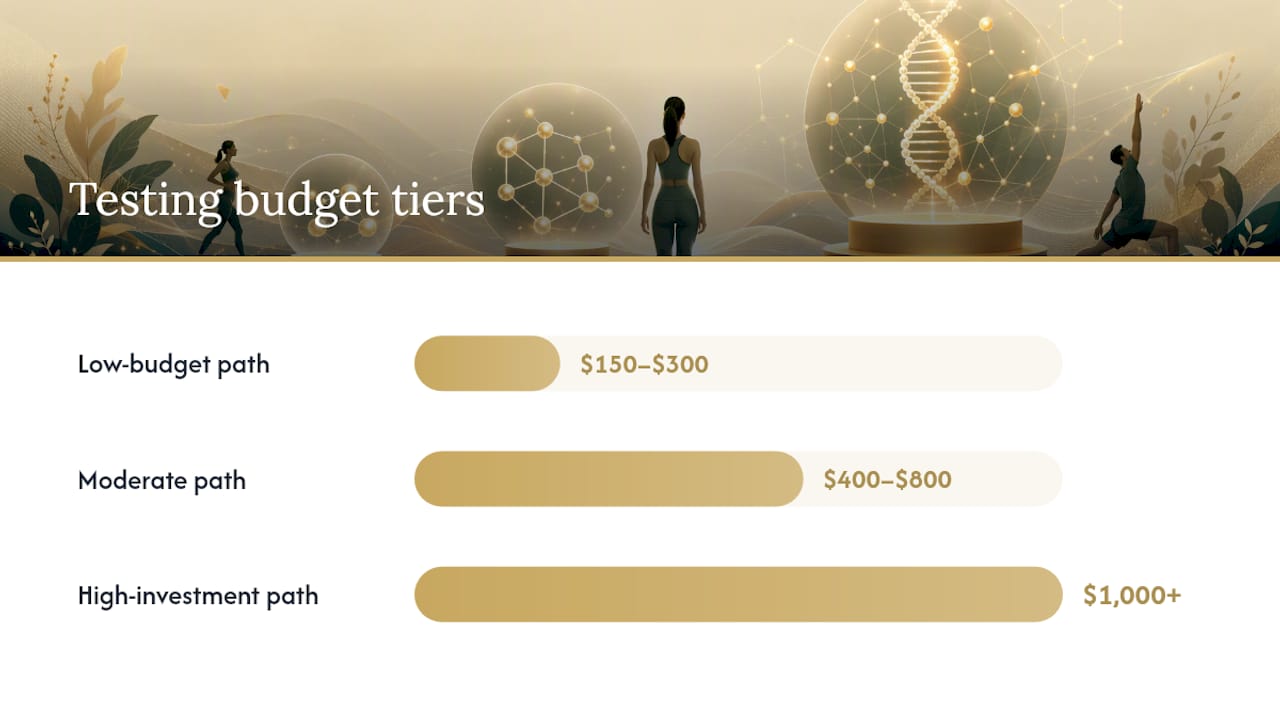
Three example pathways:
- Low-budget path ($150 to $300): Fasting insulin, HbA1c, hsCRP, vitamin D through your primary care doctor if covered, plus a home grip-strength check. Retest blood work in 12 weeks.
- Moderate path ($400 to $800): Full priority panel (ApoB, Lp(a), fasting insulin, HbA1c, hsCRP, vitamin D, omega-3 index) plus a DEXA scan. Add a clinician consult to interpret results. Retest blood markers quarterly, DEXA annually.
- High-investment path ($1,000 plus): Everything above, plus VO2 max testing, a baseline epigenetic clock, and a structured coaching relationship that sequences interventions and retests systematically.
Blood work gives you the most signal per dollar spent. A comprehensive panel costs a fraction of a DEXA scan or VO2 max test and flags the majority of actionable problems. Typical programs run baseline bloodwork and DEXA in the first two weeks, followed by a clinician consultation in weeks three and four that delivers a prioritized action plan.
Pro Tip: If budget forces a choice between DEXA and VO2 max, pick VO2 max. Cardiorespiratory fitness predicts mortality more strongly than body composition alone, and you can improve it faster.
How Do You Turn Test Results Into An Actual Upgrade Plan?
Data without a plan is just an expensive PDF. Here’s the cycle that actually works:
- Interpret with a clinician or certified coach. Don’t self-diagnose from a lab printout with reference ranges built for population averages, not your goals.
- Pick your top three levers. Not ten. Clinician-led interpretation that narrows abnormal markers down to three prioritized actions produces higher compliance and better measurable results than a shopping list of supplements.
- Implement focused interventions. Nutrition, training, sleep, and one or two targeted supplements, tied directly to the markers you flagged.
- Record targets and retest on schedule. Write down the number you’re chasing and the date you’ll recheck it.
Concrete examples:
- High ApoB: track LDL particle reduction through diet (fiber, reduced saturated fat) and consider statin or ezetimibe discussion with your doctor; retest in 12 weeks.
- Elevated fasting insulin: track HOMA-IR alongside waist circumference; prioritize resistance training and reduced refined carbohydrate intake; retest in 8 to 12 weeks.
- Low vitamin D: supplement to a target blood level (discuss dosage with your clinician); retest in 8 to 12 weeks.
- Low grip strength: add twice-weekly resistance training focused on compound lifts; retest in 12 weeks.
For tracking, a wearable that logs sleep, heart rate variability, and training load gives you the connective tissue between lab visits. Log your interventions in the same place you log your numbers, whether that’s a simple spreadsheet or an app tied to your wearable. When a marker doesn’t move after two full retest cycles, that’s your signal to escalate to specialist testing or imaging rather than adding a fourth supplement. Lab markers like these only become useful once you know how to read them and act, and the same logic applies to thyroid results, which quietly explain a lot of unresolved fatigue when nobody checks them.
A Four-Layer Approach To Turning Your Test Results Into Real Change
Here’s what most testing protocols get wrong: they treat abnormal ApoB or high cortisol as purely physical problems and stop there. Aging is a four-layer problem. Most programs address one layer, usually the physical, and wonder why results plateau. TIMELESS addresses physical, emotional, spiritual, and energetic layers simultaneously, because your test results almost never live in just one category.
Take elevated cortisol and poor HRV. The physical layer calls for mitochondrial support and sleep architecture work. But chronically dysregulated cortisol often traces back to stored trauma and nervous system dysregulation, the emotional layer no blood panel measures. Add subconscious beliefs about aging itself, the spiritual layer, and bioelectric field disruption, the energetic layer, and you understand why physical interventions alone stall out for so many people.
My last TruAge DNA methylation test confirmed a biological age of 23 at 41 years old. That result didn’t come from fixing one layer. It came from sequencing all four, deliberately, over years, then verifying the outcome with the same test I started with.
- Physical: cellular and mitochondrial interventions tied to your blood panel results
- Emotional: nervous system regulation work addressing stored trauma behind inflammatory markers
- Spiritual: identity and belief work, because how you think about aging shapes how you age
- Energetic: bioelectric and meridian practices that support the other three layers
A coached program sequences your baseline testing, layers in interventions across all four categories, and validates the result with a methylation retest, the same DNA-verified proof I use myself.
What The Testing Obsession Gets Wrong
Most of the biohacking world treats testing as the destination. People collect panels like trading cards, chase a lower biological age number, and never build the plan that actually moves it. That’s backward. Testing is diagnostic, not therapeutic. It tells you where to aim, nothing more.
The conventional advice, “get more tests,” misses the actual bottleneck: interpretation and follow-through. I’ve watched people with excellent panels do nothing useful with them because nobody connected the dots between an inflammatory marker and years of unprocessed stress sitting in their nervous system. That’s why physical-only protocols plateau. They’re solving one quarter of the problem and calling it done.
If I had to tell you one thing to prioritize first, it’s this: get your blood priority panel done, then find someone who will interpret it across more than the physical layer. A number on a page means nothing until it’s tied to a specific action and a retest date that proves whether the action worked.
Ready To Turn Your Numbers Into A Verified Age Reversal?
Once you have your test results in hand, the real question is what happens next. The 370-page book TIMELESS: Reverse Your Age documents the full four-layer protocol so you can map your own abnormal markers to physical, emotional, spiritual, and energetic interventions yourself, for $29.99.

If you want it done for you, the TIMELESS Vitality Intensive is an 8-week private coaching program that integrates your testing directly into a personalized plan, with TruAge methylation retesting built in to verify progress. It’s the only program in the longevity space guaranteeing at least 10 years of biological age reversal in 6 months, verified by DNA testing, or you get every dollar back. That kind of accountability doesn’t exist anywhere else in this category.
Want to start smaller? Grab the free upgrade guide for 14 immediate changes you can make before your first retest. If you’re ready for something bigger, the TIMELESS Challenge puts $50,000 on the line for verified transformation. Whichever entry point fits your budget, the next step is the same: turn your test results into a sequenced plan across all four layers, not just the physical one.
Sources
- Measuring your biological health: the tests that actually matter - Keep Health
- The Foundation Assessment | Protocol
- PMC article - evidence on functional markers and outcomes
FAQ
Which Peptide Does Joe Rogan Take?
Public statements attribute Rogan’s peptide use to recovery-focused compounds, though exact protocols vary by source and aren’t independently verified. This falls outside physician-supervised biological testing, and any peptide use should be discussed with a qualified clinician first.
Which Peptide Is Best For Overall Wellness?
There’s no single peptide proven best for general wellness across the board. What matters more is testing first (hormone panels, inflammatory markers) to identify whether a deficiency exists before considering any peptide intervention with a clinician.
How Often Should I Retest My Biomarkers?
Retest blood biomarkers like ApoB and fasting insulin every 8 to 12 weeks while actively changing your protocol, and retest functional tests like DEXA or VO2 max roughly annually once stable.
Is An Epigenetic Age Test Worth The Cost?
It’s worth it as a baseline benchmark and after 6 to 12 months of real intervention, but it shouldn’t replace quarterly blood and functional testing, which drive near-term decisions.

Can I Order These Tests Without A Doctor?
Yes, many direct-to-consumer labs offer ApoB, hsCRP, vitamin D, and similar panels without a physician order, though a clinician consult still matters for interpreting results and building your action plan.