Why Nature Exposure Slows Aging: A Science-Backed Guide
Discover why nature exposure slows aging with science-backed insights. Learn how a simple forest walk can enhance your health and vitality.
Why Nature Exposure Slows Aging: A Science-Backed Guide
Nature exposure is a proven biological intervention that slows aging by reducing cortisol, activating natural killer cells, and modifying epigenetic markers on the Horvath clock. This is not wellness folklore. Research now maps the molecular pathway from a 30-minute forest walk to measurable changes in your cellular age. For adults aged 35–70, understanding why nature exposure slows aging means understanding that your body is not a machine wearing down. It is a living system that responds to its environment at every level, from your immune cells to your DNA methylation patterns. The TIMELESS four-layer aging protocol treats nature as one of the most accessible physical-layer inputs available.
What biological mechanisms explain why nature exposure slows aging?
The science here is specific, and it starts with cortisol. Chronic cortisol elevation directly modifies 85 CpG sites on the Horvath epigenetic clock, the gold-standard measure of biological age. That means sustained stress does not just make you feel older. It rewrites your cellular aging program at the molecular level.
Nature reverses this process through several simultaneous pathways:
- Cortisol reduction. A single 30-minute urban forest walk lowers salivary cortisol and increases heart rate variability. Lower cortisol means fewer epigenetic modifications that accelerate biological age.
- Natural killer cell activation. A 3-day forest visit increases NK cell activity by 50% and boosts anti-cancer proteins, including perforin, granulysin, and granzymes A and B, by 40%. These effects persist for more than 30 days after a single trip.
- Phytoncide exposure. Conifer trees release volatile compounds called phytoncides, specifically α-pinene and β-pinene. These compounds modulate immune function and directly stimulate NK cell cytotoxicity. This is why a pine forest delivers a stronger biological response than an urban park.
- Inflammaging reduction. A single forest visit reduces pro-inflammatory cytokines, including IL-6 and TNF-α. These cytokines drive inflammaging, the chronic low-grade inflammation that accelerates nearly every aging pathway.
- Microbiome seeding. Contact with soil and plant microbiomes positively influences gut microbiome diversity, an overlooked anti-aging mechanism that supports immune modulation and systemic health.
Pro Tip: If you want the strongest immune response from a single outing, choose a conifer forest over a deciduous park. The phytoncide concentration is measurably higher, and your NK cells will respond accordingly.
The key insight here is that these pathways do not operate in isolation. Cortisol reduction, NK cell activation, and cytokine suppression happen simultaneously during a single nature session. That is what makes outdoor exposure so powerful as a physical-layer intervention.
How much nature exposure do you need for anti-aging benefits?
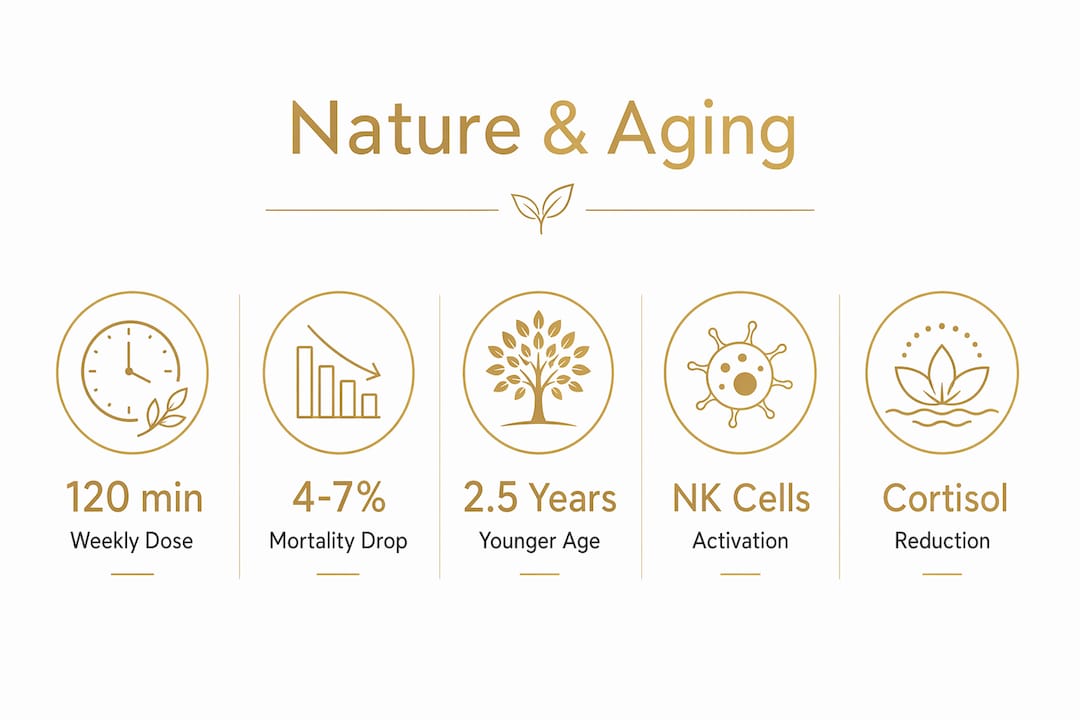
Dosing matters. Research identifies 120 minutes weekly as the minimum effective threshold for meaningful health improvements. Below that, benefits are inconsistent. Above it, the gains compound, up to a point.
Optimal daily exposure follows a seasonal pattern:
- Summer: Approximately 2 hours per day delivers maximum immune activation and epigenetic benefit. Sunlight, warmth, and higher phytoncide concentrations combine for peak effect.
- Winter: Approximately 1 hour per day remains effective for minimizing biological age acceleration. Cold air and reduced daylight lower phytoncide output, but cortisol reduction and sensory reset still occur.
- Spring and fall: These transitional seasons support 60–90 minutes daily. Phytoncide levels are moderate, and the sensory environment is often less taxing than peak summer heat.
Not all environments deliver equal results. Here is how common settings compare:
| Environment | Primary benefit | Phytoncide level |
|---|---|---|
| Conifer forest | NK cell activation, immune reset | High |
| Mixed woodland | Cortisol reduction, sensory ease | Moderate |
| Urban park | Stress relief, HRV improvement | Low |
| Coastal or lakeside | Nervous system calming | Variable |
Exceeding optimal exposure time does not cause harm, but the biological age benefits plateau beyond these windows. Your body reaches a saturation point for phytoncide absorption and cortisol suppression within a single session.
Pro Tip: Track your heart rate variability before and after each nature session using a wearable device. A consistent HRV increase after 30 minutes outdoors confirms your nervous system is responding. If you see no change, increase session length or switch to a higher-phytoncide environment.
What systemic health improvements from nature exposure contribute to slowing aging?
The anti-aging effects of nature go well beyond immune function. They reach every major system that drives biological age.
- Cardiovascular resilience. Nature exposure improves heart rate variability and reduces resting heart rate. These are direct markers of cardiovascular age. Higher HRV correlates with younger biological age on multiple epigenetic clocks.
- Metabolic stability. Longevity researchers classify nature exposure as a zero-cost systemic intervention that enhances metabolic balance by promoting movement, cleaner air intake, and breaking the sedentary energy imbalance cycle that accelerates metabolic aging.
- Nervous system reset. Fractal patterns in natural environments require minimal cognitive processing. This deactivates the amygdala within minutes of exposure, triggering a systemic drop in stress hormones that correlates with improved biological age markers. Urban environments do the opposite. They demand constant low-level threat assessment, keeping the amygdala chronically activated.
- Emotional layer regulation. Stored nervous system dysregulation is one of the four layers the TIMELESS protocol addresses directly. Nature exposure is one of the few zero-cost inputs that calms the emotional layer without requiring a formal therapeutic intervention. The amygdala deactivation described above is the mechanism.
Consistent green space exposure links to 2.5 years younger biological age on average and a 4–7% reduction in all-cause mortality per 0.1 NDVI increase in surrounding greenness. That is a measurable, verified outcome. It is not a wellness claim. It is a mortality statistic.
The TIMELESS four-layer protocol recognizes that aging is a physical, emotional, spiritual, and energetic problem simultaneously. Nature exposure addresses the physical layer through cellular and epigenetic mechanisms, and the emotional layer through nervous system calming. Most people treat these as separate problems. They are not. You can read more about aging reversal methods that work at multiple layers simultaneously.
How can adults aged 35–70 build a practical nature routine for anti-aging?
Consistency beats intensity. A daily 30-minute walk in a green environment outperforms a single weekend hike when measured across monthly biological age markers.
- Set a weekly minimum of 120 minutes. Split this across at least three sessions. Daily exposure is better than weekend-only batching.
- Prioritize conifer or mixed woodland environments. If you live in an urban area, identify the nearest park with mature trees. Even urban parks produce measurable cortisol reduction and HRV improvement.
- Practice forest bathing, not just walking. Shinrin-yoku, the Japanese practice of slow, mindful immersion in a forest environment, amplifies phytoncide absorption by slowing your breathing and increasing time in the phytoncide-rich air layer near the ground.
- Address seasonal barriers directly. Winter reduces daylight and motivation. Schedule morning outdoor sessions before your cortisol naturally peaks at 8:00–9:00 AM. This compounds the cortisol-lowering effect of nature with the natural cortisol curve.
- Track biometrics to confirm benefit. HRV, resting heart rate, and sleep quality scores are the most accessible markers. A consistent upward trend in HRV over 4–6 weeks confirms your nervous system is responding to the protocol.
Pro Tip: Remove headphones during at least half of every nature session. Auditory immersion in natural soundscapes, birdsong, wind, water, amplifies the amygdala deactivation effect. Music and podcasts keep your threat-assessment system partially engaged.
Urban living is not a disqualifier. Research confirms that even brief exposure to urban green spaces produces measurable cortisol reduction. The dose and environment type determine the magnitude of benefit, not the perfection of the setting.
Key Takeaways
Nature exposure slows biological aging through simultaneous cortisol reduction, NK cell activation, cytokine suppression, and epigenetic modification, making it one of the most effective zero-cost physical-layer interventions available.
| Point | Details |
|---|---|
| Minimum effective dose | 120 minutes weekly produces consistent health and biological age benefits. |
| Strongest environment | Conifer forests deliver the highest phytoncide concentration for NK cell activation. |
| Epigenetic mechanism | Cortisol reduction from nature exposure modifies 85 CpG sites on the Horvath aging clock. |
| Seasonal dosing | Target 2 hours daily in summer and 1 hour daily in winter for optimal anti-aging effect. |
| Systemic reach | Nature addresses both the physical and emotional aging layers simultaneously. |
What 15 years of research taught me about nature and biological age
My TruAge DNA methylation test confirmed a biological age of 23 at 41 years old. People ask what the single most surprising finding from my research was. The answer is not a supplement or a protocol. It is that the human body responds to its environment faster than almost any intervention I have tested.
The first time I measured my HRV before and after a 45-minute walk in a pine forest, the shift was immediate and significant. I had expected gradual change over weeks. What I found was a measurable nervous system response within a single session. That result changed how I structured the physical layer of the TIMELESS protocol.
Most longevity approaches treat nature as a lifestyle preference, not a clinical input. That framing is wrong. The molecular evidence is clear. Phytoncides enter your bloodstream through your lungs. Cortisol drops within 20 minutes of entering a green environment. Your amygdala deactivates. Your NK cells begin activating. This is not relaxation. This is biological reprogramming.
What I have also learned is that nature alone is not enough. Aging is a four-layer problem: physical, emotional, spiritual, and energetic. Nature addresses the first two layers well. It does not touch your subconscious beliefs about aging, your bioelectric field, or your stored identity around what it means to grow older. Those layers require deliberate work. That is exactly why the TIMELESS protocol exists. Nature is a powerful input. It is not the complete program.
My advice to anyone aged 35–70 reading this: stop treating outdoor time as optional. Schedule it with the same commitment you give to a medical appointment. Measure your HRV. Track your sleep. Verify the benefit. Then build from there.
— E. Christian Trejo
The TIMELESS protocol: nature plus the three layers most people miss

Nature exposure is a verified physical-layer intervention. It reduces cortisol, activates NK cells, and modifies epigenetic aging markers. But aging does not stop at the physical layer. The TIMELESS four-layer protocol addresses the physical, emotional, spiritual, and energetic dimensions of biological aging simultaneously. No other program in the longevity space offers a DNA-verified guarantee of 10 years of biological age reversal in 6 months, or a full refund. If you want to know exactly where your biological age stands today and how to build a complete protocol around it, book a free vitality call to map your personal aging program. Nature is the starting point. TIMELESS is the complete system.
FAQ
How quickly does nature exposure affect biological age?
A single 30-minute forest walk produces measurable cortisol reduction and HRV improvement. Consistent weekly exposure over months produces verifiable changes in epigenetic aging markers.
Does nature exposure work the same for everyone over 50?
The core mechanisms, cortisol reduction, NK cell activation, and cytokine suppression, function across age groups. Adults over 50 may see stronger relative benefits because their baseline inflammation and cortisol levels are typically higher.
Is urban park exposure enough, or do I need a forest?
Urban parks produce real cortisol reduction and nervous system benefits. Conifer forests deliver significantly higher phytoncide concentrations, which drive stronger NK cell activation and immune modulation.
Can nature exposure replace other anti-aging interventions?
Nature exposure addresses the physical and emotional aging layers effectively. It does not replace interventions targeting the spiritual and energetic layers, which require separate, deliberate protocols.
How does nature therapy for aging compare to supplement-based approaches?
Nature exposure operates through multiple simultaneous pathways, including epigenetic, immune, and nervous system mechanisms, at zero cost. Most supplements target a single pathway. The breadth of effect is what makes outdoor exposure a foundational anti-aging input.