
Why HRT Doesn't Reverse Biological Age: The Real Science
Discover why HRT doesn't reverse biological age and learn the real science behind hormone therapy. Understand its limits and benefits today!
Hormone replacement therapy (HRT) stabilizes declining hormone levels but does not reverse biological age, because it cannot reset the cellular and molecular mechanisms that govern how your body ages at its core. This distinction matters enormously for anyone in midlife weighing the real benefits of HRT against its limits. The science of biological age reversal, measured by tools like TruAge DNA methylation testing, operates on an entirely different level than hormonal stabilization. Understanding why HRT doesn’t reverse biological age is the first step toward choosing interventions that actually move the needle on your epigenetic clock.
Why HRT doesn’t reverse biological age at the cellular level
HRT manages the symptoms of hormonal decline. It does not rewrite the aging program running inside your cells. Symptom relief versus biological age reversal is the central distinction every patient deserves to understand before starting therapy.
Here is what HRT genuinely does well:
-
Reduces hot flashes, night sweats, and sleep disruption caused by estrogen loss
-
Partially preserves skin elasticity and bone mineral density during the menopausal transition
-
Supports mood stability and cognitive clarity in the short term
-
Offsets some cardiovascular risk when initiated at the right time
These are real, meaningful benefits. They improve healthspan, which is the quality of your lived years. But improving how you feel is not the same as lowering your biological age. Early HRT reduces aging acceleration in some tissues by roughly 6%, according to epigenetic clock measurements. That partial slowing is not reversal. The aging program keeps running.
Estrogen loss reshapes gene regulation in heart tissue, and HRT offsets some effects but cannot fully restore youthful gene expression. Think of it like adjusting the volume on a song without changing the track itself. The underlying code of aging remains intact.
Pro Tip: If you are using HRT and want to know whether it is actually slowing your biological age, request a TruAge DNA methylation test. It gives you a measurable number, not a symptom checklist.
What actually controls biological aging and why hormones can’t reset it
Biological age is determined by epigenetic alterations, DNA methylation patterns, cellular senescence, and systemic inflammation. These are the four core mechanisms that aging researchers at institutions like the Salk Institute and Harvard Medical School have identified as the true drivers of how fast your body ages.

| Aging Mechanism | What It Does | Does HRT Address It? |
|---|---|---|
| DNA methylation drift | Alters gene expression over time, tracked by epigenetic clocks | No |
| Cellular senescence | Accumulation of damaged, non-dividing cells that drive inflammation | No |
| Systemic inflammation | Chronic low-grade immune activation accelerating tissue damage | Partially |
| Metabolic dysfunction | Insulin resistance and mitochondrial decline reducing cellular energy | No |
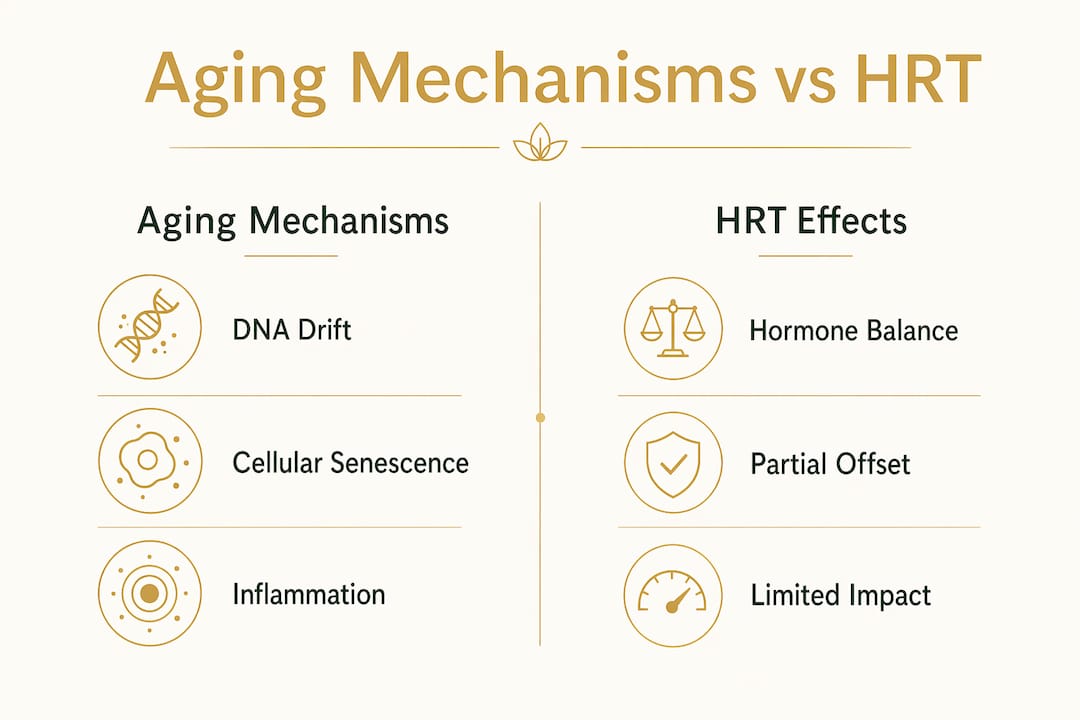
True biological age reversal requires resetting the epigenome via partial cellular reprogramming or systemic modulation. HRT does not achieve this. Hormones interact with receptors on cell surfaces and influence gene expression downstream, but they do not reprogram the methylation patterns that epigenetic clocks like TruAge or GrimAge actually measure.
Cellular senescence is a clear example. Senescent cells accumulate throughout your body after decades of division and stress. They secrete inflammatory compounds that damage neighboring tissue. Estrogen does not clear senescent cells. Neither does testosterone. Senolytics, compounds like dasatinib and quercetin studied at the Mayo Clinic, are specifically designed to target this mechanism. HRT is not.
Systemic inflammation, sometimes called inflammaging, is the one area where HRT has partial overlap with aging biology. Estrogen carries anti-inflammatory properties, and its loss at menopause correlates with rising inflammatory markers. But metabolic and lifestyle interventions affect the same gene regulation systems as sex hormones, often with greater depth and durability. Exercise, blood sugar management, and sleep optimization reach aging pathways that hormones simply cannot access.
Does the timing of HRT change what it can do for aging?
Timing is the most underappreciated variable in the entire HRT conversation. HRT initiated within 10 years of menopause or before age 60 reduces all-cause mortality and coronary heart disease risk by up to 50%. That same benefit disappears, or reverses, when therapy starts later. This is the timing hypothesis, and it has profound implications for how you think about HRT and aging.
The biological explanation centers on the endothelial glycocalyx, a delicate mesh lining your blood vessels. Estrogen protects glycocalyx structure, reducing inflammation and atherosclerosis risk during the timing window. Once that mesh degrades from years of estrogen deficiency, adding estrogen back does not rebuild it. The window closes.
Here is what the timing evidence means practically:
-
Start early or reassess your goals. If you are within 10 years of menopause and in good cardiovascular health, HRT carries genuine protective potential for heart and bone.
-
Get screened before starting late. Clinical practitioners must assess coronary calcium scores and prothrombotic risk before prescribing HRT beyond age 60, because estrogen-progestin therapy after 65 increases ischemic stroke and myocardial infarction risk 1.6 to 2 times.
-
Pair HRT with vascular health monitoring. Blood pressure, lipid panels, and inflammatory markers should be tracked alongside hormone levels.
-
Do not rely on HRT alone. Even within the optimal window, HRT does not address the epigenetic aging that continues in parallel.
Pro Tip: Ask your physician for a coronary artery calcium (CAC) score before starting or continuing HRT past age 55. A score above 100 changes the risk calculus significantly.
How HRT compares to real biological age reversal strategies
The longevity field has moved well beyond hormone replacement in its understanding of what actually reverses biological age. Comparing these approaches directly clarifies the limitations of hormone therapy and points toward what works.
| Intervention | Mechanism | Biological Age Impact | Evidence Stage |
|---|---|---|---|
| HRT | Hormone stabilization, partial gene regulation | Partial slowing, no reversal | Established clinical use |
| Epigenetic reprogramming | Resets DNA methylation patterns via Yamanaka factors | Demonstrated reversal in animal models | Experimental |
| Therapeutic plasma exchange | Resets systemic signaling by diluting pro-aging blood factors | Partial reversal of biological markers | Early human trials |
| Lifestyle protocol (sleep, exercise, nutrition, stress) | Targets inflammation, metabolism, and epigenetic regulation simultaneously | Measurable reduction in biological age | Strong clinical evidence |
| Senolytics (dasatinib, quercetin) | Clears senescent cells reducing inflammaging | Tissue-specific rejuvenation | Phase II human trials |
Plasma dilution and therapeutic plasma exchange can partially reverse biological age by resetting systemic signaling networks. This is biologically distinct from what HRT does. Aging is systemically regulated by circulating factors, and new paradigms in longevity science are targeting those factors directly.
Lifestyle interventions deserve special attention here because they are consistently underestimated. The same gene regulation pathways that estrogen influences are also activated by resistance training, intermittent fasting, and sleep optimization. The difference is that lifestyle interventions reach deeper into the aging program. They reduce DNA methylation drift, lower inflammatory cytokines, and improve mitochondrial function simultaneously. HRT does none of these things on its own.
The most effective approach to biological age management combines hormonal stabilization with metabolic control, sleep optimization, and physical conditioning. Each layer addresses a different dimension of the aging program. HRT covers one layer. True reversal requires all of them.
Key takeaways
HRT manages hormonal decline effectively but cannot reset the epigenetic, cellular, and systemic mechanisms that determine biological age, making it a supportive tool rather than a reversal strategy.
| Point | Details |
|---|---|
| HRT is not age reversal | It stabilizes hormones and relieves symptoms but does not lower your epigenetic age score. |
| Timing determines benefit | Starting HRT within 10 years of menopause or before 60 maximizes cardiovascular protection; late initiation increases risk. |
| Epigenetics drives biological age | DNA methylation, cellular senescence, and inflammaging are the real targets for age reversal, not hormone levels. |
| Lifestyle reaches deeper | Exercise, sleep, and metabolic health affect the same gene pathways as hormones, often with greater and more lasting impact. |
| Measurement matters | TruAge DNA methylation testing gives you an objective biological age number, not just symptom relief as a proxy for progress. |
My honest assessment of HRT in a longevity protocol
I have spent 15 years studying biological aging and working with practitioners across 40 countries. My own TruAge DNA methylation test confirmed a biological age of 23 at 41 years old. That result did not come from hormone therapy. It came from targeting all four layers of the aging program simultaneously.
Here is what I see consistently in practice. People start HRT, feel significantly better, and conclude they are reversing their biological age. That feeling is real. The symptom relief is genuine. But when we run a TruAge test, the epigenetic clock tells a different story. The number has not moved the way they expected. This is not a failure of HRT. It is a failure of expectation management.
HRT is a legitimate and valuable tool. For women in perimenopause or early postmenopause, it protects the cardiovascular system, preserves bone density, and maintains quality of life during a critical transition. I recommend it within the right clinical context. What I push back on is the idea that it replaces the deeper work of biological age reversal.
The aging program is written in your epigenome. Hormones influence some of the text, but they do not rewrite the code. For that, you need epigenetic reprogramming strategies, systemic rejuvenation, and a protocol that addresses physical, metabolic, and cellular aging together. HRT is one chapter in that story. It is not the whole book.
If you are serious about your biological age, measure it. Then build a protocol around the number, not around how you feel.
— Erick
Take your biological age beyond what HRT can reach
HRT addresses one dimension of aging. At TIMELESS Reverse Your Age, we address all four. The TIMELESS Vitality Intensive is an 8-week private coaching program built on 15 years of longevity research, tested across 40 countries, and guaranteed to reverse your biological age by at least 10 years in 6 months, verified by TruAge DNA methylation testing, or every dollar is refunded. No other program in the longevity space offers this level of scientific accountability. If you want to know exactly where your biological age stands and build a personalized protocol to move it, book your free Vitality Diagnosis call and start with a real number.
FAQ
Does HRT lower your biological age score?
HRT does not lower biological age as measured by epigenetic clocks like TruAge or GrimAge. It manages hormonal symptoms and may partially slow aging in some tissues, but it does not reset DNA methylation patterns.
What is the best time to start HRT for aging benefits?
Starting HRT within 10 years of menopause or before age 60 provides the strongest cardiovascular and bone-protective benefits. Beginning therapy after this window reduces efficacy and increases cardiovascular risk.
Can lifestyle changes do what HRT cannot for biological aging?
Lifestyle interventions including resistance training, sleep optimization, and blood sugar management target epigenetic regulation, cellular senescence, and systemic inflammation directly. These mechanisms drive biological aging in ways that hormone replacement does not address.
What actually reverses biological age if HRT doesn’t?
True biological age reversal requires resetting epigenetic methylation patterns through strategies like partial cellular reprogramming, therapeutic plasma exchange, senolytics, and integrated lifestyle protocols. These approaches target the cellular mechanisms that epigenetic clocks actually measure.
Is HRT still worth taking if it doesn’t reverse aging?
HRT remains a clinically valuable tool for managing menopausal symptoms, protecting cardiovascular health within the timing window, and preserving bone density. Its value lies in improving healthspan and quality of life, not in reversing the epigenetic clock.