
What Does Biological Age 23 Mean for Your Health?
Discover what biological age 23 means for your health. Learn how your cellular function can indicate a younger, healthier you.
What Does Biological Age 23 Mean for Your Health?
Biological age is a scientifically derived number showing how old your body actually is based on cellular function, not your birth date. When you ask what does biological age 23 mean, the answer is direct: your cells function like those of a typical 23-year-old, regardless of how many years you have lived. This measurement comes primarily from DNA methylation patterns, the molecular markers that epigenetic clocks read to estimate your physiological state. A biological age of 23 in a 40-year-old body signals that your cellular machinery is running nearly two decades younger than your birth year suggests. That gap is not luck. It is the result of deliberate, layered choices that can be studied, replicated, and verified.
What does biological age 23 mean, and how is it measured?
Biological age reflects cumulative cellular wear, not the year you were born. The most validated method for measuring it is DNA methylation testing, which reads chemical tags on your genome that change predictably as you age. Epigenetic clocks such as the TruAge panel translate those patterns into an estimated biological age. A result of 23 means your methylation profile matches the average profile of a 23-year-old.
Biological age estimates can differ by decades from chronological age. That spread is not a flaw in the test. It reflects real differences in how fast different people age at the cellular level.
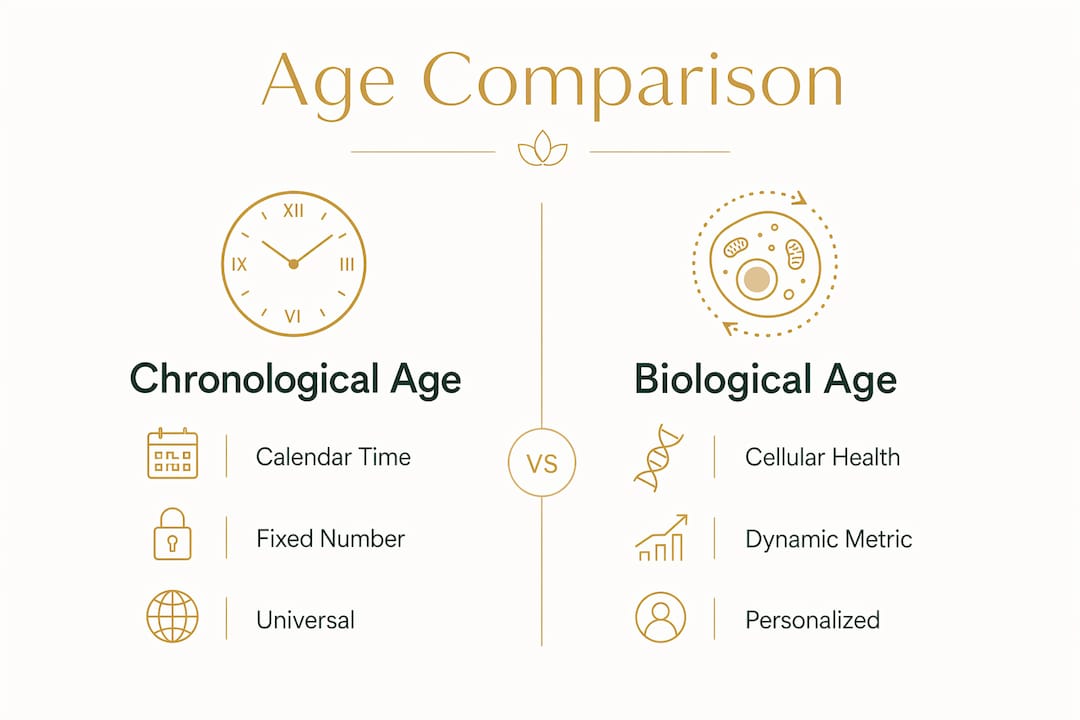
Understanding biological age versus chronological age requires one key distinction: chronological age counts time, biological age counts damage. A 45-year-old with a biological age of 23 has accumulated far less cellular damage than a 45-year-old with a biological age of 55. The practical consequence is a measurably different risk profile for disease and mortality.

The table below shows how biological and chronological age can diverge and what each range signals about physiological status.
| Chronological Age | Biological Age | Physiological Signal |
|---|---|---|
| 35 | 23 | Cellular function of a young adult; low disease risk |
| 40 | 35 | Moderate aging; typical for average lifestyle |
| 45 | 45 | Aging at calendar pace; no acceleration or reversal |
| 50 | 60 | Accelerated aging; elevated chronic disease risk |
Biological age also has a companion metric called pace of aging. Age and pace are distinct: biological age captures cumulative damage, while pace reflects how fast damage is currently accumulating. A person can hold a youthful biological age of 23 yet show a pace score above 1.0, meaning they are aging faster than average right now. That combination calls for immediate protocol adjustment, not celebration.
What factors drive a biological age as low as 23?
Genetics influence about 50% of biological aging speed. The other 50% comes from modifiable lifestyle factors. That split is the most important number in longevity science. It means half of your biological age is within your direct control.
The modifiable factors with the strongest evidence include:
- Diet: Caloric quality, micronutrient density, and anti-inflammatory food patterns directly affect DNA methylation.
- Exercise: Resistance training and aerobic work both reduce epigenetic age markers.
- Sleep: Chronic sleep deprivation accelerates methylation aging faster than almost any other single behavior.
- Stress: Unmanaged psychological stress drives nervous system dysregulation, which shows up in epigenetic clocks within months.
- Toxin exposure: Alcohol, tobacco, and environmental pollutants add measurable years to biological age.
Most longevity protocols stop at the physical layer. That is a critical error. Emotional, spiritual, and energetic health are equally important layers that most programs ignore entirely. Stored trauma and nervous system dysregulation keep the body in a chronic stress state that no amount of clean eating can fully override. Subconscious beliefs about aging, what researchers call identity-level programming, shape behavior and physiology in ways that physical interventions cannot reach alone. The bioelectric field and meridian system add a fourth layer that integrates the other three.
The Timeless - Reverse Your Age protocol addresses all four layers simultaneously: Physical (cellular, epigenetic, mitochondrial), Emotional (stored trauma, nervous system regulation), Spiritual (identity and subconscious aging beliefs), and Energetic (bioelectric field, meridians). That integration is why the results are verifiable at the DNA level.
Pro Tip: The single most common mistake people make is fixing diet and exercise while ignoring chronic stress and unresolved emotional patterns. Epigenetic clocks detect that stress load directly. Address all four layers or your biological age will plateau.
What does a biological age of 23 mean for your long-term health?
A younger biological age predicts better health outcomes with more accuracy than chronological age alone. Biological age correlates with disease risk and mortality across longitudinal studies, and a lower number consistently associates with better physical and cognitive function. A biological age of 23 in a 40-year-old body does not just feel good on paper. It translates to a measurably lower probability of cardiovascular disease, metabolic dysfunction, and cognitive decline.
The table below compares expected health trajectories at different biological age levels for a person with a chronological age of 45.
| Biological Age at 45 | Disease Risk Profile | Cognitive Function | Expected Vitality |
|---|---|---|---|
| 23 | Very low | High; strong neuroplasticity | Peak physical and mental output |
| 35 | Below average | Good; minor age-related decline | Above-average energy and recovery |
| 45 | Average | Moderate decline beginning | Typical midlife fatigue patterns |
| 60+ | High | Significant decline risk | Reduced capacity; elevated intervention need |
The key insight is that biological age is dynamic, not fixed. A youthful biological age is not a permanent state. It reflects ongoing cellular conditions shaped by current behavior. That means a biological age of 23 can rise if lifestyle degrades, and a biological age of 55 can fall with the right protocol.
Tracking both biological age and pace of aging together gives the most complete picture. A person who holds a biological age of 23 while also showing a pace score below 1.0 is aging slower than average in real time. That combination represents the gold standard for longevity assessment.
Limitations of biological age testing and how to interpret a score of 23
Epigenetic clocks carry a measurement error of ±2–4 years. A result of 23 is more accurately read as a range of 19–27. That range still represents exceptional cellular health, but it is not a precise biological passport.
A second limitation is that different tests measure different physiological systems. Epigenetic, glycan-based, and proteomic clocks each reflect distinct aging dimensions. A score of 23 on one platform does not confirm the same result on another. Comparing scores across different test types produces misleading conclusions.
The most common misuse of biological age data is treating a single test result as a final verdict. Dr. Hillary Lin highlights that trend tracking on the same test over time delivers far more value than any single snapshot. A biological age that drops from 38 to 29 over 12 months of protocol work tells you something definitive. A single score of 23 tells you where you are today.
Best practices for using biological age results:
- Retest on the same platform every 6 months to track trends.
- Pair biological age with a pace-of-aging metric for complete assessment.
- Use the number as a motivation signal, not a fixed identity.
- Combine epigenetic data with functional markers like VO2 max, grip strength, and cognitive testing.
Pro Tip: Never change your protocol based on a single test result. One data point is a snapshot. Three data points over 18 months is a trend. Trends are what drive protocol decisions.
Key Takeaways
Biological age 23 is a verified, DNA-level signal of exceptional cellular health that is achievable through a four-layer protocol addressing physical, emotional, spiritual, and energetic aging simultaneously.
| Point | Details |
|---|---|
| Biological age 23 defined | Your cells function like a 23-year-old’s, measured by DNA methylation patterns. |
| Lifestyle drives 50% of aging | Diet, sleep, stress, and emotional health each directly shift your epigenetic clock. |
| Testing has a ±2–4 year margin | Treat results as directional trends, not exact biological birthdates. |
| Pace of aging matters equally | A youthful age score paired with a high pace score signals urgent protocol adjustment. |
| Four layers must be addressed | Physical-only protocols plateau; emotional, spiritual, and energetic layers are required for full reversal. |
My honest take on what biological age 23 really proves
I was 41 years old when my TruAge DNA methylation test came back with a biological age of 23. I have shared that result publicly because it is verified, repeatable, and the direct product of 15 years of deliberate protocol work across all four aging layers.
What I want to be clear about is what that number does not mean. It does not mean I found a shortcut. It does not mean genetics handed me an advantage that most people cannot access. Genetics account for roughly half of biological aging speed. The other half is the work. My result came from addressing the physical layer through cellular and mitochondrial support, the emotional layer through resolving stored trauma and nervous system dysregulation, the spiritual layer through rewriting subconscious identity beliefs about aging, and the energetic layer through bioelectric and meridian work. Most programs I have studied address one of those four. Some address two. None that I have tested address all four simultaneously except the protocol I built.
The misconception I hear most often is that a biological age score is a destination. People get a good result and ease off. That is exactly when pace of aging accelerates. A biological age of 23 is a current reading, not a permanent state. The program that produced it has to continue producing it. That is why the Timeless - Reverse Your Age protocol is built as a lifestyle architecture, not a 30-day fix.
The future of this field is personalized biological age intervention at the four-layer level. Single-biomarker tests will give way to comprehensive panels. Protocols that ignore emotional and energetic aging will be recognized as incomplete. The people who act on that understanding now will hold the largest health advantage over the next two decades.
— E. Christian Trejo
The Timeless - Reverse Your Age protocol for biological age reversal
The Timeless - Reverse Your Age program is the only longevity protocol built on a DNA-verified guarantee. The TIMELESS Vitality Intensive is an 8-week private coaching program that addresses all four aging layers simultaneously: Physical, Emotional, Spiritual, and Energetic. The guarantee is specific: reverse your biological age by at least 10 years in 6 months, verified by TruAge DNA methylation testing, or every dollar is refunded. No other program in the longevity space offers that level of scientific accountability. The complete system is also documented in the book TIMELESS: Reverse Your Age, a 370-page blueprint available worldwide for $29.99. To begin with a personalized assessment, book a free Vitality Diagnosis Call and find out exactly where your biological age stands today.
FAQ
What does a biological age of 23 mean?
A biological age of 23 means your cells function like those of a typical 23-year-old, as measured by DNA methylation patterns. This indicates very low cellular damage and a reduced risk of age-related disease, regardless of your chronological age.
How is biological age determined?
Biological age is determined primarily through epigenetic clocks that analyze DNA methylation patterns in your cells. Tests like TruAge translate those patterns into an estimated biological age with a measurement error of ±2–4 years.
Can biological age actually be reversed?
Biological age is a dynamic metric that changes with lifestyle. Verified protocols addressing diet, sleep, stress, and emotional health have produced measurable reductions in biological age, with programs like Timeless - Reverse Your Age guaranteeing a 10-year reduction in 6 months.
Is a biological age of 23 realistic for someone over 40?
A biological age of 23 at chronological age 41 is verified and documented through TruAge DNA methylation testing. It requires sustained, multi-layer protocol work across physical, emotional, spiritual, and energetic dimensions of aging.
Why do different biological age tests give different results?
Different tests measure different physiological systems. Epigenetic, glycan-based, and proteomic clocks each reflect distinct aging dimensions and are not interchangeable. Tracking trends on the same test over time produces the most reliable data.