
Track Biological Age Improvement: Your 2026 Blueprint
Discover how to track biological age improvement effectively in 2026. Use cutting-edge tests to measure aging accurately and achieve your wellness goals.
Track Biological Age Improvement: Your 2026 Blueprint
Biological age improvement is defined as a measurable reduction in your cellular and systemic aging rate, verified through validated biomarkers rather than the number on your birth certificate. If you want to track biological age improvement with any real confidence, you need more than one test and more than one type of data. The gold standard tools today include the TruAge DNA methylation test, the DunedinPACE pace-of-aging metric, and blood biomarker panels covering inflammation and metabolic markers. Together, these give you a trajectory, not just a snapshot. That trajectory is what separates people who are genuinely reversing their biological age from those who are guessing.
What tools are most effective for monitoring biological age?
Five measurement categories currently lead the field: epigenetic clocks, blood biomarker panels, telomere length testing, glycan analysis, and composite algorithmic scores. Each targets a different layer of the aging process. Choosing the right combination depends on your budget, your timeline, and what you want to change.
Epigenetic clocks vs. blood biomarker panels
Epigenetic clocks like the Horvath clock and DunedinPACE measure DNA methylation patterns at specific sites across your genome. They are the most molecularly precise tools available for measuring age reversal. The critical distinction is that static clocks measure position while pace-of-aging clocks like DunedinPACE measure velocity. Static clocks may not shift noticeably for 18–24 months after an intervention begins. Pace metrics give you earlier feedback, which matters when you are actively testing a protocol.

Blood biomarker panels are faster and cheaper. They measure markers like C-reactive protein (CRP), fasting insulin, HbA1c, and lipid ratios. These respond to interventions within weeks, making them the best tool for short-cycle feedback between your annual epigenetic tests. Platforms like InsideTracker and Function Health offer structured panel options, though any certified lab can run the core markers.
| Method | What It Measures | Retest Frequency | Cost Range |
|---|---|---|---|
| TruAge / Epigenetic Clock | DNA methylation age | Every 6–12 months | $300–$500 |
| DunedinPACE | Rate of aging (velocity) | Every 6–12 months | Included with TruAge |
| Blood Biomarker Panel | Inflammation, metabolic markers | Quarterly | $100–$300 |
| Telomere Length | Chromosomal aging | Annually | $100–$200 |
| Glycan Analysis | Immune system aging | Annually | $300–$600 |
- Use epigenetic tests to confirm molecular-level change annually.
- Use blood panels quarterly to guide lifestyle adjustments in real time.
- Keep your testing platform consistent. Switching labs mid-experiment introduces variables that corrupt your trend data.
- Telomere and glycan tests add useful secondary confirmation but should not replace methylation testing as your primary metric.
Pro Tip: Run your first blood panel and epigenetic test within the same 30-day window. This establishes a true baseline where both data sets reflect the same physiological moment.
How do you interpret biological age test results?
A single biological age test is a snapshot with inherent variability, not a verdict. Tracking trend over time is what produces actionable insight. One test tells you where you are. Three tests over 18 months tell you where you are going.
“A single test should never be treated as a definitive health verdict. Trajectory and repeatability offer the only actionable insights.” — Superpower Biological Age Tracking Guide
The DunedinPACE metric makes this concrete. A shift of 0.05 or greater over 90 days is considered meaningful. A shift of 0.10 is exceptional. Scores below 1.0 indicate you are aging slower than calendar time. Scores above 1.0 mean you are aging faster. That single number, tracked over multiple tests, tells you whether your protocol is working at the molecular level.
Regression to the mean is the most misunderstood variable in this field. Temporary illness or stress can shift your baseline significantly, making a subsequent test look like dramatic improvement when it is simply a return to normal. Always note your health context when you test. If you had a viral infection, major surgery, or a period of severe sleep deprivation in the 60 days before a test, flag that data point before drawing conclusions.
The clinical stakes are real. Steeper biological aging trajectories correlate with a 17–28% increased mortality risk, measured across an 8.1-year median follow-up. That means the slope of your aging curve, not just your current biological age number, predicts your health outcomes. Flattening that slope is the goal.
What lifestyle interventions actually move the needle?
The evidence base for lifestyle-driven biological age improvement has expanded significantly. A systematic review of 41 studies confirmed that exercise, plant-rich diets, caloric restriction, and certain pharmacological agents measurably lower epigenetic age outputs. The effect sizes vary, but the direction is consistent: these interventions work at the molecular level.
Here is what the evidence supports, ranked by intervention type:
-
Diet quality and structure. Adults aged 65–75 who followed a specific omnivorous protocol with defined macronutrient ratios saw shifts across 20 biomarkers including insulin and CRP within 28 days. That is a fast response. It confirms that dietary change registers in your blood panels almost immediately, even if epigenetic changes take longer to confirm.
-
Exercise. Resistance training and aerobic exercise both influence epigenetic clock outputs. The combination appears more effective than either alone. Aim for at least 150 minutes of moderate aerobic activity weekly, plus two resistance sessions.
-
Sleep optimization. Chronic sleep deprivation accelerates epigenetic aging. Seven to nine hours of consistent, high-quality sleep is not optional for biological age reversal. It is a core input.
-
Stress regulation. Cortisol dysregulation drives inflammation and accelerates methylation aging. Practices like breathwork, meditation, and cold exposure all show measurable effects on inflammatory biomarkers.
-
Targeted supplementation. Omega-3 fatty acids and high-quality multivitamins have supporting evidence for epigenetic benefit. GLP-1 agonists show emerging data for metabolic age improvement, though they remain investigational in this context.
This is where most longevity programs stop. They address the physical layer and call it done. The TIMELESS four-layer protocol goes further. It addresses the Physical layer (cellular, epigenetic, mitochondrial), the Emotional layer (stored trauma and nervous system dysregulation), the Spiritual layer (subconscious identity beliefs about aging), and the Energetic layer (bioelectric field and meridian function) simultaneously. Aging is a four-layer problem. Fixing only one layer leaves three active.
Pro Tip: Track your CRP and fasting insulin quarterly. These two markers respond fastest to lifestyle changes and give you the earliest confirmation that your interventions are working before your next epigenetic test.
How do you build a practical biological age monitoring plan?
A monitoring plan that works has five components: a baseline, a retest schedule, a data log, a lifestyle adjustment cycle, and a consistent platform. Skip any one of these and your data becomes unreliable.
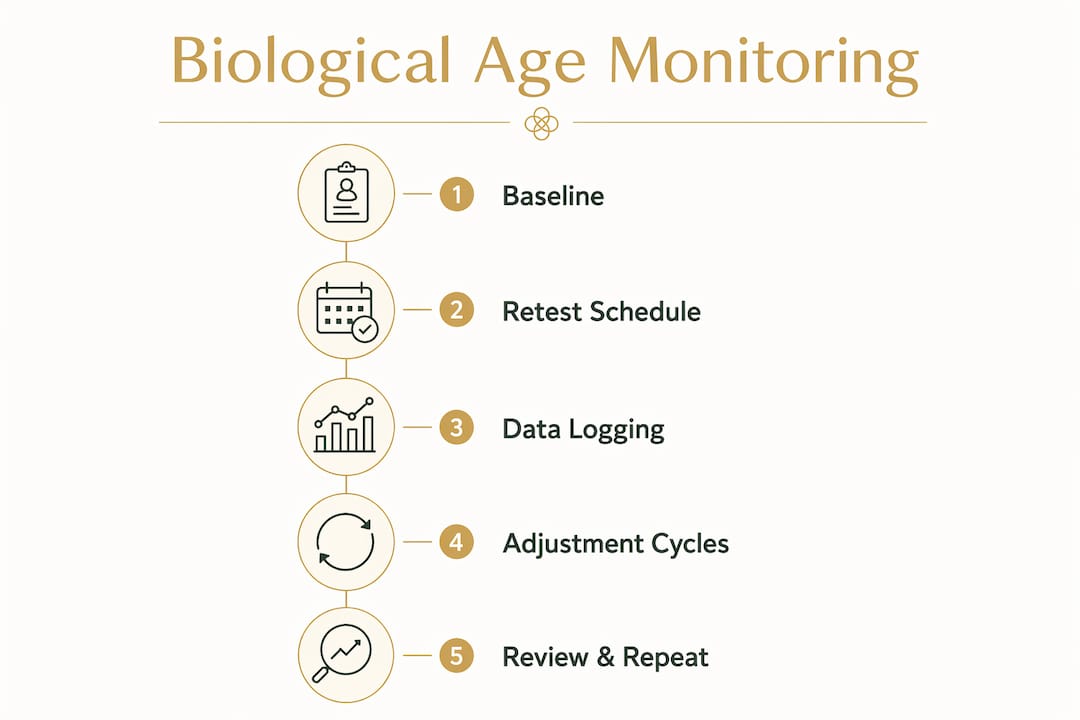
Step 1: establish your baseline
Run a blood biomarker panel and a TruAge DNA methylation test within the same 30-day window. This is your starting point. Record your DunedinPACE score, your CRP, fasting insulin, HbA1c, and lipid ratios. Note your current weight, sleep average, and exercise frequency. Context matters as much as the numbers.
Step 2: set your retest schedule
Retesting methylation clocks more frequently than every 6–12 months produces technical noise that exceeds genuine signal. Epigenetic changes accumulate slowly. Your schedule should look like this:
- Quarterly: Full blood biomarker panel (CRP, insulin, HbA1c, lipids, vitamin D, homocysteine)
- Every 6–12 months: TruAge DNA methylation test with DunedinPACE
- Daily or weekly: Wearable data (heart rate variability, resting heart rate, sleep stages via Oura Ring or WHOOP)
Wearables bridge the feedback gap between molecular tests. They do not measure biological age directly, but they track the inputs that drive it.
Step 3: log and interpret your data
Use a spreadsheet, Notion, or a dedicated longevity platform to log every test result with its date and health context. Track your DunedinPACE score over time as a line graph. A downward slope is the goal. Compare each blood panel to the previous one and note which markers moved and in which direction.
| Biomarker | Target Direction | Retest Frequency | Why It Matters |
|---|---|---|---|
| DunedinPACE | Below 1.0, trending down | Every 6–12 months | Measures rate of aging directly |
| CRP | Below 1.0 mg/L | Quarterly | Reflects systemic inflammation |
| Fasting Insulin | Below 5 µIU/mL | Quarterly | Predicts metabolic aging |
| HbA1c | Below 5.4% | Quarterly | Long-term glucose control |
| Homocysteine | Below 9 µmol/L | Every 6 months | Linked to cardiovascular aging |
For comprehensive comparisons of biological age test methods by accuracy and cost, structured guides can help you decide which panels fit your budget and goals.
Step 4: run adjustment cycles
Every 90 days, review your blood panel data and adjust one or two lifestyle variables. Change one thing at a time. This is how you isolate what is actually working. After 12 months, compare your epigenetic test results to your baseline and calculate your trajectory slope.
Key takeaways
Consistent, multi-layer biological age tracking is the only method that reliably distinguishes genuine aging reversal from normal biological fluctuation.
| Point | Details |
|---|---|
| Use multiple test types | Combine quarterly blood panels with annual TruAge epigenetic tests for complete data. |
| Track trajectory, not snapshots | A single test result is unreliable; meaningful change requires at least three data points over time. |
| DunedinPACE is your velocity metric | A shift of 0.05 or more over 90 days confirms your protocol is working at the molecular level. |
| Address all four aging layers | Physical interventions alone leave emotional, spiritual, and energetic aging drivers unresolved. |
| Context every result | Recent illness or stress can distort test results; always log health events alongside your data. |
What 15 years of tracking taught me about biological age data
Most people who start tracking their biological age make the same mistake. They run one test, get a number, and treat it as truth. I did the same thing in my first year of research. My TruAge result came back and I spent weeks adjusting my protocol based on a single data point. That was a waste of time. The number meant almost nothing without a second and third test to establish direction.
What changed everything for me was shifting my focus from the number to the slope. When my DunedinPACE score dropped from 0.82 to 0.71 over 12 months, that told me more than any single test ever could. It told me the aging program was being rewritten. My most recent TruAge test confirmed a biological age of 23 at 41 years old. That result did not come from one intervention. It came from 15 years of layered protocol work across all four dimensions of aging simultaneously.
The biggest mistake I see in my coaching practice is people who optimize their diet and exercise perfectly but ignore emotional and energetic aging. Stored trauma keeps your nervous system in a chronic stress state. That state drives cortisol, which drives inflammation, which drives epigenetic aging. You cannot out-supplement a dysregulated nervous system. The longevity field is increasingly recognizing that biological age is not purely a physical variable. It is a whole-system output.
My practical advice: run your baseline tests this month, commit to 90 days of protocol work, and let the data tell you what is real. Do not adjust your protocol based on feelings. Adjust it based on your DunedinPACE score and your quarterly blood panel. The data will not lie to you if you collect it correctly.
— E. Christian Trejo
Start reversing your biological age with verified results
If you are ready to move beyond tracking and into actual reversal, Timeless - Reverse Your Age offers the only DNA-verified guarantee in the longevity space. The TIMELESS Vitality Intensive is an 8-week private coaching program built on the four-layer aging protocol, and it is backed by a guarantee: reverse your biological age by at least 10 years in 6 months, confirmed by TruAge DNA methylation testing, or every dollar is refunded.
The complete system is also documented in the TIMELESS book, a 370-page blueprint available for $29.99. If you want to understand the full four-layer protocol before committing to coaching, the book is where to start. For personalized guidance and a free diagnostic assessment, you can book a Vitality call and get a clear picture of where your biological age stands today and what it will take to move it.
FAQ
What is biological age and how is it different from chronological age?
Biological age reflects the functional and molecular state of your cells, measured through biomarkers like DNA methylation patterns and inflammatory markers. Chronological age simply counts years lived, regardless of how well or poorly your body has aged.
How often should you test your biological age?
Run blood biomarker panels quarterly and epigenetic tests like TruAge every 6–12 months. Retesting epigenetic clocks more frequently than that produces noise rather than meaningful signal.
What is DunedinPACE and why does it matter?
DunedinPACE is a pace-of-aging metric that measures how fast you are aging relative to calendar time. A score below 1.0 means you are aging slower than your chronological clock, and a shift of 0.05 or more over 90 days confirms a meaningful intervention response.
Can lifestyle changes actually lower your biological age?
Yes. A systematic review of 41 studies confirmed that exercise, dietary changes, caloric restriction, and targeted supplements measurably lower epigenetic age outputs. Results appear in blood biomarkers within weeks and in epigenetic clocks within 6–12 months.
What is the TIMELESS four-layer protocol?
The TIMELESS four-layer protocol addresses biological aging at the Physical, Emotional, Spiritual, and Energetic levels simultaneously. Most longevity programs target only the physical layer, leaving three active drivers of aging unaddressed.