
Spermidine in Hungary: Food First, Not a Solo Fix
Human studies link spermidine with lower mortality, but lasting benefits remain unproven. See how putting food first fits TIMELESS’s four layers.
Spermidine in Hungary: Food First, Not a Solo Fix
Dietary spermidine supports cellular cleanup through autophagy, and higher intake correlates with lower mortality in long-term human cohorts. Short-term trials confirm good safety at research doses, though no trial has run long enough to prove lasting benefit. Our recommendation: build your plate around spermidine-rich foods first, and treat supplements as a secondary tool you discuss with a clinician, not a shortcut.
TL;DR:
- Meals can reach the 8 to 12 mg daily intake range used in studies with wheat germ, fermented soy, aged cheese, mushrooms, and legumes.
- A Korean study of more than 37,000 adults linked plant based spermidine intake with lower mortality, but cohort findings cannot establish cause and effect.
- A trial lasting 28 days found no adverse events among healthy older men taking 40 mg daily, but long term benefits remain untested.
- A study of 12 adults found no significant plasma rise after 15 mg daily for five days, suggesting intake does not directly determine circulating levels.
- Pregnant or breastfeeding people, those receiving chemotherapy or immune suppressing treatment, and anyone with a chronic condition should consult a clinician before taking supplements.
Table of Contents
- What Spermidine Is and How It Works in Your Cells
- How Strong Is the Human Evidence Behind Spermidine?
- Which Foods Actually Give You Spermidine, and How Much?
- Supplements, Dosing, and What Safety Data Actually Show
- Building Spermidine Into a Longevity Plan That Actually Holds Up
- Why We Think Spermidine Gets Oversold as a Solo Fix
- How TIMELESS Turns This Research Into a Plan You Can Follow
- FAQ
- Sources
What Spermidine Is and How It Works in Your Cells
Spermidine is a polyamine, a small molecule your cells produce naturally and that you also take in through food. Levels decline as you age, which is part of why researchers got curious about whether topping them up through diet could matter.
The mechanism that gets the most attention is autophagy, your cells’ internal recycling system. Damaged proteins and worn-out cell parts get tagged, broken down, and either reused or cleared out. When autophagy slows down, as it tends to with age, the junk piles up. That pileup shows up in tissue under stress, in slower repair, and in markers researchers associate with aging itself.
Spermidine nudges this system back into gear through two routes. First, it inhibits an enzyme called EP300, which normally acts as a brake on autophagy. Taking the brake off lets the cleanup machinery run more freely. Second, spermidine is required for a chemical modification called hypusination, which activates a protein (eIF5A) involved in making the proteins your autophagy system needs to function. Mechanistic reviews describe both pathways as central to how spermidine extends lifespan in lab organisms, from yeast to flies to mice.

Here’s the distinction we think gets lost in most consumer coverage: spermidine is not a vitamin. With a vitamin, you have a deficiency state and a correction. Spermidine doesn’t work that way. You’re not “deficient” in it the way you’d be deficient in vitamin D. Instead, it’s a regulator, a molecule that shifts the balance of a process your body already runs, toward more cleanup and renewal. That framing matters because it sets honest expectations. Eating more spermidine-rich food doesn’t fix a hole. It turns up the dial on a system you already have.
This is also why we think about spermidine as one input among several rather than a stand-alone fix. Your mitochondria, your inflammatory signaling, and your cellular maintenance systems are all connected. A molecule that nudges one lever rarely rewrites the whole picture by itself, which is exactly why we built the TIMELESS protocol around four layers instead of one. More on that below.
How Strong Is the Human Evidence Behind Spermidine?
This is where the spermidine conversation gets interesting, and where it gets overstated. Two different kinds of human data exist, and they tell different parts of the story.
Cohort evidence. The most cited data come from the Bruneck cohort, a long-running Italian population study. Adults with higher dietary spermidine intake showed lower all-cause and cardiovascular mortality than those with lower intake, and one analysis in that body of research estimated a longer life expectancy in the highest intake group compared to the lowest. A separate population study following more than 37,000 adults in a Korean national health database found a similar inverse relationship between plant-derived spermidine intake and all-cause and cardiovascular mortality, an association that held up after adjusting for other factors and that was more pronounced in older adults and men.
Interventional and safety trials. Observational data can’t prove cause and effect, so researchers have run smaller controlled trials. A randomized, placebo-controlled safety study of a high-purity spermidine supplement (hpSPD) gave healthy older men 40 mg per day for up to 28 days and found no treatment-related adverse events, with no meaningful changes in blood chemistry, lipids, or hematology. That’s a meaningful tolerability signal, but tolerability isn’t the same as proven benefit.
On cognition specifically, a review of both observational and interventional studies looked at 22 studies and found mixed results: some interventional trials reported memory improvements, others didn’t, and inconsistent measurement tools make it hard to draw a single conclusion. One encouraging detail: a dietary intervention using a polyamine-rich diet for one year reduced inflammatory markers in participants, which fits the broader autophagy story even without a clean cognitive outcome.
Why the picture stays blurry. A few limitations keep these findings from becoming settled fact.
- Cohort studies show association, not causation. People who eat more spermidine-rich foods often have other healthier habits that could explain part of the mortality gap.
- Most interventional trials run for weeks, not years, so we have safety data but limited long-term efficacy data.
- Your body regulates spermidine tightly. A crossover pharmacokinetic study gave 12 adults 15 mg per day for five days and found plasma spermidine didn’t rise significantly, even though spermine (its metabolic product) did. Your body appears to convert and buffer spermidine quickly, which complicates the idea that “more intake equals more circulating spermidine.”
- Study designs vary enough in dose, duration, and measurement that comparing results directly is often misleading.
The lower-mortality association in the Bruneck cohort is one of the more consistently replicated findings in spermidine research, and it’s a major reason we take dietary spermidine seriously as part of a broader protocol rather than dismissing it as a fad.
Which Foods Actually Give You Spermidine, and How Much?
Food-first is the right starting point, and the numbers back it up. Research-associated intake ranges sit around 8 to 12 mg per day, a target that’s realistic to hit through ordinary meals rather than requiring a supplement regimen.
These food-level estimates vary with fermentation stage, ripeness, and preparation. Fermented soy products like natto generally run higher than fresh soybeans because fermentation concentrates polyamines. Aging adds similar concentration effects to cheese. Cooking method and portion size shift the numbers too, which is why ranges rather than fixed values are the honest way to report this.
A realistic day that lands in the research-associated range looks like this:
- Breakfast: Oatmeal topped with 2 tablespoons of wheat germ and a sliced pear.
- Lunch: A lentil and vegetable salad with a side of aged cheddar.
- Snack: A small serving of edamame or a handful of mixed legumes.
- Dinner: Stir-fried mushrooms and green peas over rice, with natto on the side if you enjoy the flavor and texture (it’s an acquired taste for most people outside Japan, but it’s one of the most concentrated sources available).
If natto isn’t for you, leaning harder on wheat germ, aged cheese, and mushrooms across meals gets you close to the same range without it.
Supplements, Dosing, and What Safety Data Actually Show
Supplements exist for people who want a more concentrated, consistent dose than food alone reliably provides, but the evidence here is narrower than the marketing around it.
The most relevant human safety data come from the hpSPD trial already mentioned: 40 mg per day of a high-purity spermidine trihydrochloride for up to 28 days, with no treatment-related adverse events in healthy older men. That’s a solid short-term tolerability signal at a dose roughly four to five times higher than typical dietary intake. Separately, the crossover pharmacokinetic study used a lower 15 mg per day dose over five days and still saw minimal plasma spermidine changes, reinforcing how tightly your body regulates this molecule regardless of intake route.
A few practical points worth knowing before you consider a supplement:
- Trial doses (15 to 40 mg per day) are considerably higher than what most food-extract supplements on the market provide per serving.
- Higher purity doesn’t automatically mean higher absorption. Your body converts a meaningful share of oral spermidine into spermine before it reaches circulation.
- No published trial has tracked outcomes like mortality, cognitive change, or cardiovascular events over months or years at a fixed supplement dose. Safety data and efficacy data are not the same thing, and right now we have more of the former.
- Pregnant or breastfeeding individuals, people on immunosuppressive or chemotherapy regimens, and anyone with a chronic condition should talk to a physician before starting any polyamine supplement, since these populations were not part of the safety trials above.
Pro Tip: If you’re going to try a supplement, keep it as an addition to a spermidine-rich diet, not a replacement for one, and reassess with your clinician after a few months rather than taking it indefinitely without checking in.
Building Spermidine Into a Longevity Plan That Actually Holds Up
Diet changes alone rarely move the needle on aging the way people hope, not because the food science is wrong, but because aging isn’t a single-layer problem. This is the core premise behind the TIMELESS four-layer protocol, and it’s worth walking through how spermidine fits inside it rather than standing alone.
- Physical layer: Prioritize wheat germ, fermented soy, aged cheese, and mushrooms daily, and pair that intake with time-restricted eating and regular exercise. Food-based spermidine and metabolic triggers like fasting activate autophagy through different molecular routes (EP300/hypusination versus nutrient-sensing pathways), so combining them gives you two complementary signals instead of one.
- Emotional layer: Chronic stress and unresolved nervous system dysregulation drive inflammation that can work against the cellular maintenance spermidine supports. Addressing stored tension matters as much as what’s on your plate.
- Spiritual layer: Your subconscious beliefs about aging, whether you expect decline or expect vitality, shape behavior in ways that compound over years. This layer is about identity, not nutrition, but it determines whether you stick with the physical steps.
- Energetic layer: Supporting your bioelectric field and meridian function through dedicated practices rounds out what food and mindset alone don’t reach.
Set your expectations around biomarkers and function, not a single number. If you’re considering supplementation beyond food, a clinician check-in before you start, and periodically after, is the responsible move.
Why We Think Spermidine Gets Oversold as a Solo Fix
Here’s our honest read after going through the cohort data, the trial data, and the mechanism papers side by side: spermidine is a real, defensible piece of the aging puzzle, and it is not, on its own, a reason to expect dramatic change.
The DNA-verified result I track in my own biology didn’t come from one molecule. It came from addressing cellular inputs like spermidine-rich food alongside the emotional, spiritual, and energetic layers that most longevity content ignores entirely. That’s the gap we see constantly: single-nutrient thinking applied to a multi-system problem.
If you take one thing from the evidence here, take this. The Bruneck mortality association is genuinely compelling, and the safety data on moderate supplementation is reassuring. But neither of those facts means spermidine alone will reverse your biological age. Food-first, paired with the other three layers, is where the real signal lives.
— E. Christian Trejo
How TIMELESS Turns This Research Into a Plan You Can Follow
Reading the spermidine research is useful. Knowing exactly how to sequence it with the emotional, spiritual, and energetic work that determines whether it sticks is a different problem, and it’s the one we built TIMELESS to solve.
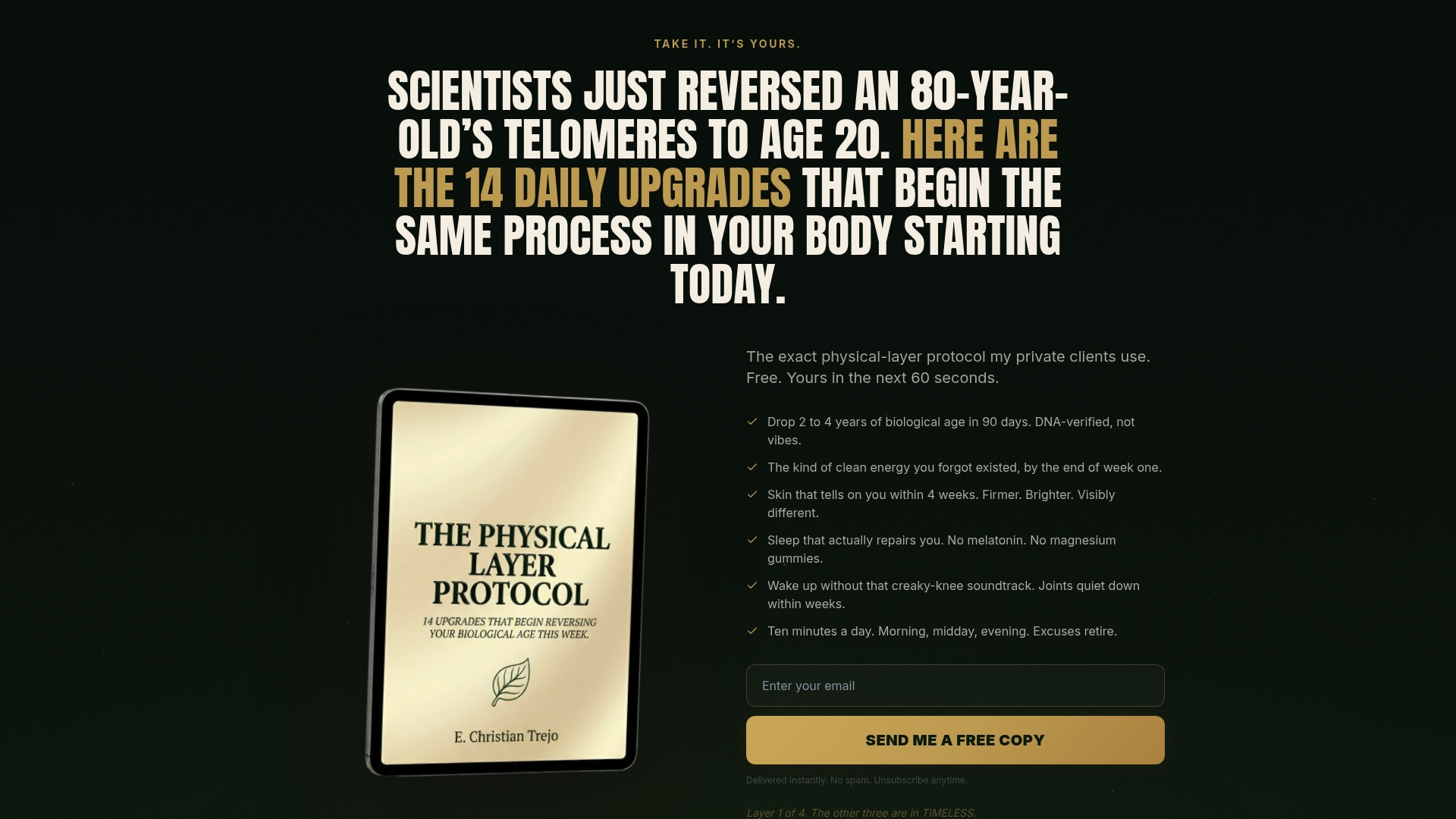
The TIMELESS: Reverse Your Age book ($29.99) is the 370-page blueprint we wrote to walk you through all four layers step by step, including exactly where food-based interventions like spermidine-rich eating fit alongside the nervous system, identity, and bioelectric work that most aging advice skips. For readers who want a coached route instead of self-directed reading, the TIMELESS Vitality Intensive is our 8-week private program, and it comes with a guarantee: a minimum of 10 years of biological age reversal in 6 months, verified by TruAge DNA methylation testing, or you get every dollar back. No other longevity program backs its claims with that level of accountability.
What each option includes:
- The book: the complete four-layer framework, written for readers working through the protocol on their own.
- The Vitality Intensive: 1-on-1 coaching, DNA methylation testing before and after, and the reversal guarantee described above.
- A free starting point: our 14 Upgrades guide if you want a no-cost first step before committing to either.
Ready to see which layer you’re missing? Explore the Vitality Intensive and start with a program built to prove its results, not just promise them.
This article is general information, not a substitute for advice from a qualified doctor. Consult a qualified healthcare professional about your own circumstances before acting on anything here.
FAQ
Mire jó a spermidin?
Spermidine supports autophagy, your cells’ process for clearing out damaged components and recycling them, which researchers link to healthier aging at the cellular level. Human cohort data also associate higher dietary intake with lower all-cause and cardiovascular mortality, though this reflects correlation in population studies rather than proof that spermidine alone extends life.
Mi a spermidin kapszula, és mire kell figyelni vásárlás előtt?
A spermidine capsule is a concentrated supplement form, often derived from wheat germ extract or made as a high-purity compound, designed to deliver a fixed daily dose. Before choosing one, check whether the dose matches research ranges (trials have used 15 to 40 mg per day) and talk to a clinician first, since long-term outcome data for any brand or formulation remains limited.
Milyen biztonsági adatok állnak rendelkezésre a spermidin kapszulákról?
A randomized, placebo-controlled trial found that 40 mg per day of a high-purity spermidine supplement for up to 28 days produced no treatment-related adverse events in healthy older men, with stable blood chemistry and lipid markers. That’s a solid short-term safety signal, but no published trial has tracked supplement use over months or years, so long-term safety and benefit remain unestablished.
Mi a GymBeam spermidin, és miben különbözik más forrásoktól?
Commercial spermidine products sold under various brand names typically use wheat germ extract or synthesized spermidine trihydrochloride as their active ingredient, similar to the formulations tested in published trials. The practical difference between brands usually comes down to dose, purity, and whether the product discloses the exact milligram amount per serving, which matters more for comparing against research than the brand name itself.
Sources
- Higher spermidine intake is linked to lower mortality: a prospective population-based study
- Spermidine for cognitive ageing: insights into observational and interventional studies
- Pharmacokinetics and metabolism of orally administered spermidine in humans (crossover study)
- Review: spermidine and caloric restriction mimetic mechanisms (Madeo et al.)