Longevity Science vs Cosmetics: What You Need to Know
Discover what is longevity science vs cosmetics. Learn how these approaches differ and find out how to extend your healthspan effectively.
Longevity Science vs Cosmetics: What You Need to Know
Longevity science is a multidisciplinary field focused on understanding and intervening in the biological mechanisms of aging to extend healthspan, and it is fundamentally different from cosmetics, which improve skin appearance without altering systemic aging. Understanding what is longevity science vs cosmetics matters because the anti-aging market blurs this line constantly. Retinol serums sit next to “longevity” supplements on the same shelf, and marketing language makes them sound equivalent. They are not. One targets the surface. The other targets the program running underneath it.
What is longevity science and how does it target aging?
Longevity science, formally called geroscience, investigates the nine hallmarks of aging to extend healthspan systemically. These hallmarks include genomic instability, telomere attrition, epigenetic alterations, loss of proteostasis, and cellular senescence, among others. Each one represents a biological failure mode that compounds over time. Longevity science targets these failure modes directly.
The field uses measurable tools. The DunedinPACE DNA methylation clock, for example, measures how fast a person is biologically aging at the cellular level. This is not a skin assessment. It is a readout of your epigenome, the chemical layer that controls which genes get expressed. When that readout changes, your biological age changes. That is the standard longevity science works toward.
Current interventions include:
- Senolytics: Compounds that clear senescent (“zombie”) cells, which accumulate with age and drive chronic inflammation. Over 20 companies were testing senolytic therapies in 2026.
- Epigenetic reprogramming: Techniques that reset gene expression patterns to a younger state, reversing one of the core hallmarks of aging.
- Metabolic interventions: Caloric restriction mimetics like rapamycin and metformin, studied for their effects on the mTOR and AMPK pathways.
- Lifestyle-based epigenetic shifts: Sleep quality, resistance training, and dietary protocols that measurably alter DNA methylation patterns.
The goal is not to look younger. The goal is to be younger at the cellular level, with measurable proof.
The TIMELESS four-layer aging protocol built by Timeless - Reverse Your Age addresses this at four simultaneous levels: Physical (cellular, epigenetic, mitochondrial), Emotional (stored trauma, nervous system dysregulation), Spiritual (identity and subconscious beliefs about aging), and Energetic (bioelectric field, meridians). Most longevity programs address one layer. This protocol addresses all four, because aging is a four-layer problem that requires a four-layer solution.
Pro Tip: Ask any anti-aging program for your biological age before and after. If they cannot provide a DNA methylation test result, they are measuring nothing. Chronological age is just a number. Biological age is the truth.
What are cosmetics for aging and their limitations?
Cosmetics are regulated by the FDA as non-drug products. That classification carries a critical implication: cosmetics do not require pre-market approval or rigorous clinical trials to prove efficacy. A drug must demonstrate that it changes biological function. A cosmetic only needs to be safe to apply. This regulatory gap is where most consumer confusion lives.
Here is how to evaluate cosmetic anti-aging claims critically:
- Check the study size. A 2026 study of 32 women over 12 weeks showed improved skin radiance from a cosmetic formula. That is a real result. It is also not biological age reversal. Small, short-term studies measure surface outcomes, not systemic aging.
- Identify the ingredient category. Retinoids, peptides, and antioxidants are the workhorses of anti-aging cosmetics. They are effective at what they do: stimulating collagen, reducing oxidative stress, and improving skin texture. None of them reprogram your epigenome.
- Decode the marketing language. Words like “cellular renewal” and “age-defying” are cosmetic claims, not drug claims. The FDA prohibits cosmetics from claiming to alter biological structure or function. If a product crosses that line, it legally becomes a drug.
- Look for longevity rebranding. Longevity branding reframes the same retinol and peptide formulas under new language without adding new biological mechanisms. The ingredients are identical. The price tag is not.
- Ask what is being measured. Skin hydration, radiance, and wrinkle depth are cosmetic outcomes. Biological age, inflammatory markers, and telomere length are longevity outcomes. These are different measurements of different things.
Cosmetics deliver real, visible benefits. Hydrated skin looks better. Retinoids reduce fine lines. These are legitimate outcomes worth pursuing. The problem is not the products. The problem is the claim that these outcomes constitute age reversal.
Pro Tip: When a skincare brand uses the word “longevity,” ask one question: do they measure biological age before and after use? If the answer is no, the word is marketing, not science.
How do longevity science and cosmetics differ in their approach to skin aging?
Skin aging is where the two fields overlap most visibly, and where the confusion runs deepest. Skin longevity science focuses on preserving the skin’s functional and structural integrity through biological processes: barrier health, hydration retention, and cellular resilience. Cosmetics treat the symptoms of those failures after they appear.
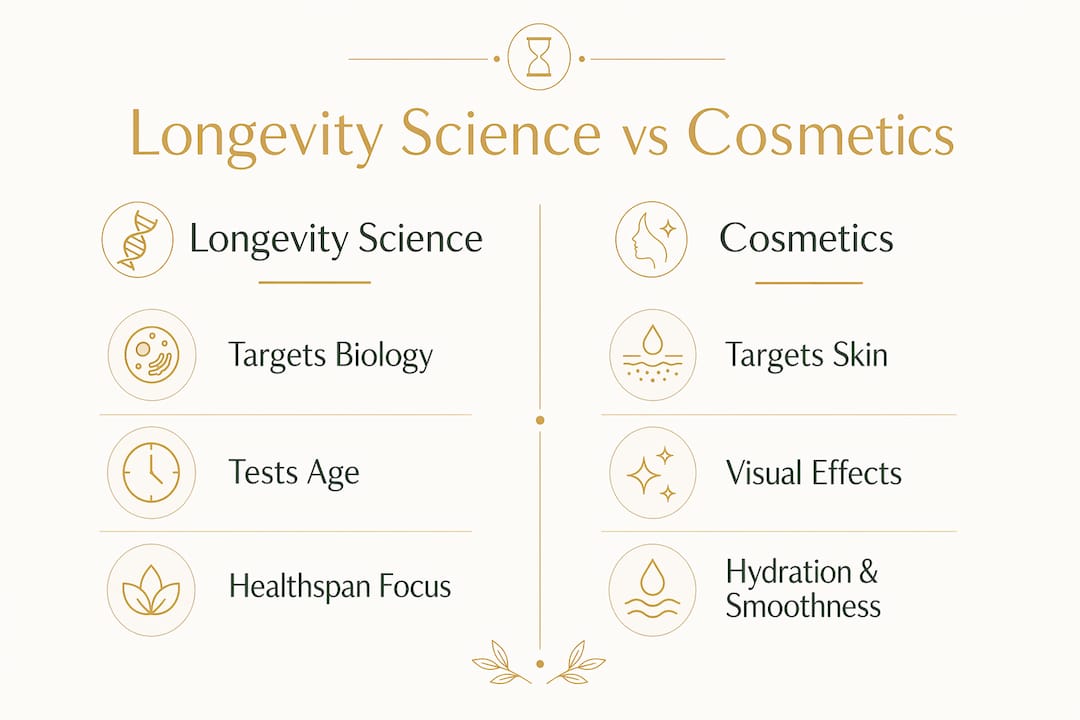
The concept of “longevity cosmeceuticals” sits in between. It sounds scientific. Researchers at Frontiers in Aging confirmed that longevity cosmeceuticals lack standardized biomarker data and peer-reviewed validation for systemic impact. The category exists as a marketing concept, not a scientific classification. That does not mean the ingredients are useless. It means the longevity claim is unverified.
| Category | Target | Testing standard | Expected outcome |
|---|---|---|---|
| Longevity science | Biological aging mechanisms (epigenome, senescence, mitochondria) | DNA methylation clocks, longitudinal biomarker studies | Measurable biological age reduction |
| Longevity cosmeceuticals | Skin cellular processes (antioxidant defense, barrier function) | Small-scale dermatological trials, no standardized biomarkers | Improved skin health markers, no systemic age reversal |
| Standard cosmetics | Visible skin signs (wrinkles, hydration, radiance) | Short-term consumer studies, no pre-market approval required | Temporary appearance improvements |
The table above shows why the difference between longevity science and cosmetics is not a matter of degree. It is a matter of category. You cannot get from column three to column one by adding a better peptide. The mechanisms are different. The measurements are different. The outcomes are different.
Common misconception: using a high-quality skincare routine is “doing longevity.” It is not. It is doing skincare well. That is worth doing. It is just not the same thing.
What are practical implications for holistic age management?
Relying on cosmetics alone for age management is like painting a house with a cracked foundation. The surface looks better. The structure keeps deteriorating. Evidence-based longevity science consistently points to foundational lifestyle pillars as the primary drivers of biological age change.
Nobel Laureate Venki Ramakrishnan identifies sleep, diet, and exercise as the core trio of longevity essentials. No topical product replaces these. This is not a wellness opinion. It is molecular biology.
Practical steps for integrating longevity science with your existing skincare routine:
- Measure your biological age. Use a TruAge or DunedinPACE DNA methylation test as your baseline. This gives you a real number to work against, not a mirror reflection.
- Prioritize sleep architecture. Deep sleep is when cellular repair, growth hormone release, and glymphatic clearance happen. Disrupted sleep accelerates epigenetic aging faster than most topical products can compensate for.
- Address emotional and nervous system health. Chronic stress drives cortisol dysregulation, which accelerates telomere shortening and inflammatory aging. This is the Emotional layer of the TIMELESS protocol, and most people never address it.
- Support your bioelectric field. Grounding, breathwork, and meridian-based practices influence the Energetic layer of aging. These are not metaphors. They are measurable inputs into your body’s regulatory systems.
- Use cosmetics for what they do well. A good SPF, a retinoid, and a barrier-supporting moisturizer are legitimate tools for skin health. Place them in the right category: surface maintenance, not age reversal.
The TIMELESS aging protocol addresses all four layers simultaneously because none of them operates in isolation. Physical cellular health, emotional regulation, spiritual identity, and energetic coherence all influence how fast your biological clock runs.
Key Takeaways
Longevity science targets the biological mechanisms of aging with measurable tools like DNA methylation testing, while cosmetics address visible skin signs without altering systemic aging processes.
| Point | Details |
|---|---|
| Longevity science targets biology | Geroscience addresses nine hallmarks of aging using epigenetic clocks, senolytics, and systemic interventions. |
| Cosmetics are surface-level tools | FDA-classified cosmetics improve appearance but do not require clinical proof of biological age change. |
| “Longevity” branding is often marketing | Longevity cosmeceuticals lack standardized biomarkers and peer-reviewed validation for systemic impact. |
| Lifestyle pillars outperform topicals | Sleep, diet, and exercise produce measurable epigenetic changes that no skincare product can replicate. |
| Four-layer aging requires four-layer solutions | Physical, Emotional, Spiritual, and Energetic dimensions all drive biological aging and must be addressed together. |
Why I stopped trusting the mirror as my aging metric
I was 41 years old when my TruAge DNA methylation test confirmed a biological age of 23. My skin looked fine before that test. It looked fine after. The mirror told me nothing useful. The test told me everything.
That is the core problem with how most people approach anti-aging. They use appearance as the metric. Appearance is a lagging indicator. By the time your skin shows significant aging, the biological processes driving it have been running for years. Cosmetics address the lag. Longevity science addresses the source.
I have spent 15 years building and testing the TIMELESS protocol across thousands of practitioners in 40 countries. The people who get the most dramatic biological age reversals are never the ones with the most expensive skincare routines. They are the ones who addressed their nervous system dysregulation, their subconscious beliefs about aging, their sleep architecture, and their cellular health simultaneously. The four layers work together. Ignoring three of them and buying a better serum is not a longevity strategy.
Consumers deserve clarity here. The word “longevity” is being attached to products that have no longevity science behind them. That is not a minor marketing nuance. It is a misdirection that costs people time, money, and most importantly, biological years they could have been recovering. Evaluate every anti-aging claim with one question: what does it measure, and how?
— E. Christian Trejo
The TIMELESS protocol: biological age reversal with verified results
The difference between longevity science and cosmetics becomes concrete when you have a number to point to. Timeless - Reverse Your Age is the only program that guarantees a 10-year biological age reversal in 6 months, verified by TruAge DNA methylation testing, or every dollar is refunded.
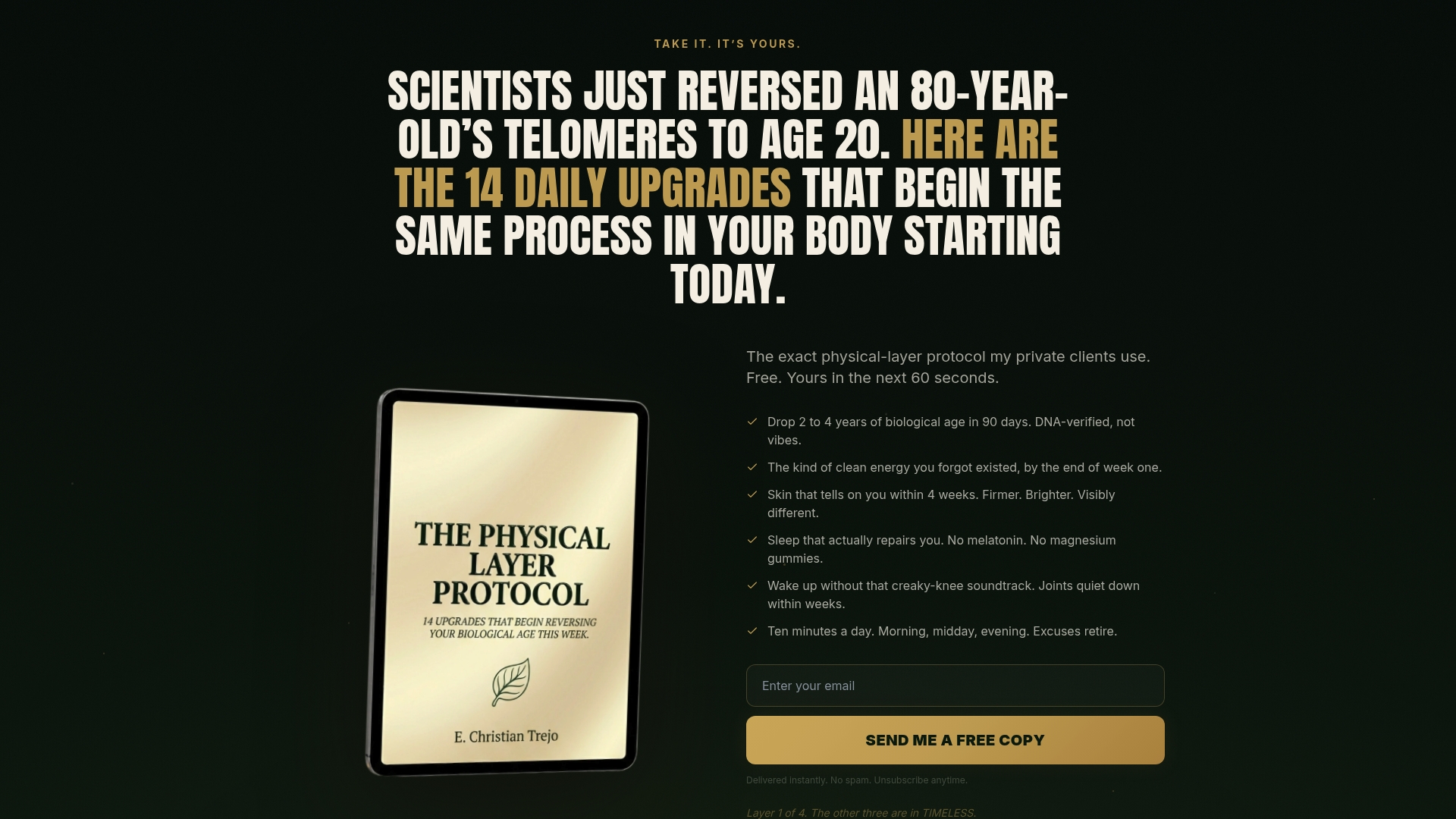
The TIMELESS book is a 370-page blueprint documenting the complete four-layer protocol for $29.99. For personalized guidance, the TIMELESS Vitality Intensive is an 8-week private coaching program at $7,000 with the DNA-verified guarantee attached. No other program in the longevity space offers this level of scientific accountability. Start with the book, get your biological age tested, and build from there.
FAQ
What is the difference between longevity science and cosmetics?
Longevity science targets the biological mechanisms of aging, such as epigenetic alterations and cellular senescence, using measurable tools like DNA methylation clocks. Cosmetics improve visible skin signs without altering underlying aging processes or requiring clinical proof of efficacy.
Can anti-aging cosmetics reverse biological age?
No. The FDA classifies anti-aging topical products as cosmetics, which do not require pre-market approval or rigorous trials to prove biological age change. They improve appearance, not biological age.
What are longevity cosmeceuticals?
Longevity cosmeceuticals are a marketing-driven category that applies longevity language to skincare products. Researchers confirm they currently lack standardized biomarkers and peer-reviewed validation for systemic biological age reversal.
How is biological age measured in longevity science?
Biological age is measured using DNA methylation clocks like TruAge and DunedinPACE, which assess epigenetic changes at the cellular level. These tests provide a measurable number independent of how a person looks.
What actually reverses biological age?
Sleep, diet, exercise, and nervous system regulation produce measurable epigenetic changes that drive biological age reversal. The TIMELESS four-layer protocol addresses Physical, Emotional, Spiritual, and Energetic dimensions simultaneously for verified results.