
HRV and Aging: Turn Daily HRV Gains Into DNA Verified Age Reversal
Use daily HRV trends as a fast resilience signal. Learn evidence‑backed habits that raise HRV in weeks and how DNA methylation tests verify true...
HRV and Aging: Turn Daily HRV Gains Into DNA Verified Age Reversal
Heart rate variability declines with chronological age on average, but the number is far more elastic than most people assume. HRV is a functional readout of your autonomic nervous system, not a fixed clock, and it moves in response to sleep, exercise, and stress within weeks. DNA methylation testing measures biological age at the molecular level, a different but complementary signal. Start by tracking your own HRV trend under consistent conditions, then work on sleep, movement, and breathing before you worry about the number itself.
TL;DR:
- HRV is highly responsive to sleep, exercise, and stress, and tracking its trend over weeks provides more meaningful insights than single readings.
- Factors like chronic stress, poor sleep, low fitness, inflammation, and substance use significantly lower HRV, but most are modifiable with consistent habits.
- Consumer wearable devices can track HRV trends, but ECG remains the gold standard for accuracy, especially for diagnostic purposes.
- Interventions such as aerobic exercise, sleep regularity, resonant breathing, diet, and cold exposure gradually improve HRV over several weeks.
- Persistent low HRV signals the need for medical evaluation if associated with fainting, irregular heartbeat, or ongoing decline despite healthy habits.
Table of Contents
- What Does HRV Have to Do With Aging?
- How Does HRV Change as You Get Older?
- What Causes Low HRV as You Age?
- ECG vs Wearables: Which HRV Measurement Is Right for You?
- What Actually Raises HRV? Evidence-Based Interventions
- When Should You See a Doctor About Low HRV?
- The Timeless Perspective on HRV and Real Age Reversal
- The Bottom Line on HRV and Aging
- What Do Long-Term Studies Show About HRV Across a Lifetime?
- How Do Chronic Illnesses Affect Heart Rate Variability?
- Does HRV Aging Look Different by Sex or Ethnicity?
- What Are the Limits of HRV Research?
- Why Everyday HRV Habits Matter More Than the Number Itself
- Turn HRV Progress Into Verified Biological Age Reversal
- Sources
- FAQ
What Does HRV Have to Do With Aging?
Heart rate variability measures the time between successive heartbeats, technically called RR intervals. A heart that speeds up and slows down fluidly, breath by breath, has high variability. A heart that ticks along at a nearly fixed interval has low variability, and that rigidity is the signature autonomic nervous systems show under chronic strain.
The autonomic nervous system runs on two competing branches. The sympathetic branch drives your fight-or-flight response and speeds the heart up. The parasympathetic branch, largely through the vagus nerve, slows it down and governs rest, digestion, and recovery. HRV reflects the ongoing negotiation between those two systems. When the balance tilts too far toward sympathetic dominance, and stays there, HRV drops.
That makes HRV a resilience marker more than an aging marker in the strict sense. It tells you how well your body absorbs stress and recovers from it right now, this week, based on how you slept, trained, and ate. It does not tell you how old your cells are at the molecular level.
That distinction matters because DNA methylation clocks measure something structurally different: chemical marks on your DNA that accumulate and shift with true biological aging. Where HRV answers “how is my nervous system handling stress today,” a methylation clock answers “how old are my cells, independent of the calendar.”
The two measures work best together:
- HRV gives you a fast, cheap, daily feedback loop you can act on immediately.
- Methylation testing gives you a slower, molecular confirmation that behavior change actually shifted your biological age.
- Neither replaces the other. A rising HRV trend with no methylation verification is a good sign, not proof.
- A favorable methylation result with a flat HRV trend suggests your day-to-day resilience has not yet caught up to your cellular gains.
How Does HRV Change as You Get Older?
HRV generally rises through childhood and adolescence, peaks in your late teens to twenties, and then declines gradually across adulthood. That downward slope is well documented in clinical reviews of heart rhythm patterns, which also flag something equally important: the decline is not uniform.
A fit, well-rested 55-year-old can post a higher HRV than a sedentary, chronically stressed 30-year-old. Interindividual variance in HRV, across otherwise similar age groups, is often as large as the average age-related decline itself. Fitness level, sleep consistency, body composition, and chronic stress load all bend the trajectory, sometimes dramatically.
This is precisely why comparing your single HRV reading to a population average tells you almost nothing useful. A number that sits below the “typical” range for your age could reflect one rough night, a hard training block, or a genuine chronic pattern. Only a trend distinguishes those cases.
Track your morning HRV for four to six weeks under consistent conditions before drawing conclusions. Look at the seven-day rolling average, not the daily number. A trend climbing steadily, even slowly, tells you more about your trajectory than any single-day comparison to a chart ever will.
What Causes Low HRV as You Age?
Some drivers of HRV decline are structural. Most are modifiable, and that is the entire point of paying attention to this number in the first place.
- Chronic stress and autonomic imbalance. Sustained cortisol elevation keeps the sympathetic branch dominant, suppressing the vagal tone that drives HRV upward.
- Poor sleep quality and irregular timing. Fragmented sleep and inconsistent bedtimes disrupt the nightly parasympathetic recovery window your heart rhythm depends on.
- Low cardiorespiratory fitness. A deconditioned cardiovascular system has less vagal reserve to draw on, so it defaults toward sympathetic dominance more easily.
- Systemic inflammation and metabolic disease. Elevated inflammatory markers interfere with autonomic signaling, a relationship documented in research on autonomic function and health outcomes.
- Substance use and certain medications. Alcohol, in particular, suppresses vagal tone for hours after consumption, and some beta blockers and antidepressants alter HRV readings independent of underlying health.
Each of these mechanisms converges on the same pathway: less parasympathetic input, more sympathetic dominance, a flatter heart rhythm.
Pro Tip: If you drink socially, check your HRV the morning after. Most people see a visible dip that lingers into the next day, even after just two or three drinks.
ECG vs Wearables: Which HRV Measurement Is Right for You?
Not every measurement method gives you the same picture, and the gap between clinical-grade and consumer-grade tools is bigger than most marketing admits.
ECG is the clinical gold standard for HRV, full stop. Methodological reviews comparing ECG, chest straps, and wrist devices confirm that ECG captures the electrical signal directly, with the precision needed for diagnostic use. Holter monitoring, a portable ECG worn for 24 hours, extends that precision into real-world diagnostic screening when a clinician suspects arrhythmia or significant autonomic dysfunction.
Chest straps, which also derive their signal from electrical activity rather than optical sensing, come in a close second and are the most practical accurate option for daily tracking. Wrist-worn devices using photoplethysmography, the optical pulse-sensing method in most smartwatches and rings, are convenient and good for spotting trends but measurably less accurate than chest-strap or ECG readings, particularly during movement.
Two metrics dominate everyday reporting:
- RMSSD (root mean square of successive differences), a time-domain measure closely tied to short-term parasympathetic activity.
- SDNN (standard deviation of NN intervals), a broader time-domain measure reflecting overall variability across the full recording period.
Frequency-domain analysis breaks the signal into high-frequency and low-frequency bands, offering a more granular look at vagal versus sympathetic contribution, though it is used more in research than in daily consumer tracking.
For a usable baseline: measure at the same time each morning, ideally supine or seated at rest for two to five minutes, before caffeine, and note anything unusual (poor sleep, alcohol, illness) alongside the reading.
What Actually Raises HRV? Evidence-Based Interventions
The interventions with the strongest evidence base share one trait: they work on a timeline, not overnight, and consistency beats intensity every time.
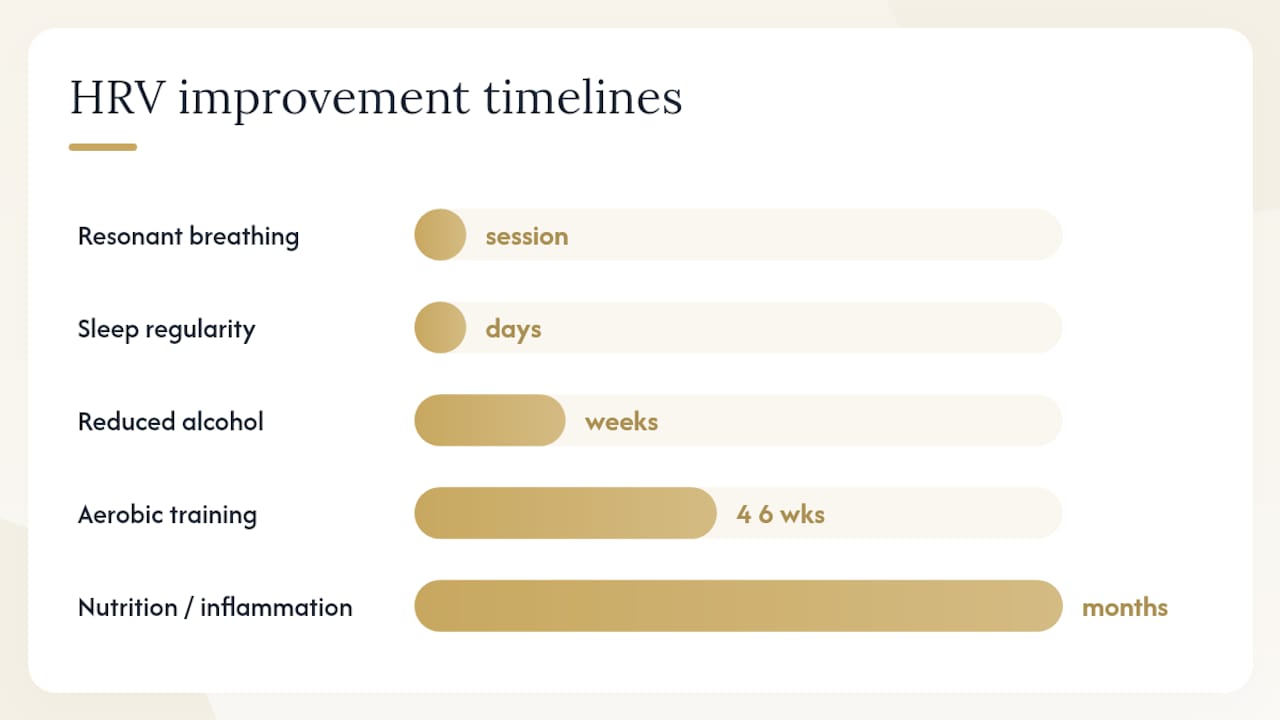
- Aerobic and mixed exercise. Randomized trials and meta-analyses show HRV improvements building over four to eight weeks of consistent training, with continued gains over several months.
- Sleep and circadian regularity. Fixing bedtime and wake time produces some HRV benefit within days, with fuller autonomic recovery over several weeks of consistent sleep.
- Resonant breathing and HRV biofeedback. Breathing at roughly six breaths per minute (a four-second inhale, six-second exhale) stimulates vagal tone directly and can shift HRV within a single session, with cumulative gains from daily practice.
- Nutrition and inflammation reduction. Lower inflammatory load, largely diet-driven, supports autonomic balance over a chronic, months-long timescale rather than producing a quick spike.
- Reduced alcohol intake. Cutting back reduces the acute suppression effect and, over weeks, supports a healthier baseline trend.
- Cold exposure. Brief cold showers or cold plunges can stimulate vagal activity, but they carry real cardiovascular risk for anyone with uncontrolled hypertension or heart disease and should be introduced gradually, ideally with medical clearance.
Combine no more than two or three of these at once so you can actually attribute a trend change to a specific habit, and give each combination four weeks before judging results.
Pro Tip: Start resonant breathing with just five minutes before bed. Ten to twenty minutes daily is the effective dose in most studies, but five minutes done consistently beats twenty minutes done twice.
When Should You See a Doctor About Low HRV?
A persistently low or crashing HRV trend is a reason to pay attention, not panic, but certain signs cross the line into something a clinician needs to evaluate directly.
- Episodes of fainting or near-fainting (syncope), which can point to significant autonomic or cardiac issues.
- A racing, fluttering, or irregular heartbeat you can feel, especially if it recurs.
- Poorly controlled diabetes, hypertension, or thyroid disease alongside a falling HRV trend.
- A sudden, unexplained HRV drop that persists for more than two to three weeks despite normal sleep and training.
Reduced HRV following a cardiac event correlates with worse long-term outcomes, which is exactly why autonomic markers get taken seriously in clinical cardiology, not just wellness tracking.
When you go in, bring your trend data, not a single reading: note the device you used, the time of day, and anything unusual around low points. A clinician will likely start with a resting ECG, may order 24-hour Holter monitoring if arrhythmia is suspected, and will typically screen basic metabolic markers alongside it.
The Timeless Perspective on HRV and Real Age Reversal
Most HRV advice stops at the physical layer: sleep more, exercise, breathe slower. That advice is correct, and it is also incomplete. The TIMELESS four-layer protocol treats low HRV as a symptom that can originate in any of four places, often more than one at once.
Physical covers what most people already track: mitochondrial function, cellular health, cardiorespiratory fitness. Emotional covers something HRV trackers rarely mention: stored trauma and nervous system dysregulation that keeps the sympathetic branch locked on regardless of how well you sleep. Spiritual addresses subconscious beliefs about aging itself, because a person who has decided decline is inevitable behaves in ways that make it so. Energetic works on the bioelectric field and meridian systems that influence autonomic tone through pathways conventional protocols ignore entirely.
Aging is a four-layer problem. Almost every protocol on the market addresses one layer, usually the physical, and calls it complete. That is why so many people do everything “right” and still see their HRV stall.
I built TIMELESS after my own TruAge DNA methylation test came back showing a biological age of 23 at 41 years old, verified, not estimated. Combining behavior change with targeted coaching and molecular testing is how you prove an HRV trend actually reflects biological-age reversal, not noise.
The Bottom Line on HRV and Aging
HRV is not a verdict on how old you are. It is a modifiable readout of how well your nervous system handles the life you are currently living, and it responds to real changes within weeks.
Three starter actions this week: check your HRV every morning under the same conditions, start ten minutes of resonant breathing daily, and commit to three moderate aerobic sessions weekly. Track the trend, not the daily number. If you want to know whether those changes are shifting your biological age at the molecular level, not just the functional one, that requires a different kind of test entirely.
What Do Long-Term Studies Show About HRV Across a Lifetime?
Cross-sectional snapshots miss the real story, which is why longitudinal data matters more for understanding HRV’s aging trajectory. Studies that follow the same individuals across years, rather than comparing different age groups at one point in time, consistently show the decline is not linear.
The steepest drop in HRV tends to occur from the twenties through the forties, a period packed with career stress, sleep disruption, and, for many, the onset of weight gain and reduced activity. The rate of decline then tends to flatten somewhat in the fifties and sixties among people who maintain fitness and sleep habits, while it steepens sharply in those who develop metabolic disease during the same window.
This pattern reinforces something clinical HRV reviews already emphasize: chronological age predicts a general direction, but the slope of your personal curve is set largely by what happens in midlife, not by genetics alone. People who intervene early, in their thirties and forties, tend to preserve a meaningfully flatter decline curve than those who wait until symptoms appear in their sixties.
The practical takeaway is timing. If you are in your thirties or forties reading this, you are in the window where intervention has the largest measurable effect on your future trajectory, not just your current number.
How Do Chronic Illnesses Affect Heart Rate Variability?
Chronic disease and low HRV feed each other in both directions, which is part of why autonomic markers get so much attention in cardiology and endocrinology alike.
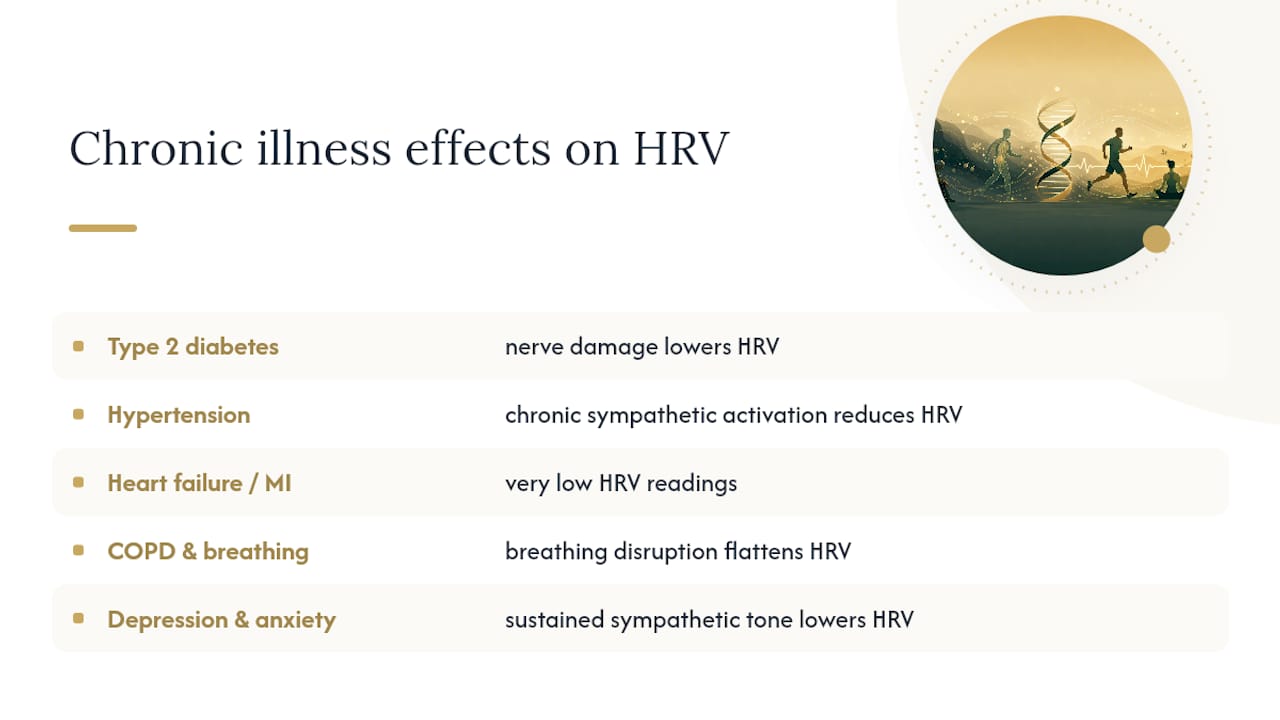
Type 2 diabetes damages the small nerve fibers that carry autonomic signals, a complication called cardiac autonomic neuropathy, which directly suppresses HRV as blood sugar control worsens over years. Hypertension keeps the sympathetic nervous system chronically activated to manage elevated pressure, crowding out the parasympathetic recovery signal HRV depends on. Heart failure and prior myocardial infarction are associated with some of the lowest HRV readings seen clinically, reflecting damaged or overworked cardiac tissue that cannot respond as flexibly to autonomic input.
Chronic obstructive pulmonary disease and other conditions that disrupt breathing mechanics also flatten HRV, since breathing rhythm and heart rhythm are tightly coupled through the vagus nerve. Even depression and anxiety disorders, though not “chronic disease” in the traditional sense, show consistent associations with lower HRV, likely through sustained sympathetic activation.
The overlap across these conditions points to a shared mechanism: systemic inflammation and autonomic strain compound each other, and inflammatory load itself appears to interfere with autonomic signaling independent of any single diagnosis. Managing the underlying condition, not just chasing the HRV number, remains the priority when a chronic illness is present.
Does HRV Aging Look Different by Sex or Ethnicity?
Sex differences in HRV show up early and persist across most of adulthood. Women generally show higher HRV than men of the same age through their reproductive years, an effect linked to estrogen’s influence on vagal tone. That gap narrows after menopause, when estrogen levels drop and the female HRV trajectory tends to decline somewhat more steeply for a period before leveling off again.
Men, by contrast, tend to show a steadier, more gradual decline across the same decades, without the same hormonally driven inflection point. The net effect is that the “advantage” women show earlier in life partially closes with age, though it rarely disappears entirely.
Ethnic and population differences in HRV are documented but less consistently characterized, in part because most large HRV datasets originate from a narrow set of countries and populations. Differences that do appear are frequently confounded by variation in average fitness levels, healthcare access, and rates of underlying conditions like hypertension and diabetes across populations, rather than reflecting a purely biological difference in autonomic aging.
The practical implication for you is straightforward: population averages segmented by sex are more useful as rough context than as a target. Your own baseline, tracked consistently, still tells you more than any demographic comparison.
What Are the Limits of HRV Research?
HRV research is genuinely useful, but it carries real limitations worth understanding before you over-interpret a single number.
- Measurement inconsistency across studies. Some research uses short two-to-five-minute readings, others use full 24-hour recordings, and the two are not directly comparable.
- Confounding lifestyle variables. Fitness, caffeine intake, hydration, and even the specific software algorithm calculating RMSSD can shift results independent of true physiological change.
- Device variability in consumer research. Studies using wrist-worn PPG devices carry more measurement noise than ECG-based studies, which can inflate or mute reported intervention effects.
- Limited long-duration randomized trials. Much of the intervention evidence covers eight to twelve weeks; data on whether HRV gains hold or continue improving over years is thinner.
- Population sampling bias. Many foundational studies draw from relatively healthy, motivated volunteers, which likely overstates how easily the general population sees the same results.
None of this undermines the core relationship between HRV, autonomic health, and aging. It does mean you should treat any single study’s exact numbers as directional rather than as a precise target to hit.
Why Everyday HRV Habits Matter More Than the Number Itself
The conventional wisdom on HRV treats it like a grade to optimize: get the number up, feel better about aging. That framing misses what the research actually supports, which is that HRV is a feedback signal about how four separate systems, physical, emotional, spiritual, and energetic, are functioning together on any given day.
Where most advice falls short is stopping at exercise and sleep hygiene, as if the nervous system operates in isolation from stored stress, identity beliefs about aging, or subconscious patterns that keep the sympathetic branch activated regardless of how many miles you run. I have seen people train hard, sleep eight hours, and still plateau because the emotional and spiritual layers never entered the equation.
Prioritize consistency over intensity first. A daily five-minute breathing practice will move your HRV further than one intense weekly session ever will, because the autonomic nervous system responds to repeated signals, not occasional heroics. Then, if you want proof that your efforts are translating into real biological change and not just a better morning number, pair the behavioral work with molecular verification.
— E. Christian Trejo
Turn HRV Progress Into Verified Biological Age Reversal
Tracking HRV tells you your nervous system is responding. It does not tell you whether your cells are actually aging in reverse, and that gap is exactly what Timeless — Reverse Your Age closes.
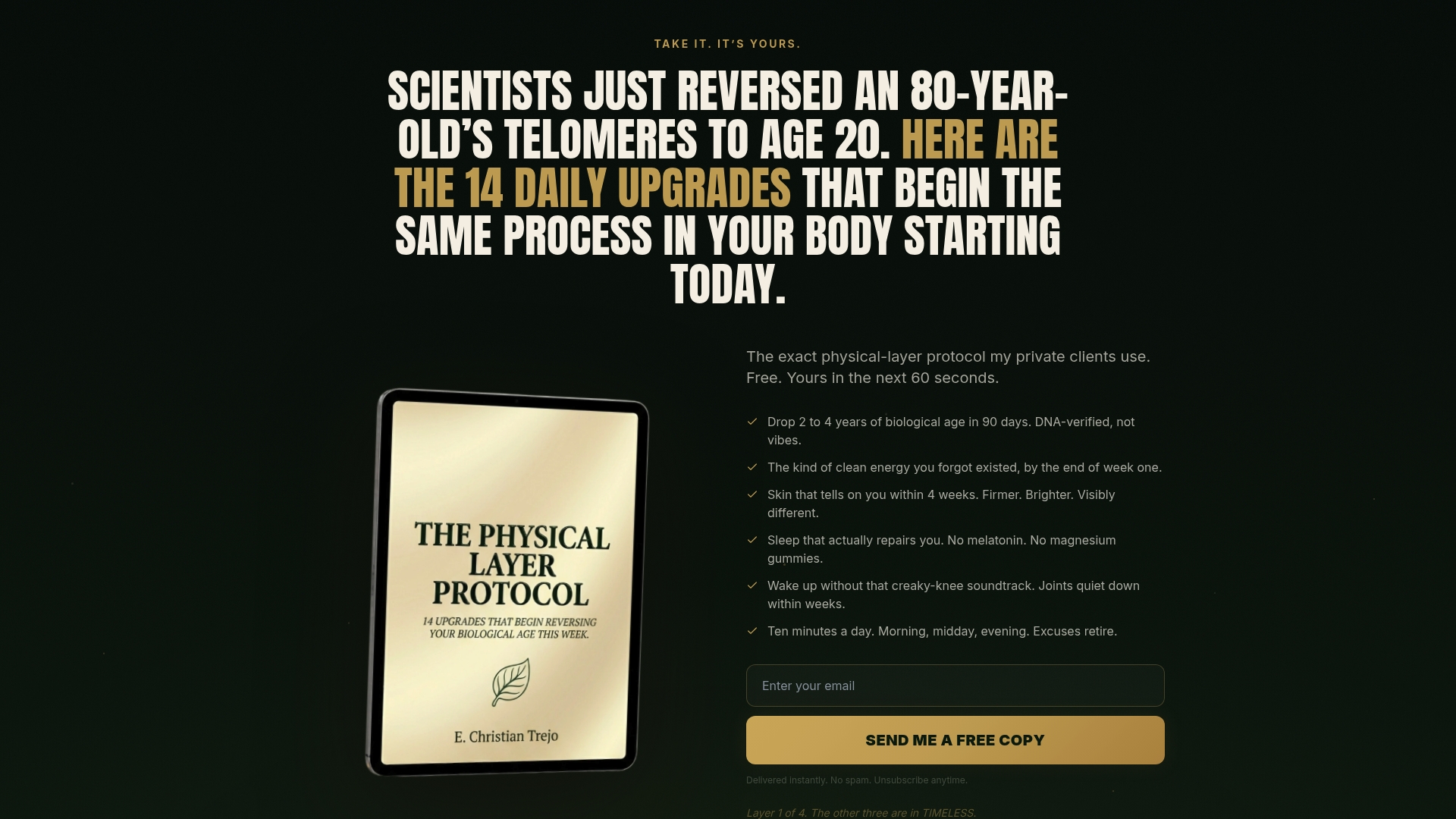
The 370-page book lays out the complete four-layer protocol, physical, emotional, spiritual, and energetic, in a self-directed format you can start this week for $29.99. If you want the free starting point first, grab the 14 upgrades guide at reverseyourage.org/14-upgrades. For readers who want personalized guidance, the eight-week Vitality Intensive coaching program, priced at $7,000, includes TruAge DNA methylation testing before and after and carries a guarantee: reverse your biological age by at least ten years in six months, verified by TruAge, or every dollar is refunded. No other longevity program backs that claim with DNA verification. Book a free vitality diagnosis call to find out which path fits where you are right now.
Sources
The claims in this piece rest on clinical and physiological research, not lifestyle speculation:
This article is general information, not a substitute for advice from a qualified doctor. Consult a qualified healthcare professional about your own circumstances before acting on anything here.
FAQ
What Is a Normal HRV for My Age?
There is no single normal value, since fitness, sex, and measurement method all shift the range significantly. Your own trend over four to six weeks tells you more than any age-based chart.
What Does Low HRV Actually Mean?
Low HRV usually signals sympathetic dominance, meaning your nervous system is stuck in a stress-response pattern rather than cycling normally into recovery. It is most often driven by poor sleep, chronic stress, low fitness, or inflammation, all of which are modifiable.
Can You Really Increase HRV Naturally With Age?
Yes. Randomized trials show consistent aerobic exercise, better sleep, and resonant breathing practices raise HRV measurably within four to eight weeks, regardless of chronological age.
How Is HRV Different From Biological Age?
HRV measures your autonomic nervous system’s current functional state, while biological age, measured through DNA methylation, reflects molecular aging in your cells. The two are related but distinct, and Timeless — Reverse Your Age pairs both to verify that behavioral change is producing real cellular results.
When Should I Get My HRV Checked by a Doctor?
See a clinician if you experience fainting, a persistently irregular heartbeat, or a sudden HRV drop lasting more than two to three weeks with no clear cause. Bring your trend data and device information so the reading has context.