
How to Measure Epigenetic Age Progress Accurately
Discover how to measure epigenetic age progress accurately and understand your biological age. Learn the science for a healthier life.
How to Measure Epigenetic Age Progress Accurately
Epigenetic age is defined as your body’s biological age calculated from DNA methylation patterns at specific CpG sites across your genome. It tells you far more than your birth certificate ever could. Measuring epigenetic age progress means analyzing how those methylation patterns shift over time in response to your lifestyle, interventions, and environment. Researchers at Harvard and Duke University have used these methods to confirm that biological age and chronological age can diverge by a decade or more. My own TruAge DNA methylation test verified a biological age of 23 at 41 years old. That result is not magic. It is the product of a protocol that addresses aging at four distinct layers simultaneously.
How do epigenetic clocks measure biological age?
Epigenetic clocks are algorithms trained on DNA methylation data to predict biological age. They work by reading the methylation state of hundreds of thousands of CpG sites, the chemical tags that switch genes on or off without changing the DNA sequence itself. When these patterns shift in predictable ways, the clock reads it as aging.
The field has produced three generations of clocks, each more informative than the last:
- First-generation clocks (Horvath, Hannum): Trained to match chronological age as closely as possible. Useful for establishing a baseline biological age estimate.
- Second-generation clocks (PhenoAge, GrimAge): Trained on health and mortality outcomes rather than chronological age. GrimAge, developed at UCLA, predicts time-to-death and disease risk with greater accuracy than first-generation tools.
- Third-generation clocks (DunedinPACE): Measure the pace of aging rather than a static age number. DunedinPACE tells you how fast you are aging right now, expressed as a rate. A score of 1.0 means aging at the average rate. A score of 0.7 means aging 30% slower.
Longitudinal changes in epigenetic clocks predict mortality risk independently of baseline age in the InCHIANTI cohort study. That finding confirms that tracking your pace of aging over time is more informative than a single snapshot. The clock is not just a number. It is a signal about trajectory.
What methods and technologies measure epigenetic age?

The two dominant laboratory technologies for epigenetic age measurement are microarray platforms and droplet digital PCR (ddPCR).
Microarray platforms, particularly the Illumina EPIC BeadChip, analyze over 900,000 CpG sites in a single run. This breadth makes them the standard for comprehensive testing. TruAge COMPLETE uses this approach, delivering organ-specific biological ages, immune function scores, and disease risk markers in one report. Droplet digital PCR offers a more sensitive and targeted alternative. The 12 o’clock ddPCR assay correlates with chronological age at r > 0.83 and performs well in low-input samples, making it useful when blood volume is limited.
For most people tracking biological age progress, the practical choice comes down to two test types:
| Test type | Best use | Coverage |
|---|---|---|
| Comprehensive (e.g., TruAge COMPLETE) | Initial baseline, full health picture | 900,000+ CpG sites, organ-specific ages |
| Pace-focused (e.g., TruAge PACE) | Follow-up monitoring, intervention tracking | Targeted markers, aging rate |
Blood samples generally produce more consistent results than saliva because they contain a more uniform cell population. Saliva introduces variability from mixed cell types, which can affect clock accuracy. For longitudinal tracking, using the same sample type across all tests is non-negotiable.
Pro Tip: If you are choosing between test types for the first time, start with the comprehensive option. You cannot interpret a pace score meaningfully without knowing your organ-specific baseline first.
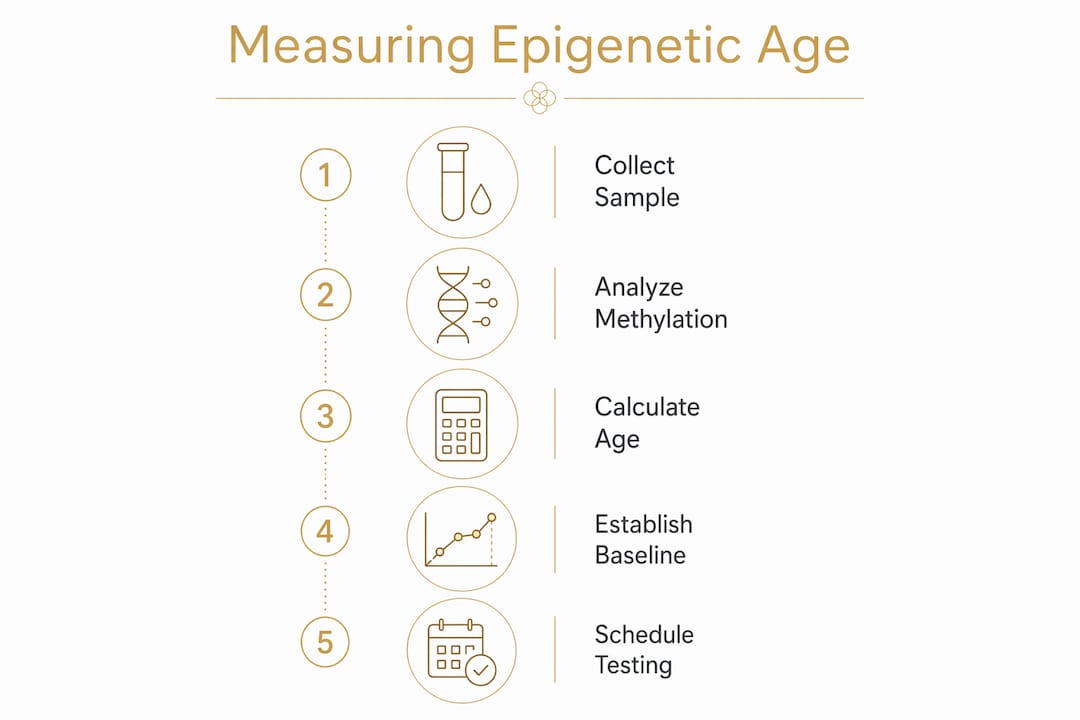
How do you establish a baseline and design a testing schedule?
A meaningful testing program starts with one rule: get the full picture before you start tracking pieces of it. Starting with a comprehensive test covering organ-specific ages, immune function, and risk factors is the only way to know which lifestyle changes are actually moving the needle.
Here is the testing schedule that produces the most useful data:
- Month 0: Comprehensive baseline test. Run TruAge COMPLETE or an equivalent microarray-based panel. Record your overall biological age, organ-specific ages, immune age, and pace score. This is your reference point for everything that follows.
- Months 3–6: Pace-focused follow-up. Use a pace-only test like TruAge PACE to check whether your interventions are shifting your aging rate. This costs less and targets the metric most sensitive to recent lifestyle changes.
- Month 12: Second comprehensive test. Repeat the full panel to assess changes in organ-specific ages and overall biological age. Compare directly against your month-zero baseline.
- Ongoing: Annual comprehensive plus midpoint pace tests. This cadence gives you both depth and frequency without wasting resources on tests run too close together.
Meaningful epigenetic changes from lifestyle interventions typically require at least 3–6 months to register in test results. Testing more frequently than that generates noise, not signal. The biology needs time to rewrite itself.
Pro Tip: Log your lifestyle variables alongside each test date: sleep hours, exercise frequency, alcohol intake, and any supplements or protocols you are following. Without this record, you cannot connect a result change to a specific cause.
How do you interpret epigenetic age test results?
A biological age number carries a standard error range, typically plus or minus a few years depending on the clock and platform used. A single result is a data point, not a verdict. What matters is the direction and magnitude of change across multiple tests.
Key distinctions to hold when reading your results:
- Overall biological age vs. organ-specific ages: Your liver may be aging faster than your brain. Organ-specific data tells you where to focus intervention, not just whether you are “doing well” overall.
- Biological age vs. pace of aging: A biological age of 38 at chronological age 45 is good. A DunedinPACE score trending downward over 12 months is better. Pace tells you what is happening right now.
- Age acceleration: This is the gap between your biological age and your chronological age. A negative gap means you are biologically younger. A positive gap means your cells are ahead of your years.
Lifestyle factors including smoking, physical activity, and alcohol consumption are the primary modifiable determinants of biological aging rates measured via DNA methylation. A study of 894 participants over approximately 8 years confirmed these associations directly. That means the levers you pull every day are the same ones showing up in your test results.
“Commercial biological age tests currently function best as personal curiosity or research tools rather than definitive clinical diagnostics. Experts caution that uncertainty ranges and variability between platforms mean results should inform decisions, not dictate them.”
Avoid treating a one-point increase in biological age as a crisis. PC-based epigenetic clocks using principal component analysis reduce measurement noise and improve longitudinal stability, but no test eliminates biological variability entirely. Trends across three or more tests are far more reliable than any single reading.
What are the common challenges in tracking epigenetic age?
Tracking biological age progress is genuinely useful, but several pitfalls reduce the value of the data if you are not careful.
- Over-testing: Running tests every 4–6 weeks wastes money and generates anxiety from normal biological fluctuation. The 3–6 month minimum interval exists because that is how long meaningful epigenetic remodeling takes.
- Skipping the baseline: Starting with a pace-only test gives you a rate without context. You will not know whether a pace improvement reflects real age reversal or just a good week of sleep.
- Mixing platforms: Different epigenetic clocks produce different numbers. Comparing a GrimAge result from one lab to a PhenoAge result from another is not a valid longitudinal comparison. Use the same platform and same clock across all your tests.
- Ignoring the other three layers: Epigenetic data reflects the physical layer of aging. But aging is a four-layer problem. The TIMELESS protocol addresses the Physical (cellular, epigenetic, mitochondrial), Emotional (stored trauma, nervous system dysregulation), Spiritual (identity and subconscious beliefs about aging), and Energetic (bioelectric field, meridians) layers simultaneously. A test that only reads your DNA methylation cannot tell you whether unresolved emotional stress or a dysregulated nervous system is driving your age acceleration.
- Choosing low-quality providers: Select labs that use validated, published clock algorithms and report standard error ranges. If a provider does not disclose which clock they use, that is a red flag.
The most useful thing epigenetic testing does is create a feedback loop for interventions. Baseline plus pace monitoring tells you exactly which changes are working and which are not.
Key Takeaways
Measuring epigenetic age progress requires a comprehensive baseline, a disciplined testing schedule, and interpretation grounded in trend data rather than single results.
| Point | Details |
|---|---|
| Start with a comprehensive test | Organ-specific and immune data from a full panel makes follow-up pace tests meaningful. |
| Test every 3–6 months minimum | Meaningful epigenetic changes take at least 3–6 months to register; testing sooner creates noise. |
| Track pace, not just age | DunedinPACE measures your current aging rate and responds faster to lifestyle interventions. |
| Use the same platform consistently | Mixing clock types across tests invalidates longitudinal comparisons. |
| Address all four aging layers | DNA methylation reflects the physical layer only; emotional, spiritual, and energetic factors also drive biological age. |
Why I think most people are measuring the wrong thing
I have been testing my own biological age for over 15 years. My most recent TruAge result confirmed a biological age of 23 at 41. People often ask me which test I use. That is the wrong question.
The right question is: what are you doing between tests? Epigenetic clocks are feedback instruments. They tell you whether the program you are running is working. But most people I work with across 40 countries make the same mistake. They get one test, see a number they do not like, and start chasing supplements. They are addressing one layer of a four-layer problem.
Aging is not just a cellular process. It is also an emotional one. Stored trauma and chronic nervous system dysregulation accelerate biological aging just as reliably as smoking does. Subconscious beliefs about aging, what I call the Spiritual layer, shape the biological environment your cells live in. The Energetic layer, your bioelectric field and meridian system, influences cellular communication in ways that no methylation clock currently captures.
Evidence-based aging reversal methods that address the physical layer alone will move your numbers. But they will not move them as far or as fast as a protocol that works all four layers at once. I have seen this pattern repeat across thousands of practitioners. The people who get the most dramatic verified results are the ones who stop treating their test score as the goal and start treating it as the report card.
Use your epigenetic data as a compass, not a destination. Test with discipline. Intervene across all four layers. Then let the biology confirm what you already feel.
— E. Christian Trejo
What biological age reversal looks like with DNA verification
The TIMELESS Vitality Intensive is an 8-week private coaching program built on 15 years of research and verified by TruAge DNA methylation testing. It is the only program in the longevity space that guarantees at least 10 years of biological age reversal in 6 months or refunds every dollar.
The program addresses all four aging layers: Physical, Emotional, Spiritual, and Energetic. Most longevity protocols address one. TIMELESS addresses all four simultaneously, which is why the results show up in the methylation data. If you want to know exactly where your biological age stands today and what it would take to reverse it by a decade, book a free Vitality Diagnosis call to get a personalized assessment. Or visit reverseyourage.org to learn how the program works and what the guarantee covers.
FAQ
What is epigenetic age and how is it measured?
Epigenetic age is a biological age estimate derived from DNA methylation patterns at CpG sites across your genome. It is calculated using validated algorithms called epigenetic clocks, such as Horvath, GrimAge, or DunedinPACE, applied to blood or saliva samples.
How often should I test my epigenetic age?
Test no more frequently than every 3–6 months. Meaningful epigenetic changes from lifestyle interventions require at least that long to register, and testing sooner produces results driven by normal biological variance rather than real progress.
Can epigenetic age be reversed?
Yes. Longitudinal research confirms that modifiable lifestyle factors including exercise, smoking cessation, and alcohol reduction directly shift DNA methylation age acceleration. The TIMELESS protocol has produced verified biological age reversal of 10 or more years in 6 months, confirmed by TruAge testing.
What is the difference between biological age and pace of aging?
Biological age is a snapshot estimate of how old your cells appear based on methylation patterns. Pace of aging, measured by clocks like DunedinPACE, tells you how fast you are currently aging. Pace responds faster to recent interventions and is the more sensitive metric for tracking progress.
Which epigenetic test should I start with?
Start with a comprehensive test that covers organ-specific ages, immune function, and overall biological age. Pace-only tests are best reserved for follow-up monitoring once you have a full baseline established.