
How Inflammation Accelerates Aging: What You Must Know
Discover how inflammation accelerates aging and learn effective strategies to combat it. Improve your health and add life to your years.
How Inflammation Accelerates Aging: What You Must Know
Chronic inflammation is the single most underestimated driver of biological aging, and the scientific term for it is inflammaging. This low-grade, persistent inflammatory state correlates directly with frailty, multimorbidity, and mortality, and it accelerates biological aging as measured by epigenetic clocks. Understanding how inflammation accelerates aging is not an academic exercise. It is the difference between adding years to your life and adding life to your years. The good news: inflammaging is not inevitable. It is a modifiable biological process, and the right protocol can rewrite the program.
How does inflammation accelerate aging at the biological level?
Acute inflammation is your body’s repair crew. It shows up fast, fixes the damage, and leaves. Inflammaging is the opposite. It is a low-level fire that never goes out, burning through your tissues day after day without triggering the dramatic symptoms that would send you to a doctor.
The drivers of this chronic state are well established. Inflammaging is driven by gut microbiome dysbiosis, cellular senescence, and metabolic dysfunction. Each of these feeds the others in a self-amplifying loop. Senescent cells, for example, secrete a cocktail of inflammatory signals called the senescence-associated secretory phenotype (SASP), which recruits immune cells and keeps the inflammatory environment alive long after the original trigger is gone.

The aging immune system also loses its ability to resolve inflammation properly. Healthy resolution depends on a process called efferocytosis, where dead and damaged cells are cleared efficiently. It also depends on specialized pro-resolving mediators (SPMs), lipid molecules that actively switch off inflammatory signals. Aging impairs both efferocytosis and SPM production, leaving inflammatory debris to accumulate and tissue damage to compound over time.
Pro Tip: If you are tracking your inflammation, do not rely on a single CRP reading. CRP reflects acute-phase response, not the chronic low-grade signaling that drives biological aging. Ask your physician about IL-6 and, better yet, look into epigenetic clock testing like TruAge to see how inflammation is affecting your actual biological age.
The result is a feedback loop where immune dysfunction creates more inflammation, which creates more immune dysfunction. This is not aging happening to you. This is a program running inside you, and programs can be rewritten.
What does chronic inflammation do to your organs and cells?
The cellular damage from inflammaging is not confined to one system. It spreads, and it compounds. Persistent inflammation promotes fibrosis, replacing functional tissue with scar-like material that reduces elasticity and organ reserve. Your heart, lungs, kidneys, and skin all lose their ability to bounce back from stress.
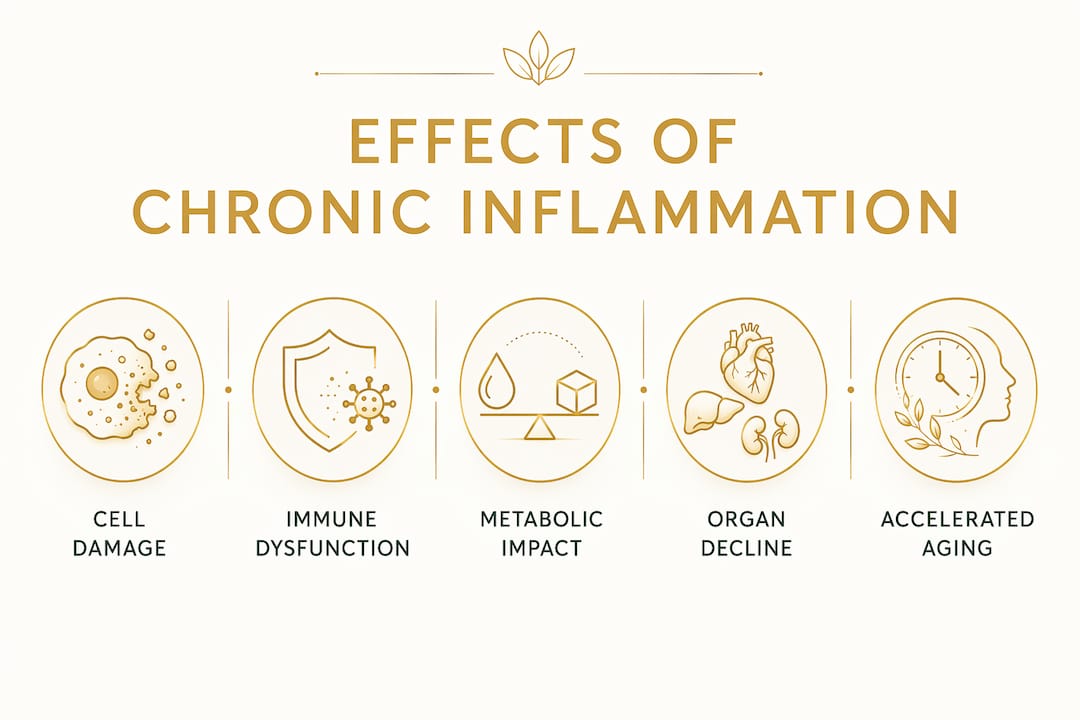
Here is where it gets more alarming. Dysregulated neutrophils, a type of immune cell, do not stay at the site of inflammation. Neutrophils can cause remote organ damage, meaning inflammation in your gut can actively harm your brain and heart. This immune-organ crosstalk is one reason why inflammaging presents as a multi-system problem rather than a localized one.
The specific downstream effects include:
- Stem cell exhaustion. Inflammatory cytokines impair the function of tissue stem cells, slowing repair and regeneration across every organ system.
- Neurodegeneration. Chronic neuroinflammation accelerates the loss of synaptic connections and is a recognized driver of cognitive decline and Alzheimer’s disease.
- Cardiovascular disease. Inflammatory signaling destabilizes arterial plaques and promotes endothelial dysfunction, raising the risk of heart attack and stroke.
- Metabolic syndrome. Inflammation disrupts insulin signaling and promotes visceral fat accumulation, which in turn produces more inflammatory cytokines.
- Musculoskeletal decline. Inflammatory mediators accelerate cartilage breakdown and muscle wasting, contributing to sarcopenia and osteoarthritis.
Immunosenescence acts as both a mediator and amplifier of this multi-organ dysfunction. The immune system does not just fail to protect you. It actively participates in your decline. Recognizing this changes everything about how you approach aging.
What does the science say about targeting inflammation to slow aging?
The field has moved well past “take an anti-inflammatory.” The new paradigm is precision. Researchers are now targeting specific inflammatory signaling nodes rather than broadly suppressing immune activity, which carries its own serious risks.
Precision targeting of the NLRP3 inflammasome and JAK/STAT signaling pathways represents a genuine paradigm shift in how we approach the biology of aging. The NLRP3 inflammasome is a molecular complex that, when chronically activated, drives IL-1β and IL-18 production, two cytokines that accelerate tissue aging. JAK/STAT signaling mediates many of the downstream effects of inflammatory cytokines on gene expression. Blocking these specific nodes disrupts the chronic inflammation cycle without shutting down the immune system’s ability to respond to real threats.
Traditional markers like CRP and IL-6 are insufficient for guiding precision intervention. They tell you fire exists. They do not tell you which circuit to cut. The new focus is on causal pathways, not downstream biomarkers.
What should you look for in any intervention targeting inflammaging?
- Resolution enhancement, not just suppression. The goal is to restore the body’s ability to turn off inflammation, not just dampen it temporarily.
- Senolytic activity. Interventions that clear senescent cells reduce the SASP burden and lower the chronic inflammatory baseline.
- Gut microbiome support. A diverse, resilient microbiome produces short-chain fatty acids that actively reduce systemic inflammation.
- Immune resilience. Improving immune function in older adults extends healthspan by reducing dysfunctional, inflammatory immune phenotypes.
Pro Tip: Natural anti-inflammatories like omega-3 fatty acids, curcumin, and resveratrol have research support, but their effect size is modest when used in isolation. They work best as part of a protocol that also addresses the upstream drivers: sleep, stress physiology, gut health, and epigenetic reprogramming.
The science is clear that multi-organ immune-tissue interactions require integrated, systemic approaches rather than localized interventions. A pill targeting one pathway will not reverse a system-wide problem.
How the TIMELESS four-layer protocol addresses inflammaging
Most aging protocols address one layer of the problem. The TIMELESS protocol, developed by E. Christian Trejo and tested across thousands of practitioners in 40 countries, addresses four simultaneously. This matters because inflammation does not live in just one layer of your biology.
The four layers, and how inflammation connects to each, are:
| Layer | Inflammation connection | TIMELESS approach |
|---|---|---|
| Physical | Cellular senescence, mitochondrial dysfunction, epigenetic aging | Cellular and epigenetic reprogramming, senolytic strategies, mitochondrial support |
| Emotional | Chronic stress and stored trauma elevate cortisol, which drives systemic inflammation | Nervous system regulation, trauma resolution protocols |
| Spiritual | Subconscious beliefs about aging accelerate biological decline through psychoneuroimmunology | Identity reprogramming, belief-level intervention |
| Energetic | Disrupted bioelectric fields and meridian imbalances impair cellular communication and repair | Bioelectric field restoration, meridian-based practices |
The physical layer is where most people start and stop. Cellular senescence, mitochondrial dysfunction, and epigenetic drift all feed the inflammatory cycle. Addressing them directly reduces the SASP burden and restores tissue repair capacity. But the emotional layer is equally real. Chronic psychological stress elevates cortisol and activates NF-κB, one of the master switches of inflammatory gene expression. Stored trauma keeps the nervous system in a low-grade threat state, which means the immune system never fully stands down.
The spiritual and energetic layers are not metaphors. Psychoneuroimmunology research confirms that subconscious beliefs about aging influence immune function through measurable neuroendocrine pathways. The TIMELESS four-layer protocol is the only framework that addresses all four simultaneously, which is why it produces verified biological age reversal rather than incremental improvements. You can read more about aging reversal methods that work beyond surface-level interventions.
Key Takeaways
Chronic inflammaging is a modifiable, multi-system driver of biological aging that requires a four-layer protocol to address effectively at the cellular, emotional, spiritual, and energetic levels simultaneously.
| Point | Details |
|---|---|
| Inflammaging is modifiable | Gut dysbiosis, senescence, and metabolic dysfunction drive it, and all three can be targeted. |
| Resolution matters more than suppression | Restoring the body’s ability to turn off inflammation is more effective than broadly dampening it. |
| Remote organ damage is real | Dysregulated immune cells can harm distant organs, making systemic approaches non-negotiable. |
| Precision targeting is the new standard | NLRP3 and JAK/STAT pathways are more effective targets than broad biomarkers like CRP. |
| Four layers must be addressed | Physical, emotional, spiritual, and energetic factors all drive chronic inflammation in aging. |
What 15 years of research taught me about inflammaging
Most people I work with arrive focused on one thing: their CRP number, their diet, or their supplement stack. They are not wrong to care about those things. But they are looking at the problem through a keyhole.
What I have found, after 15 years of research and after verifying my own biological age at 23 when I was 41 years old, is that inflammation is a symptom of a system running the wrong program. You can suppress it temporarily with the right foods and the right molecules. But if you do not address the nervous system dysregulation, the subconscious beliefs about aging, and the energetic disruptions that keep the immune system in a threat state, the inflammation comes back. Every time.
The practitioners I have worked with across 40 countries confirm this pattern. The ones who get the most dramatic results, verified by TruAge DNA methylation testing, are the ones who commit to all four layers. The ones who plateau are almost always skipping the emotional or energetic work because it feels less “scientific.” Psychoneuroimmunology is not soft science. It is the mechanism by which your mind writes instructions to your immune system.
Inflammaging is not your destiny. It is a program. And every program has an off switch, if you know where to look.
— E. Christian Trejo
The TIMELESS protocol puts inflammation science into practice
Knowing that inflammaging drives biological aging is one thing. Having a verified system to reverse it is another.
The TIMELESS protocol is the only longevity program in the world that guarantees a minimum of 10 years of biological age reversal in 6 months, verified by TruAge DNA methylation testing, or every dollar is refunded. It addresses inflammation across all four layers: physical, emotional, spiritual, and energetic. No other program offers this level of scientific accountability. You can start with the TIMELESS book for $29.99, a 370-page blueprint built on 15 years of research. If you want personalized guidance, book a free Vitality Diagnosis call to see if the 8-week coaching program is right for you.
FAQ
What is inflammaging?
Inflammaging is a chronic, low-grade inflammatory state that develops with age and accelerates biological aging as measured by epigenetic clocks. Unlike acute inflammation, it persists without a clear trigger and drives frailty, multimorbidity, and organ decline.
Can you reverse chronic inflammation from aging?
Yes. Inflammaging is a modifiable process driven by gut dysbiosis, cellular senescence, and metabolic dysfunction, all of which respond to targeted intervention. Addressing resolution pathways, senescent cell burden, and immune resilience can measurably reduce the chronic inflammatory baseline.
What are the best natural anti-inflammatories for aging?
Omega-3 fatty acids, curcumin, and resveratrol have the strongest research support among natural anti-inflammatories. They are most effective when combined with interventions that address upstream drivers like sleep quality, stress physiology, and gut microbiome diversity.
How does stress drive inflammation in aging?
Chronic psychological stress activates NF-κB, a master regulator of inflammatory gene expression, and elevates cortisol, which disrupts immune regulation over time. This is why nervous system dysregulation is a direct contributor to inflammaging, not just a wellness concern.
How does the TIMELESS protocol measure inflammation reversal?
The TIMELESS protocol uses TruAge DNA methylation testing to verify biological age before and after the program. DNA methylation clocks are the most validated measure of biological aging and directly reflect the epigenetic impact of chronic inflammation on your cells.