
How Detoxification Affects Biological Age: 2026 Science
Discover how detoxification affects biological age by reducing cellular damage, enhancing longevity, and improving your overall health. Learn more!
How Detoxification Affects Biological Age: 2026 Science
Detoxification directly lowers biological age by reducing the toxin-driven cellular damage that accelerates aging at the DNA, mitochondrial, and epigenetic levels. Biological age, measured through tools like TruAge DNA methylation testing, reflects how fast your cells are aging relative to your chronological years. It can run ahead of or behind your birth year depending on how well your body clears harmful compounds. When detox systems function well, they neutralize the electrophiles, glycation byproducts, and reactive oxygen species that would otherwise corrupt your genome and shorten your telomeres.
The core mechanisms connecting detox to longevity are:
- Glutathione transferase catalyzes the conjugation of harmful electrophiles, neutralizing lipid peroxidation products like 4-HNE that damage mitochondrial proteins and accelerate cellular aging
- The KEAP1-NRF2 system acts as the master switch for antioxidant and detox gene expression, activating cellular defenses against oxidative stress when functioning correctly
- The glyoxalase system clears methylglyoxal and other glycation intermediates before they form Advanced Glycation End-products (AGEs), which stiffen tissues and drive inflammatory aging
- Seven distinct detox organs (liver, kidneys, gut, lymphatic system, skin, lungs, and bile) must all function together; failure in any one pathway risks toxin reabsorption and chronic inflammation
Research published in Trends in Molecular Medicine confirms that detoxification mechanisms like glutathione transferase are not optional biochemistry. They are primary longevity assurance systems. Support them, and your biological clock slows. Neglect them, and it accelerates.
How detoxification systems work to protect your biological age
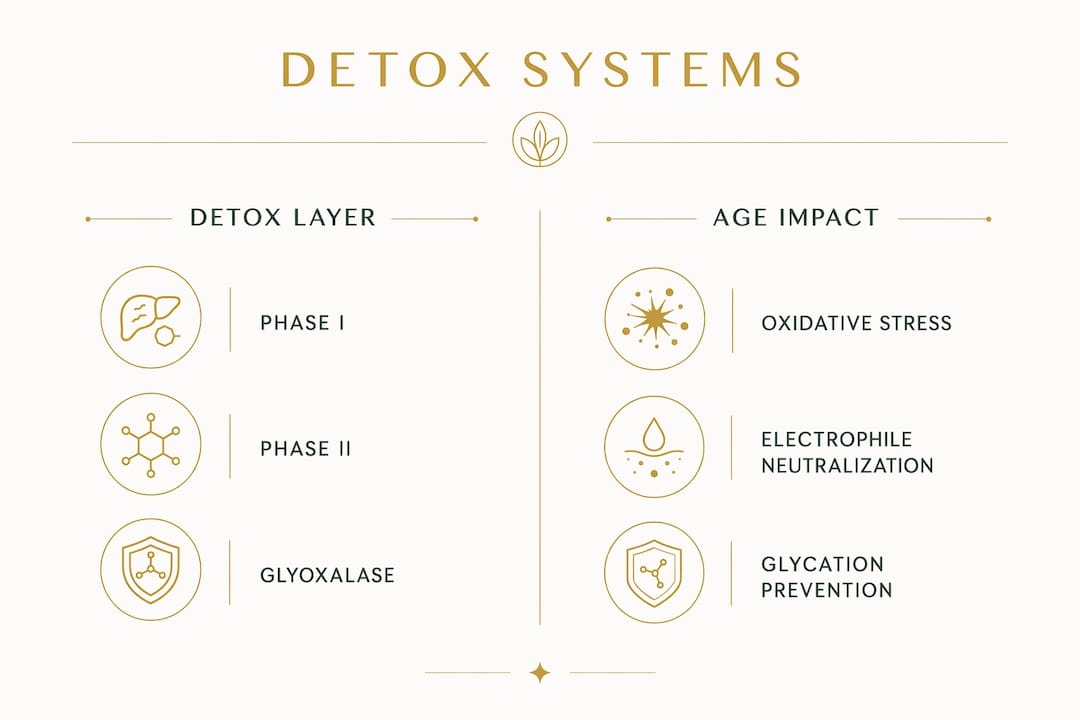
Your body runs three coordinated phases of detoxification, and each one matters for how fast you age. Phase I converts fat-soluble toxins into reactive intermediates using cytochrome P450 enzymes. Phase II conjugates those intermediates with molecules like glutathione, making them water-soluble. Phase III exports the conjugated compounds through bile, urine, or sweat. A breakdown at any phase leaves reactive compounds circulating longer than they should.

Glutathione transferase sits at the center of Phase II. It catalyzes the binding of glutathione to electrophilic compounds, including the lipid peroxidation product 4-hydroxynonenal (4-HNE). When 4-HNE accumulates unchecked, it binds to mitochondrial proteins, disrupts the electron transport chain, and generates a feedback loop of rising reactive oxygen species (ROS). Research in C. elegans showed that silencing the glutathione transferase gene gst-10 increased 4-HNE protein adducts and shortened median lifespan, while overexpressing it extended life. The biology translates: glutathione transferase activity is a measurable longevity variable.
The KEAP1-NRF2 system is the upstream regulator. Under normal conditions, the protein KEAP1 keeps NRF2 tagged for degradation. When oxidative stress or electrophiles are detected, KEAP1 releases NRF2, which travels to the nucleus and switches on over 200 cytoprotective genes, including those encoding glutathione synthesis enzymes, heme oxygenase-1, and NAD(P)H quinone oxidoreductase 1. The KEAP1-NRF2 pathway is one of the most studied anti-aging mechanisms in molecular biology, and its dysfunction is directly implicated in accelerated biological aging. Chronic toxin exposure suppresses NRF2 signaling, which is why toxin load and biological age tend to rise together.
The glyoxalase system handles a different but equally serious threat: glycation. Methylglyoxal, a byproduct of glucose metabolism, spontaneously reacts with proteins and DNA to form AGEs. The enzyme glyoxalase 1 (GLO1) converts methylglyoxal into a harmless metabolite before it can glycate. GLO1 activity declines with age, most pronouncedly in the liver, allowing AGE accumulation to accelerate tissue stiffening, vascular damage, and neurodegeneration. Dietary strategies that support GLO1 expression are now recognized as a legitimate anti-aging intervention.
| Detox System | Primary Target | Age-Related Change | Key Support Nutrient |
|---|---|---|---|
| Glutathione transferase | Electrophiles, 4-HNE | Declines with oxidative load | N-acetylcysteine (NAC), glycine |
| KEAP1-NRF2 | Oxidative stress, toxins | Suppressed by chronic toxin exposure | Sulforaphane, curcumin |
| Glyoxalase (GLO1) | Methylglyoxal, AGEs | Declines with age, especially in liver | B vitamins, zinc, carnosine |
| Cytochrome P450 (Phase I) | Fat-soluble toxins | Altered by genetics and toxin load | Adequate protein, B vitamins |
Pro Tip: NRF2 activation requires intermittent stimulation, not constant high-dose antioxidants. Taking large doses of vitamin C or vitamin E around the clock can actually blunt the hormetic NRF2 response your body needs for adaptive detox. Cycle your antioxidant support and use food-based sources like broccoli sprouts for sulforaphane.
How toxins accelerate biological aging at the cellular level
Toxins do not age you gradually and evenly. They hit specific molecular targets that trigger cascading damage, and the speed of that damage is what your biological age score reflects. A 2025 Stanford study of over 2,300 U.S. adults found that environmental chemical exposure accelerates cellular senescence, one of the most well-established drivers of biological aging. Senescent cells stop dividing but refuse to die. They secrete a cocktail of inflammatory proteins called the senescence-associated secretory phenotype (SASP), which damages neighboring healthy cells and degrades tissue function across every organ system.
Microplastics and heavy metals are particularly aggressive. Microparticle exposure induces both cellular senescence and oxidative stress, creating a dual hit on biological age. Heavy metals like cadmium and arsenic directly inhibit DNA repair enzymes, allowing mutations to accumulate faster than the body can correct them. Ambient pollutants like PM2.5 trigger ROS overproduction through cytochrome P450 biotransformation, and PM2.5-driven oxidative stress has been shown to accelerate epigenetic age through DNA methylation changes, the same markers measured by biological age clocks.
The telomere connection is direct. Oxidative stress shortens telomeres by damaging the guanine-rich sequences at chromosome ends, which are especially vulnerable to ROS attack. Shorter telomeres trigger cellular senescence, which feeds more SASP, which generates more inflammation, which produces more ROS. Effective detoxification interrupts this cycle at multiple points.
- Glutathione transferase neutralizes the lipid peroxidation products that would otherwise attack telomeric DNA
- NRF2 activation upregulates telomerase-supporting antioxidant enzymes
- GLO1 prevents AGE formation on telomere-binding proteins, preserving their protective function
- Autophagy, induced by fasting and NAD+ metabolism, clears senescent cells before SASP spreads
Pro Tip: DNA methylation clocks like TruAge, PhenoAge, and GrimAge measure biological age by reading epigenetic marks that shift in response to toxin load, inflammation, and cellular stress. If you want to know whether your detox efforts are actually moving the needle, a baseline TruAge test before and after a structured protocol gives you objective data, not guesswork.
| Toxin Class | Primary Aging Mechanism | Biological Age Impact |
|---|---|---|
| Heavy metals (Pb, Cd, As) | DNA repair inhibition, mitochondrial damage | Accelerates epigenetic aging |
| Microplastics | Cellular senescence, oxidative stress | Increases SASP-driven inflammation |
| Lipid peroxidation products (4-HNE) | Protein adduct formation, mitochondrial dysfunction | Shortens functional lifespan of cells |
| Glycation intermediates (methylglyoxal) | AGE formation on proteins and DNA | Stiffens tissues, impairs cellular signaling |
| Ambient pollutants (PM2.5) | ROS overproduction, telomere shortening | Accelerates DNA methylation age |
What actually works: detox practices that reduce biological age
The wellness industry has flooded the market with detox products that do nothing measurable. Real detoxification support works through specific, documented biochemical pathways. The distinction matters because doing the wrong protocol can actually increase toxin reabsorption and worsen biological age.
Supporting all seven detox pathways simultaneously is the baseline requirement. Most people focus only on the liver, but if the gut is inflamed, the lymphatic system is sluggish, or the kidneys are under-hydrated, mobilized toxins get reabsorbed rather than excreted. This is not a theoretical risk. It is a documented clinical pattern that produces worsening inflammation when people do aggressive liver cleanses without preparing the downstream elimination routes first.
Nutrition-based detox support with the strongest evidence:
- N-acetylcysteine (NAC): The direct precursor to glutathione, NAC replenishes intracellular glutathione faster than oral glutathione supplements, which are largely degraded in the gut. NAD+ metabolism and glutathione synthesis are interdependent, making NAD+ support a complementary strategy
- Sulforaphane (from broccoli sprouts): The most potent food-derived NRF2 activator studied. Three to five days of broccoli sprout consumption produces measurable increases in Phase II enzyme activity
- Alpha-lipoic acid: Both water and fat-soluble, it regenerates vitamins C and E and supports glutathione recycling in mitochondria
- Milk thistle (silymarin): Protects hepatocytes from toxin-induced damage and supports Phase II conjugation reactions
- Cruciferous vegetables (broccoli, cauliflower, Brussels sprouts): Provide glucosinolates that convert to isothiocyanates, activating NRF2 and upregulating glutathione S-transferase enzymes
- Carnosine and zinc: Support GLO1 activity, directly countering AGE formation from methylglyoxal
- Adequate protein and B vitamins: Required cofactors for Phase I and Phase II enzyme function; deficiency in either stalls detox at the conversion stage
Hormone-healthy nutrition that emphasizes cruciferous vegetables, adequate protein, and anti-inflammatory fats supports detox pathways while also managing the hormonal disruption that accelerates biological aging in women specifically.
Lifestyle factors carry equal weight. Sleep is when the glymphatic system clears neurotoxic waste from the brain, including amyloid beta and tau proteins. Cutting sleep below seven hours measurably increases inflammatory markers and reduces glutathione synthesis. Exercise increases lymphatic flow, promotes autophagy through AMPK activation, and upregulates NRF2 through hormetic physical stress. Sauna use drives toxin excretion through sweat, particularly for heavy metals and fat-soluble compounds.
Pro Tip: Avoid high-dose chronic antioxidant supplementation during a detox protocol. Research confirms that excessive antioxidant intake can blunt the very NRF2 hormetic response that drives adaptive detoxification. Use targeted, intermittent dosing instead of daily megadoses.
The TIMELESS four-layer protocol and what 2025 research confirms
Most longevity protocols treat aging as a single-layer biology problem. They address the physical layer, maybe, and call it done. That is why most people plateau. Aging is a four-layer problem, and detoxification operates across all four simultaneously.
My own TruAge DNA methylation test, taken at chronological age 41, returned a biological age of 23, a result verified and supported by consistent application of the four-layer TIMELESS protocol. It came from 15 years of research applied across every layer of the aging program, tested across thousands of practitioners in 40 countries.
The TIMELESS four-layer protocol addresses:
Physical layer: Cellular detoxification through glutathione support, NRF2 activation, glyoxalase system optimization, mitochondrial repair, and epigenetic reprogramming. This is where most protocols stop.
Emotional layer: Stored trauma and chronic nervous system dysregulation maintain the body in a persistent stress state, which elevates cortisol, suppresses NRF2 signaling, and increases inflammatory cytokines. You cannot detox your way out of a dysregulated nervous system. The emotional layer must be addressed directly.
Spiritual layer: Subconscious beliefs about aging, identity, and biological possibility set a ceiling on what the physical interventions can achieve. If your nervous system is running a program that says “I age like my parents did,” epigenetic reprogramming works against that current. Rewriting the identity layer removes the ceiling.
Energetic layer: The bioelectric field and meridian system influence cellular signaling in ways that conventional biochemistry is only beginning to quantify. Disruptions at this layer create patterns of cellular dysfunction that nutritional support alone cannot resolve.
Long-lived organisms across species share a transcriptomic signature: upregulated xenobiotic detoxification genes. The biology of longevity is, in part, the biology of superior toxin clearance. Nuclear hormone receptors including FXR, LXR, PXR, CAR, and VDR in mammals control the expression of detoxification enzymes with broad substrate specificities, and their activity declines with age unless actively supported.
Nanoparticle delivery systems, including liposomes and nanoemulsions, now allow intracellular glutathione delivery that bypasses gut degradation, dramatically improving the efficacy of detox nutrient protocols. This is the kind of delivery precision the TIMELESS physical layer incorporates, because getting the nutrient to the right compartment inside the cell is what separates a measurable result from a theoretical one.
| Detox Layer | Primary Intervention | Biological Age Impact |
|---|---|---|
| Physical (cellular/epigenetic) | NRF2 activation, glutathione support, GLO1 optimization | Reduces oxidative damage, slows telomere attrition |
| Emotional (nervous system) | Trauma resolution, HRV training, nervous system regulation | Lowers cortisol, restores NRF2 signaling |
| Spiritual (identity/subconscious) | Belief reprogramming, identity work | Removes epigenetic ceiling on age reversal |
| Energetic (bioelectric/meridian) | Biofield therapies, meridian support | Restores cellular signaling coherence |
The TIMELESS Vitality Intensive is an 8-week private coaching program with a DNA-verified guarantee: reverse your biological age by at least 10 years in 6 months, confirmed by TruAge testing, or every dollar is refunded. No other program in the longevity space makes that offer because no other program works across all four layers simultaneously.
Start reversing your biological age today
The science is clear. Detoxification is not a wellness trend. It is a primary mechanism of longevity, and how well your detox systems function is one of the strongest determinants of your biological age. You can measure it. You can change it.
The TIMELESS: Reverse Your Age book is a 370-page blueprint covering every layer of the protocol, available for $29.99. If you want personalized guidance with a DNA-verified guarantee, the TIMELESS Vitality Intensive is the only program in the world that puts a full refund behind a 10-year biological age reversal in six months. Book a free Vitality Diagnosis call at reverseyourage.org/book and we will map your current biological age and the exact protocol to reverse it.
Key Takeaways
Detoxification lowers biological age by neutralizing the toxins, electrophiles, and glycation intermediates that drive cellular senescence, telomere shortening, and epigenetic aging across every organ system.
| Point | Details |
|---|---|
| Glutathione transferase is a longevity enzyme | It neutralizes 4-HNE and other electrophiles that damage mitochondria and shorten lifespan. |
| KEAP1-NRF2 is the master detox switch | Chronic toxin exposure suppresses NRF2, accelerating biological aging; nutrients like sulforaphane reactivate it. |
| GLO1 decline drives AGE accumulation | Glyoxalase 1 activity falls with age, allowing methylglyoxal to form AGEs that stiffen tissues and impair signaling. |
| All seven detox pathways must be open | Mobilizing toxins without supporting gut, lymphatic, and kidney clearance causes reabsorption and worsens inflammation. |
| Aging is a four-layer problem | Physical detox alone is insufficient; emotional, spiritual, and energetic layers must be addressed for full biological age reversal. |
FAQ
Does detoxing make you look younger?
Supporting detox pathways reduces AGE accumulation and oxidative damage, both of which degrade skin collagen and accelerate visible aging. Measurable biological age reduction, verified by DNA methylation testing, correlates with improved tissue function and appearance.
How can you reverse your body’s biological age?
Biological age reversal requires activating cellular detox systems like NRF2 and glutathione transferase, reducing toxin load, supporting mitochondrial function, and addressing the emotional and epigenetic layers that keep aging programs running. The TIMELESS protocol has demonstrated significant reduction in biological age for those following the four-layer approach.
What slows down biological aging?
Consistent NRF2 activation through diet and hormetic stress, adequate glutathione synthesis, GLO1 support to prevent AGE formation, quality sleep for glymphatic clearance, and reducing chronic toxin exposure all slow the rate at which your biological clock advances.
What affects your biological age most?
Toxin load, oxidative stress, chronic inflammation, telomere attrition, and epigenetic drift are the primary drivers of biological age acceleration. A 2025 Stanford study of over 2,300 adults confirmed that environmental chemical exposure directly accelerates cellular senescence, one of the most measurable markers of biological aging.