
How Anti-Aging Protocols Are Tested Globally
Discover how anti-aging protocols are tested globally through rigorous standards, ensuring credible results. Learn more now!
How Anti-Aging Protocols Are Tested Globally
Anti-aging protocols are validated through biomarker-verified clinical trials, short-window mechanistic studies, and conventional RCT standards, because neither the FDA nor the EMA recognizes aging as a treatable indication. That single regulatory fact shapes every credible study design on earth. The three trust signals that separate real evidence from marketing copy:
- DNA methylation verification by an independent, accredited third-party lab
- Randomized controlled trials or documented short-window mechanistic biopsies with preregistered endpoints
- Independent replication or peer-reviewed publication of results
Most programs you will encounter offer none of these. The ones worth your attention offer all three.
Table of Contents
- How anti-aging protocols are tested globally: the regulatory foundation
- Common study designs used to test anti-aging interventions
- What biomarkers researchers actually measure
- What in vitro and preclinical models can and cannot tell you
- How computational methods accelerate candidate discovery
- What short-term study windows can and cannot prove
- Measuring biological age in practice
- How to validate integrated multi-layer programs
- How to spot weak evidence and misleading claims
- A quick checklist before you enroll in any program
- How regulatory approaches differ across Asia and Latin America
- Ethical standards in global anti-aging trials
- Challenges unique to anti-aging research
- International efforts to standardize anti-aging research
- Statistical methods specific to biological-age reversal studies
- Landmark global trials that shaped anti-aging validation
- Key Takeaways
- Why most longevity programs fail the verification test
- The TIMELESS program: verified options and next steps
- Useful sources and further reading
- FAQ
How anti-aging protocols are tested globally: the regulatory foundation
The FDA and EMA do not treat aging as a formal disease indication. That means any drug or protocol claiming to reverse aging must demonstrate efficacy against a recognized disease or a pre-qualified surrogate biomarker endpoint to earn marketing authorization. There is no shortcut.
This creates a practical design constraint. Researchers either run disease-delay trials (targeting conditions like type 2 diabetes or cardiovascular disease as proxies for aging) or pursue biomarker qualification, which requires prospective evidence that changing a biomarker actually alters a clinically meaningful outcome. That second path is harder than it sounds.
Experts increasingly argue for a paradigm shift: moving regulators beyond single-disease models toward trials that accept functional status and healthspan as primary outcomes. The ICFSR Task Force, convening in March 2025, formally called for this shift and for a minimum common dataset of biological, physiological, and clinical factors across geroscience trials.
Pro Tip: When evaluating any anti-aging program, search ClinicalTrials.gov for its registry ID. If none exists, the evidence base is almost certainly pre-scientific.
Common study designs used to test anti-aging interventions
Not all trial formats carry equal weight. Here is the hierarchy readers should know:
- Parallel-arm RCTs with blinding, placebo control, and preregistered endpoints. Strongest for causal claims.
- Surgical-window mechanistic trials (e.g., the REPROGRAM protocol), which randomize older adults to geroprotectors like Metformin MR, Fisetin, or Spermidine, then measure paired adipose biopsies before and after a short intervention window.
- Proof-of-concept open-label trials that generate mechanistic signals but cannot establish causation.
- N-of-1 series with repeated biomarker measurement across individuals, useful for integrated programs.
- Observational and cohort studies that show association but not mechanism.
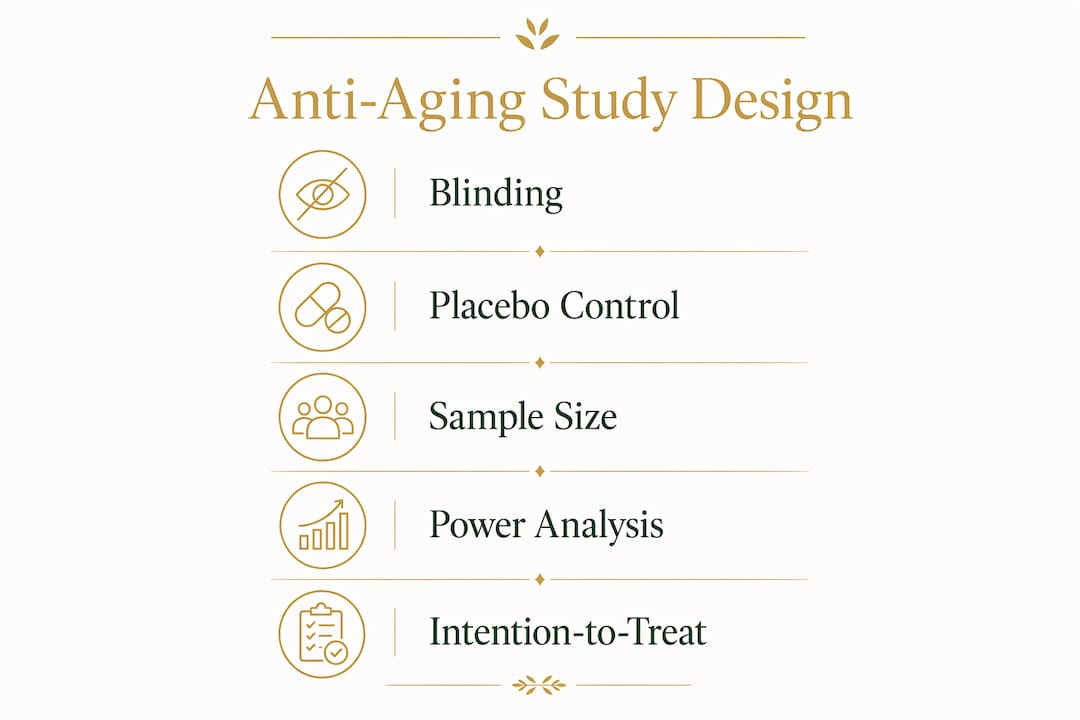
Trust signals apply across all designs: blinding, placebo controls, sample-size and power calculations, intention-to-treat analysis, and preregistration. Geroscience trials currently face small samples and short follow-up, which limits their ability to demonstrate clinical phenotype progression. Validated composite biomarkers are the recommended workaround.
What biomarkers researchers actually measure
Valid evidence of biological-age reversal requires specific, measurable endpoints, not subjective reports. The most credible:
| Biomarker Type | What It Signals | Typical Measurement Window |
|---|---|---|
| DNA methylation clocks | Epigenetic age and pace of aging | Baseline + 3–6 months |
| Senescent cell markers (SA-β-GAL) | Cellular senescence burden | 3–6 weeks (biopsy) |
| Telomere length assays | Replicative aging | 6 months |
| Inflammatory markers (CRP, IL-6) | Systemic inflammation | 4–8 weeks |
| Proteomic/metabolomic signatures | Multi-system aging state | 3–6 months |
| Functional tests (gait speed, grip strength) | Clinical aging phenotype | 3–6 months |
Regulators distinguish surrogate endpoints (biomarkers) from clinical endpoints (disease, mortality). A biomarker must be qualified for a specific context of use before regulators accept it as a trial endpoint. Research recommends standardized core outcomes including mobility, autonomy, quality of life, and physiological indicators for healthy aging trials.
Pro Tip: Require third-party accredited lab reports for any methylation-based reversal claim. Independent DNA methylation testing is the single hardest claim to fake.
What in vitro and preclinical models can and cannot tell you
Lab models accelerate candidate selection but cannot prove systemic anti-aging in humans on their own. The most common:
- 3D reconstructed human epidermis (RHE) and corneal epithelium (HCE) models test biocompatibility and marker production after controlled stress. Studies using RHE/HCE measure metalloproteinase-1 (MMP-1) after UVB exposure to establish protective efficacy baselines.
- Normal human dermal fibroblasts (NHDF) and keratinocytes (HaCaT) measure collagen, elastin, and IL-6 production.
- Organoids and rodent lifespan models provide mechanistic signals for systemic interventions.
- Cellular senescence assays quantify SA-β-GAL expression as a proxy for senescent cell burden.
In vitro endpoints are meaningful for mechanism and safety screening. Human biomarker verification remains essential before any systemic claim is made.
How computational methods accelerate candidate discovery
Modern geroscience does not start in a clinic. Network-driven computational frameworks map longevity-associated genes onto the human interactome to identify approved drugs positioned to perturb hallmarks of aging. This repurposing approach cuts early-stage development time significantly.

Computational hits move to in vitro mechanistic tests, then to short-window human studies. The pipeline is faster and cheaper than de novo drug development, which is why it now anchors most serious geroscience discovery programs.
What short-term study windows can and cannot prove
Short windows are not a weakness. They are a deliberate design choice for mechanistic triage.
- Day 0: Baseline biomarker collection (methylation, senescence markers, inflammatory panel)
- Day 21: Adipose biopsy senescence readout (REPROGRAM-style surgical window)
- Day 56: Non-invasive AGE reader, VISIA CR imaging, and skin probe panel for anti-glycation endpoints
- Day 56+: Inflammatory marker reassessment
A 56-day cohort of 33 participants can reliably detect glycation changes, inflammatory marker shifts, and cellular senescence reduction. However, such a short timeframe is not sufficient to demonstrate long-term mortality benefit, sustained functional improvement, or durable biological-age reversal without longer follow-up and replication.
Measuring biological age in practice
DNA methylation clocks, including DunedinPACE developed from the Dunedin Longitudinal Study, measure pace of biological aging from blood samples using machine-learning algorithms trained on 19 organ-system biomarkers. Independent third-party verification matters because lab-to-lab variability, sample handling, and software settings all introduce interpretation bias.
| Test Type | Expected Variance | Verification Steps |
|---|---|---|
| Epigenetic clock (TruAge, DunedinPACE) | Low to moderate | Third-party lab, blinded processing, repeat test |
| Telomere length PCR | Moderate | Accredited lab, standardized protocol |
| Device-based skin probes | Moderate to high | Disclosed probe placement, standardized settings |
Pro Tip: Request pre- and post-intervention methylation reports from any provider before enrolling. Preregistered analysis plans and blinded lab processing are non-negotiable for credible reversal claims.
How to validate integrated multi-layer programs
Aging is a four-layer problem: Physical (cellular, epigenetic, mitochondrial), Emotional (stored trauma, nervous system dysregulation), Spiritual (identity and subconscious beliefs about aging), and Energetic (bioelectric field, meridians). Most protocols address one layer. Validating a program that addresses all four requires a mixed-methods framework:
- Objective biomarkers: DNA methylation, senescent cell markers, metabolic panels, inflammatory markers
- Validated psychometric measures: Standardized instruments for emotional regulation, stress, and psychological well-being
- Functional endpoints: Gait speed, grip strength, cognitive assessments
- N-of-1 series with cohort replication: Individual biomarker tracking across multiple participants, blinded methylation verification at baseline and follow-up
- Patient-reported outcome measures (PROMs): Validated instruments for energetic and spiritual dimensions
Pro Tip: Require independent biomarker verification, preregistered endpoints, and at least six months of follow-up before accepting any claim of multi-layer biological-age reversal.
How to spot weak evidence and misleading claims
Red flags that disqualify a study or program:
- No ClinicalTrials.gov registration
- No third-party biomarker verification
- Small convenience samples with no power calculation
- No blinding or placebo control
- Reliance on unvalidated biomarkers
- Short-term cosmetic endpoints presented as systemic reversal
Trust signals that indicate credible evidence:
- RCT-level design with preregistration
- Independent methylation testing by an accredited lab
- Peer-reviewed publication with replication
- Composite biomarker endpoints with qualified surrogate status
- Transparent reporting of effect sizes and confidence intervals
A small, non-replicated shift in a surrogate marker is a hypothesis, not proof. Treat it accordingly.
A quick checklist before you enroll in any program
- Confirm a ClinicalTrials.gov registry ID exists
- Request independent methylation verification reports (pre- and post-intervention)
- Ask for the sample-size and power calculation behind any efficacy claim
- Verify peer-reviewed publication or preprint with replication
- Confirm blinding and placebo control in any RCT cited
Pro Tip: Ask the provider directly: “Can you send me your third-party methylation lab reports and your preregistered analysis plan?” A credible program answers immediately. One that cannot answer is telling you something important.
How regulatory approaches differ across Asia and Latin America
Beyond the US and EU, regulatory frameworks vary considerably. Japan’s PMDA allows functional food and cosmetic claims with shorter clinical windows than FDA requires, which is why many anti-aging ingredient studies originate there. China’s NMPA has expanded its clinical trial infrastructure rapidly, with growing acceptance of biomarker-based endpoints for health product approvals. Latin American regulators, particularly ANVISA in Brazil and COFEPRIS in Mexico, generally follow FDA and EMA frameworks but with less rigorous enforcement of preregistration requirements. The practical impact: studies conducted in these markets may use smaller cohorts, shorter windows, and less stringent blinding, which affects how much weight their results should carry when you evaluate a global program’s evidence base.
Ethical standards in global anti-aging trials
Every credible trial, regardless of country, must clear the Declaration of Helsinki standards: informed consent, independent ethics committee review, and risk-benefit justification. The healthy-volunteer paradox creates a specific ethical tension in aging research: excluding participants with comorbidities produces cleaner data but reduces generalizability to the real-world older population who would actually use the intervention. Researchers must also disclose conflicts of interest, particularly when a trial is funded by the company selling the protocol being tested. Independent oversight is not optional.
Challenges unique to anti-aging research
The placebo effect is unusually powerful in aging research because participants who believe they are aging better often report improved energy, mood, and function, which can inflate self-reported outcomes. Subject heterogeneity compounds the problem: two 60-year-olds can have biological ages 15 years apart, making group-level averages misleading without stratification by baseline biological age. Short follow-up windows, the healthy-volunteer paradox, and the absence of validated composite endpoints all limit what current trials can conclude. These are not reasons to dismiss the field. They are reasons to demand rigorous design.
International efforts to standardize anti-aging research
The ICFSR Task Force’s 2025 meeting in Toulouse produced a formal call for a minimum dataset of standardized measures across geroscience trials, including epigenetic clocks, gait speed, VO2 max, isokinetic strength, and body composition. Centralized biobanking and open-access data repositories are recommended to improve reproducibility. The goal is harmonization: a world where a methylation result from a Tokyo lab and one from a Boston lab mean the same thing, measured the same way, interpreted by the same standard.
Statistical methods specific to biological-age reversal studies
Mixed-effects models handle repeated biomarker measures across time points. Intention-to-treat analysis prevents dropout bias from inflating results. For methylation clock studies, researchers must account for cell-type composition differences between samples, which can confound age estimates if not corrected. Effect sizes matter more than p-values in small-cohort geroscience trials: a statistically significant but clinically trivial shift in a methylation score is not reversal. Bayesian adaptive designs are gaining traction because they allow interim analyses without inflating Type I error, which is valuable when follow-up windows are short and sample sizes are constrained.
Landmark global trials that shaped anti-aging validation
The CALERIE trial (NIH-funded, US) randomized more than 200 healthy middle-aged adults to 25% caloric restriction for two years. Participants in the restriction group showed a significant decrease in DunedinPACE, the epigenetic aging speedometer, while the control group did not. This is the strongest RCT evidence to date that a lifestyle intervention measurably slows biological aging. The REPROGRAM trial (Europe) introduced the surgical-window model for geroprotector testing, using paired adipose biopsies to measure senescence changes over three weeks. The Dunedin Longitudinal Study (New Zealand) provided the training data for DunedinPACE itself, tracking over 1,000 participants from birth with comprehensive biomarker panels. Each of these trials set methodological standards the field now treats as baseline requirements.
Key Takeaways
Anti-aging protocols earn credibility through independent biomarker verification, preregistered RCT or mechanistic trial design, and peer-reviewed replication, not marketing claims.
| Point | Details |
|---|---|
| Regulatory constraint | FDA and EMA do not recognize aging as an indication; trials must target disease endpoints or qualified surrogate biomarkers. |
| Strongest trust signals | ClinicalTrials.gov registration, independent third-party methylation verification, and peer-reviewed replication. |
| Short-window limits | 56-day and 3-week trials can detect mechanistic signals but are not sufficient to confirm durable biological-age reversal without longer follow-up. |
| Red flags | No preregistration, no third-party verification, no power calculation, and cosmetic endpoints presented as systemic reversal. |
| Timeless - Reverse Your Age | Offers a DNA-verified guarantee: 10 years of biological age reversal in 6 months, confirmed by TruAge third-party methylation testing, or a full refund. |
Why most longevity programs fail the verification test
The gap between what the science requires and what most programs deliver is not small. It is enormous. After 15 years of research and working with practitioners across 40 countries, the pattern is consistent: programs that address only the physical layer, cellular or epigenetic, produce partial results at best. The aging program runs on four layers simultaneously. Rewriting only one leaves the other three running the old code.
What I require before trusting any study: a ClinicalTrials.gov ID, third-party methylation reports with blinded lab processing, a stated power calculation, and at least one independent replication. Most programs cannot produce a single one of these. The ones that can are worth serious attention.
The TIMELESS protocol maps validation onto all four layers. Physical changes are tracked via TruAge methylation testing and metabolic panels. Emotional and nervous system shifts are measured with validated psychometric instruments. Spiritual and energetic changes are documented through structured self-report and functional assessments. Every claim is tied to a verifiable output. This is not a marketing position. It is a methodological requirement.
The TIMELESS program: verified options and next steps
If you have read this far, you understand what real verification looks like. The TIMELESS paperback ($29.99) documents the complete four-layer protocol in 370 pages, with the science behind each layer and the measurement framework built in.

For personalized guidance, the TIMELESS Vitality Intensive is an 8-week private coaching program backed by a DNA-verified guarantee: 10 years of biological age reversal in 6 months, confirmed by TruAge third-party methylation testing, or every dollar is refunded. No other program in the longevity space offers this. The free 14-upgrades guide at reverseyourage.org/14-upgrades is the fastest way to see the protocol’s structure before committing to the full program. Start there.
This article is general information, not medical advice. Confirm any protocol with a qualified healthcare professional and verify current regulatory standards with the FDA or your country’s primary health authority.
Useful sources and further reading
- ICFSR Task Force 2025 geroscience trial insights (PMC) — The most current consensus on trial methodology, biomarker standardization, and regulatory reform needs.
- REPROGRAM trial protocol (PLOS ONE) — The definitive short-window surgical-window geroprotector trial design.
- Network-driven computational geroscience (Nature) — How computational repurposing pipelines accelerate candidate identification.
- Challenges in geroscience trials (Nature Communications) — Honest assessment of sample-size, follow-up, and composite endpoint limitations.
- Anti-aging claims and the FDA (Citeline) — Regulatory pathway analysis for US-based anti-aging claims.
- In vitro anti-aging models (MDPI Cosmetics) — Comprehensive review of preclinical skin aging assays and their limits.
FAQ
What is the strongest evidence standard for anti-aging claims?
A preregistered randomized controlled trial with independent third-party methylation verification and peer-reviewed publication. No single study design is sufficient without replication.
Why can’t companies just claim their product reverses aging?
The FDA does not recognize aging as a treatable indication, so any drug or supplement claiming to reverse it must demonstrate efficacy against a recognized disease or a pre-qualified surrogate biomarker endpoint.
What does a DNA methylation test actually measure?
It measures chemical modifications to DNA that change predictably with age, producing a biological age estimate. Tools like TruAge and DunedinPACE use machine-learning algorithms trained on large longitudinal datasets to calculate your pace of aging from a blood sample.
How does Timeless - Reverse Your Age verify its results?
The TIMELESS Vitality Intensive uses TruAge third-party methylation testing at baseline and at six months, with a guaranteed minimum of 10 years of biological age reversal or a full refund.
What red flags should I look for in a global anti-aging study?
No ClinicalTrials.gov registration, no third-party biomarker verification, no stated power calculation, and short-term cosmetic endpoints presented as evidence of systemic biological-age reversal.