
Energetic Age vs Biological Age: What You Need to Know
Discover what is energetic age vs biological age and learn how understanding these concepts can transform your health and vitality.
Energetic Age vs Biological Age: What You Need to Know
Energetic age is a metabolic measure of how youthfully your cells generate energy, while biological age is a broader indicator of physiological decline across multiple body systems beyond calendar years. Understanding what is energetic age vs biological age matters because two people with identical birth years can have radically different health trajectories. One may carry the cellular vitality of someone 20 years younger. The other may be aging at twice the expected rate. At Timeless - Reverse Your Age, we built our entire four-layer protocol around this distinction because most aging programs measure only one dimension and miss the full picture entirely.
What is biological age and how is it measured?
Biological age reflects how fast your body’s systems deteriorate beyond your chronological age. A 2026 JCI review confirms biological age’s role in explaining differences in disease susceptibility and mortality. That means your birth certificate tells you almost nothing about your actual health risk.
Scientists measure biological age using several methods:
- Epigenetic clocks read DNA methylation patterns across thousands of sites in your genome. The Horvath clock was the first generation, predicting chronological age from tissue samples. GrimAge improved on this by correlating methylation patterns with mortality risk. DunedinPACE goes further by measuring the pace of aging rather than a static age estimate.
- Biomarker composites combine blood markers like C-reactive protein, albumin, creatinine, and white blood cell counts into a single physiological age score.
- Functional assessments test grip strength, walking speed, lung capacity, and cognitive performance to build a phenotypic age profile.
The critical distinction between these tools is state versus pace. State clocks like Horvath tell you where you are. Pace clocks like DunedinPACE tell you how fast you are getting there. A person with a biological age of 38 could be aging at 0.7 years per calendar year or at 1.4 years per calendar year. Those two people need completely different interventions.
Pro Tip: If you test your biological age once and stop, you are reading a single frame from a movie. Track the same metric every 6 months to see whether your interventions are actually working.
Modifiable lifestyle factors such as chronic stress, poor sleep, smoking, physical inactivity, and obesity all accelerate biological aging. About 50% of individual aging pace is genetic, which means the other half is within your control. That is not a small window. That is your entire strategy.
What is energetic age and why does it matter?
Energetic age, also called bioenergetic age, measures how youthfully your metabolism generates energy at the cellular level. The formal term in research is bioenergetic age, and it is a subset dimension within the broader framework of biological aging. Research from Weill Cornell Medicine identified blood acylcarnitine levels as metabolic markers that form a bioenergetic clock correlated with, but distinct from, chronological age.

Acylcarnitines are compounds your cells produce when they shuttle fatty acids into mitochondria for energy production. When that process becomes less efficient with age, acylcarnitine profiles shift in measurable ways. Scientists can read those shifts to calculate a bioenergetic age score.
Key findings from the energetic age research:
- Alzheimer’s resilience: Higher bioenergetic capacity is linked to resilience against Alzheimer’s disease pathology. People with younger bioenergetic ages showed stronger protection against cognitive decline even when other risk factors were present.
- Lifestyle modifiability: Healthy lifestyle choices defer metabolic aging. Diet quality, physical activity, and sleep all shift acylcarnitine profiles toward younger patterns.
- Genetic variability: Genetics influence baseline bioenergetic capacity, which explains why two people following identical protocols can show different energetic age results.
One important clarification: the term “energetic age” appears in multiple contexts. Different definitions address metabolism-focused bioenergetic clocks, theoretical cellular power capacity, or non-biomedical energy frameworks. When you see it in longevity research, it refers to the metabolic and mitochondrial dimension. At Timeless - Reverse Your Age, the Energetic layer of our four-layer protocol addresses the bioelectric field and meridian systems, which sit alongside but are distinct from the biochemical bioenergetic clock.
How do energetic age and biological age differ?
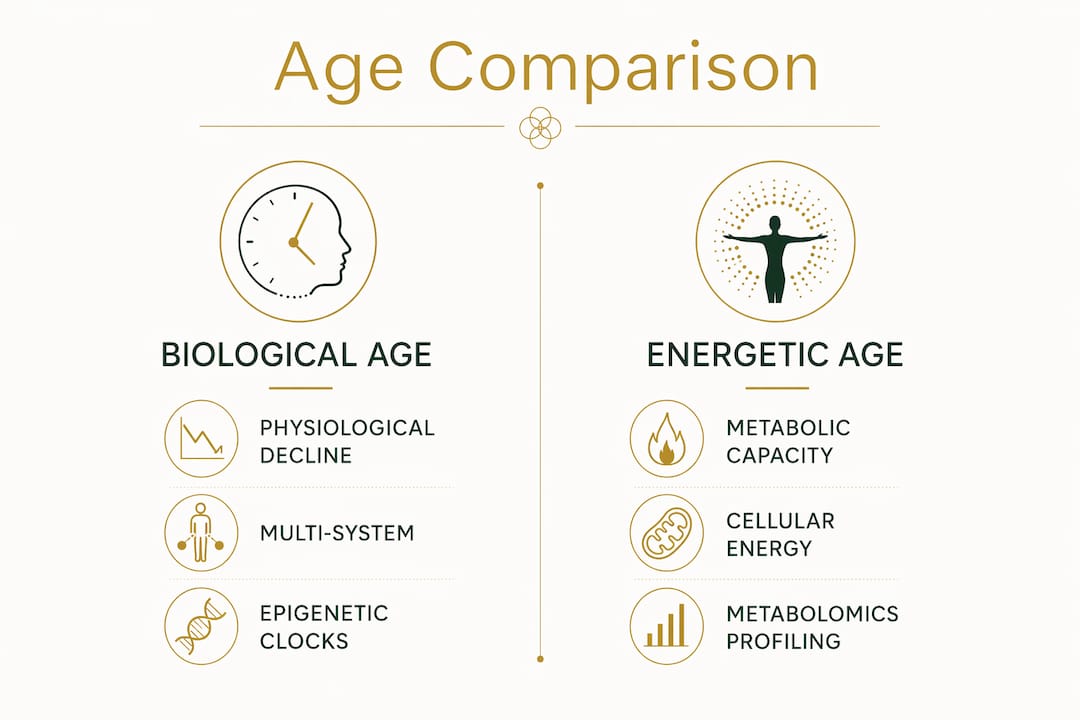
Biological age measures accumulated damage across multiple body systems. Energetic age measures current metabolic capacity. These are related but not interchangeable.
| Dimension | Biological age | Energetic age |
|---|---|---|
| What it measures | Multi-system physiological decline | Cellular energy generation capacity |
| Primary tools | Epigenetic clocks, biomarker panels | Acylcarnitine profiling, metabolomics |
| Clock type | State (where you are) and pace (how fast) | Primarily metabolic state |
| Key risk linked | All-cause mortality, disease susceptibility | Cognitive decline, Alzheimer’s resilience |
| Modifiable by | Lifestyle, environment, epigenetic reprogramming | Diet, exercise, mitochondrial support |
The deeper nuance is resilience. Epigenetic clocks are odometers and speedometers but they do not gauge physiological resilience. Two people can share the same biological age score yet have vastly different capacities to recover from illness, stress, or injury. The EpiAge-R framework introduced in 2026 attempts to address this by measuring damage versus repair capacity simultaneously.
Functional stress tests reveal homeostatic reserve before resting biomarkers even falter. This means a resting blood draw or a saliva sample tells you your baseline state. It does not tell you how well your body bounces back under pressure. That recovery capacity is arguably more important for long-term health than any single age score.
Pro Tip: Do not interpret a low biological age score as permission to stop working on your health. A young biological age with poor resilience is still a vulnerability. Track both your resting scores and your recovery metrics.
The difference between energetic age and biological age also shows up in intervention response. A person who improves mitochondrial function through targeted nutrition and exercise may lower their energetic age significantly while their epigenetic clock score moves more slowly. Both changes are real. They operate on different timelines and through different mechanisms.
How to measure your energetic and biological ages
Testing is more accessible than most people realize. Here is a practical framework for adults aged 35–70:
- Start with a DNA methylation test. TruAge, offered through Trudiagnostic, uses saliva to calculate biological age from epigenetic data. It reports both a state age and a DunedinPACE score. This is the same test used to verify my own biological age of 23 at chronological age 41.
- Add metabolomic blood testing for energetic age. Acylcarnitine profiling is available through specialty labs and some functional medicine practitioners. Ask specifically for a bioenergetic age panel or a comprehensive metabolomics panel that includes acylcarnitine species.
- Track longitudinally. Trend tracking over 6–18 months provides far more useful information than a single snapshot. A single test tells you where you are. A series of tests tells you whether your protocol is working.
- Address the modifiable factors. Stress, sleep quality, physical activity, and diet are the primary levers for shifting both biological and energetic age. These are not optional lifestyle suggestions. They are the mechanism.
- Apply a multi-layer protocol. Single-metric interventions produce single-layer results. The TIMELESS four-layer protocol addresses Physical (cellular, epigenetic, mitochondrial), Emotional (stored trauma, nervous system dysregulation), Spiritual (identity and subconscious beliefs about aging), and Energetic (bioelectric field, meridians) simultaneously. Aging is a four-layer problem. Treating one layer while ignoring the others produces incomplete results.
Pro Tip: Before spending money on advanced testing, optimize your sleep to 7–9 hours, reduce chronic stressors, and eliminate processed food for 90 days. Retest after those changes. The delta will be more informative than any baseline taken during a period of poor lifestyle habits.
For a broader look at age reversal methods that go beyond surface-level interventions, the TIMELESS Journal covers the medical and wellness strategies with the strongest evidence base.
Key Takeaways
Energetic age and biological age measure different dimensions of the same aging process, and addressing both requires a multi-layer protocol rather than a single biomarker fix.
| Point | Details |
|---|---|
| Biological age definition | Biological age reflects multi-system physiological decline, measured by epigenetic clocks and biomarker panels. |
| Energetic age definition | Energetic age measures cellular energy generation capacity, primarily through acylcarnitine metabolic profiling. |
| State vs pace distinction | State clocks show where you are; pace clocks like DunedinPACE show how fast you are aging right now. |
| Resilience gap | Neither clock type captures recovery capacity, which requires functional stress testing beyond resting biomarkers. |
| Modifiable leverage | About 50% of aging pace is genetic; lifestyle, environment, and protocol-based interventions drive the other half. |
Why I measure both, and what most people get wrong
Most people who discover biological age testing make one of two mistakes. They either obsess over a single number and declare victory, or they get a result they dislike and dismiss the entire field as pseudoscience. Both responses miss the point.
My TruAge test confirmed a biological age of 23 at chronological age 41. That result did not come from optimizing one variable. It came from 15 years of working all four layers simultaneously: physical, emotional, spiritual, and energetic. The energetic layer alone, which includes the bioelectric field and meridian systems, is the dimension most longevity programs ignore entirely. That omission is why so many people plateau.
The research on bioenergetic age and Alzheimer’s resilience is one of the most underreported findings in longevity science right now. Your metabolic capacity to generate cellular energy is not just a fitness metric. It is a cognitive protection mechanism. If you are 45 and your bioenergetic age is 60, that gap is a warning signal worth acting on immediately.
What I tell every person I work with: a low biological age score is a confirmation, not a finish line. The goal is to keep the pace of aging below 1.0 years per calendar year while building resilience capacity that does not show up on any single clock. That requires addressing the aging program at every layer, not just the one your current test happens to measure.
— E. Christian Trejo
What Timeless - Reverse Your Age offers for age reversal
The science is clear. Aging operates across four layers simultaneously, and measuring only one gives you an incomplete picture.
Timeless - Reverse Your Age offers two direct paths forward. The book Timeless: Reverse Your Age is a 370-page blueprint documenting the complete four-layer protocol, available for $29.99. For those who want verified results with accountability, the TIMELESS Vitality Intensive is an 8-week private coaching program guaranteed to reverse biological age by at least 10 years in 6 months, confirmed by TruAge DNA methylation testing, or every dollar is refunded. No other longevity program in the world backs its results with that level of scientific accountability. If you want to know exactly where your biological age stands before committing to a program, book a free Vitality Diagnosis call to get a personalized assessment.
FAQ
What is the difference between energetic age and biological age?
Biological age measures overall physiological decline across multiple body systems using epigenetic clocks and biomarker panels. Energetic age specifically measures cellular energy generation capacity, primarily through blood acylcarnitine metabolic profiling.
How is energetic age measured?
Energetic age is measured through blood-based metabolomics, specifically acylcarnitine profiling, which reflects how efficiently your mitochondria generate energy. Specialty labs and functional medicine practitioners offer this testing.
What affects biological age the most?
Chronic stress, poor sleep, smoking, physical inactivity, and obesity are the primary accelerators of biological aging. About 50% of aging pace is genetic, but lifestyle factors directly control the remaining half.
Can you lower both your energetic and biological age at the same time?
Yes. Interventions like targeted nutrition, exercise, sleep optimization, and stress reduction shift both acylcarnitine profiles and epigenetic clock scores, though they operate on different timelines and through different mechanisms.
Why do two people with the same biological age feel so different?
Epigenetic clocks measure accumulated damage but do not capture resilience or recovery capacity. Two people can share the same biological age score while having very different abilities to recover from stress, illness, or physical challenge.